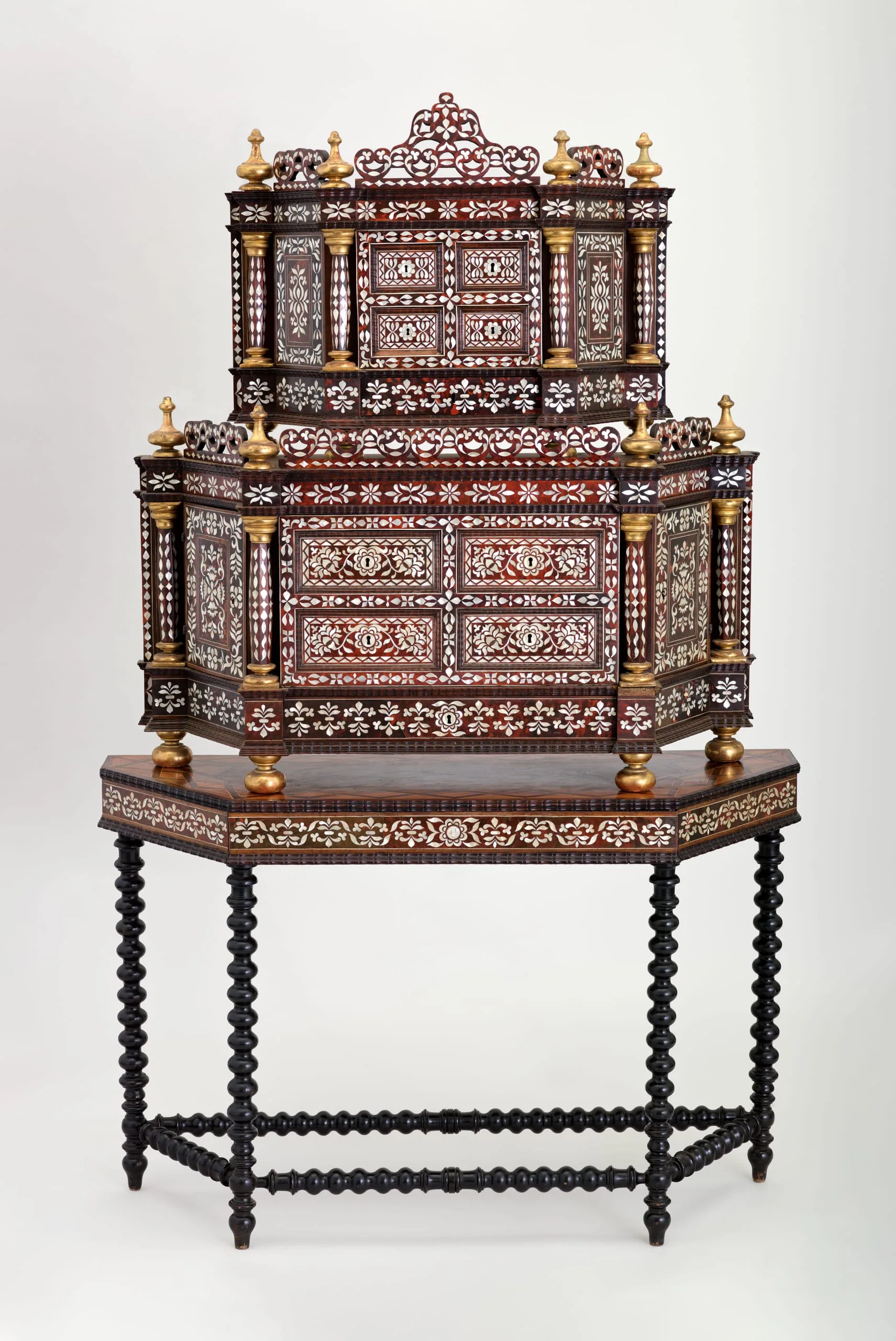
- Title
- Cabinet (Contador)
- Date Made
- 18th century
- Medium
- Wood, inlaid with tortoiseshell and mother-of-pearl; brass; copper fittings; and iron hinges
- Dimensions
- Base: 31 7/8 × 51 3/16 in. (81 × 130 cm); central cabinet: 27 3/16 × 45 1/4 × 14 3/16 in. (69 × 115 × 36 cm); top cabinet: 24 7/16 × 31 1/2 × 11 13/16 in. (62 × 80 × 30 cm); overall height: 83 7/16 in. (212 cm); overall width: 31 7/8 in. (81 cm)
- Accession Number
- M.2024.98a-c
- Curatorial Notes
This wood cabinet is richly ornamented with inlaid mother-of-pearl and tortoiseshell. The central cabinet is displayed on a matching bufete (stand), with a second bureau stacked on top forming a pyramidal ensemble. The canted sides, flanked by decorated columns with copper mounts, are ingeniously designed to showcase their sumptuous decoration when viewed from the front and provide an overwhelming first impression. Modeled after seventeenth-century German, Flemish, and Iberian prototypes, these “towers of riches” were usually crowned with a valuable object or sculpture.
Because of their materials and their designs that vaguely resemble Asian decorative arts, these works have been difficult to categorize. Scholars have suggested that they were imported aboard the famous Spanish trading ships—known as the Manila Galleons—that traveled annually between the Philippines and Mexico. But archival and material documentation suggests that such works originated in Guatemala, where mother-of-pearl and tortoiseshell were harvested locally and considered prized commodities. Many items made of these materials were exported to Mexico and Peru. The designs draw on a range of European and Asian sources, which local artists creatively reinterpreted.
Ilona Katzew
2024