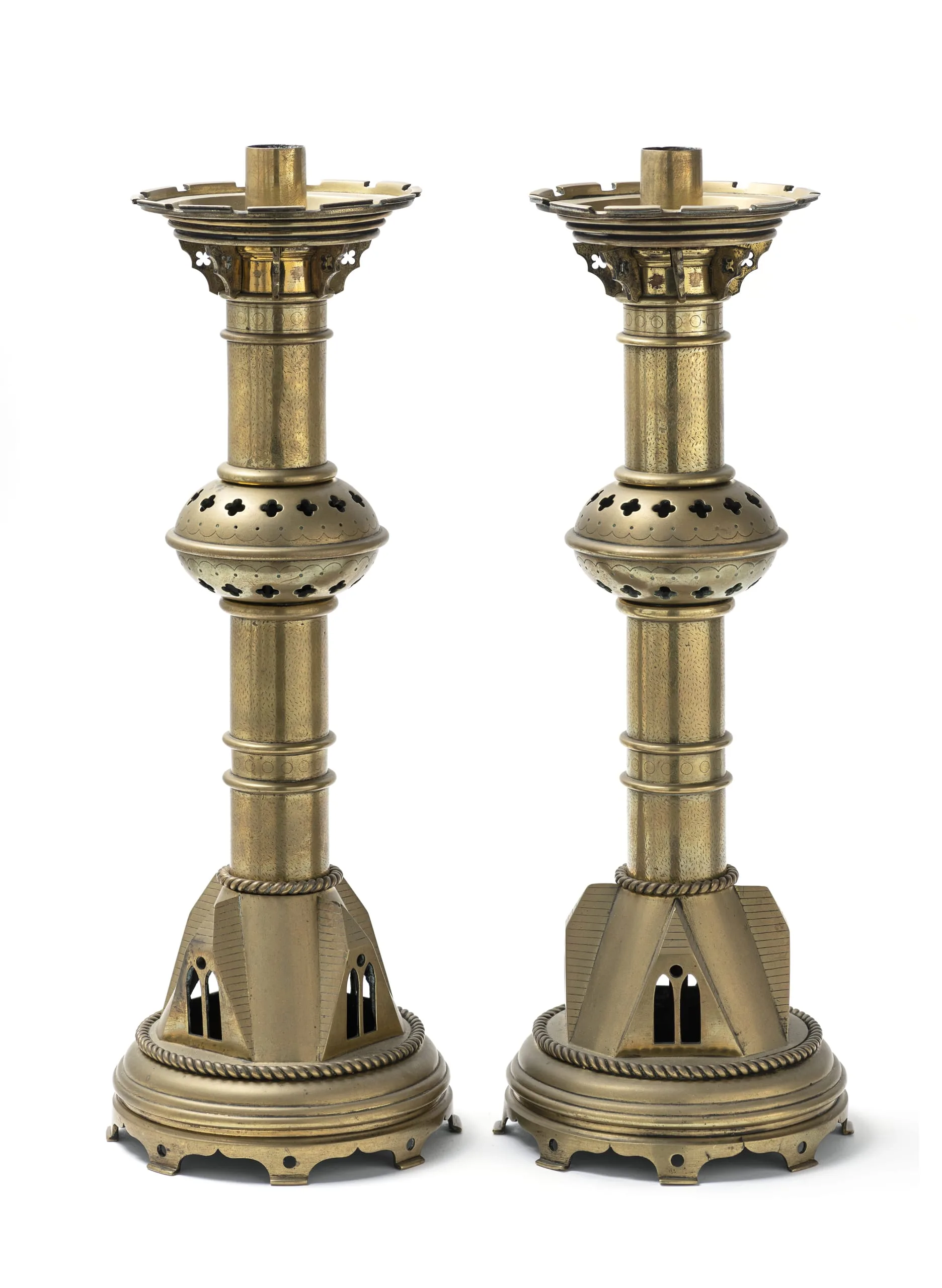
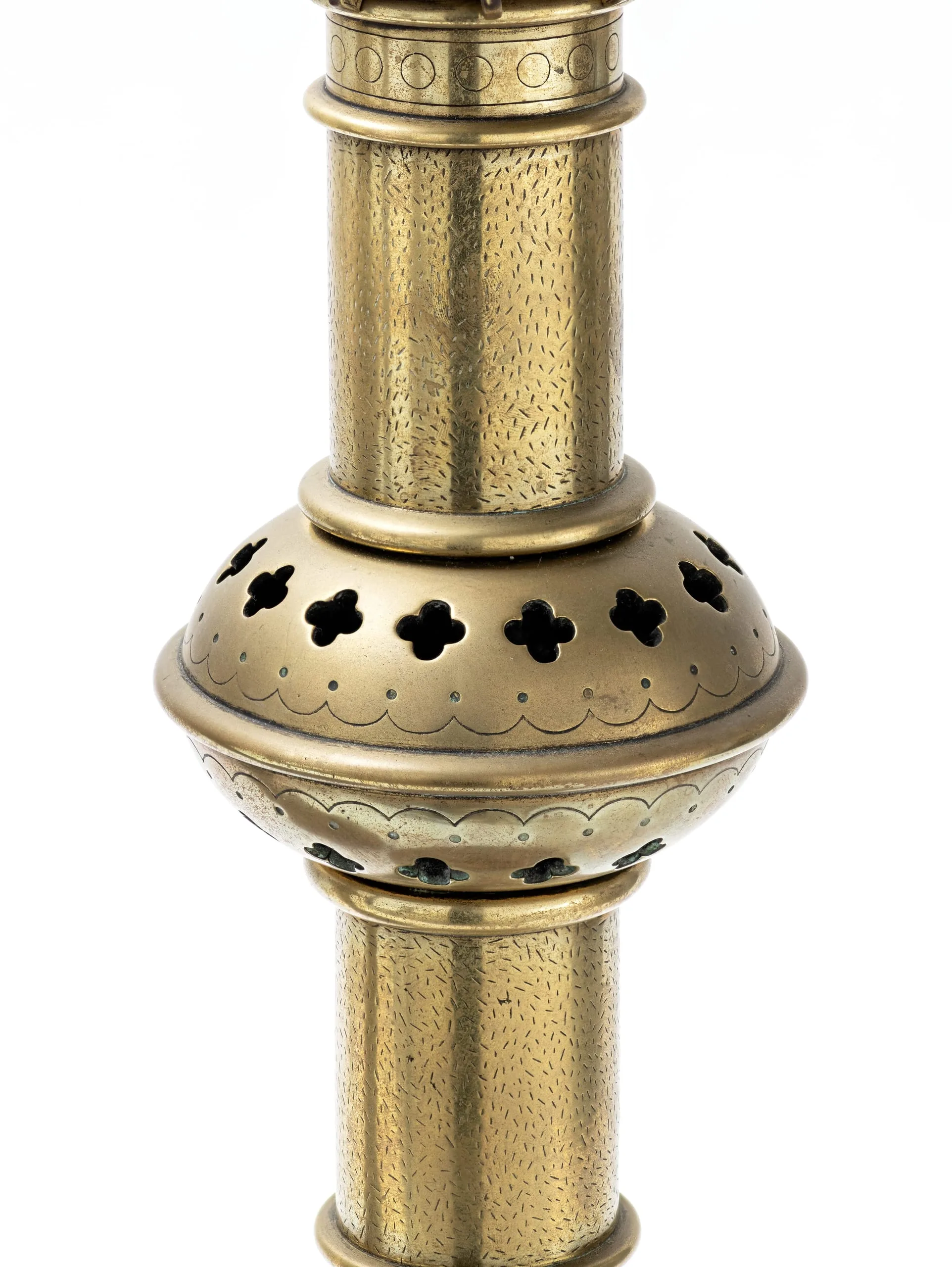
According to his biographer, the architect William Burges was “the most dazzling exponent of the High Victorian Dream,” and his achievements in metalwork, jewelry, furniture, and stained glass rivaled those of A. W. N. Pugin in creating a Gesamtkunstwerk (total work of art) for the Gothic Revival in Britain. These candlesticks exemplify Burges’s commingling of aesthetics and morality, a conflation that was the most important manifestation of the revival. Proselytizers such as Burges asserted that the Gothic style would restore values that had been corrupted by the modern world. Medieval precedent was seen to represent the order, stability, community, and “joy in labor” missing from nineteenth-century life.
Commissioned by the Ecclesiological Society, the candlesticks were prominently displayed in the Medieval Court of London’s International Exhibition in 1862. The society was founded to radically reform the Anglican church; this goal would be accomplished by bringing the church’s rituals closer to those of Catholicism and by adopting the Gothic style. While not particularly religious himself, Burges was a member of the society and its favorite architect—he designed the group’s entire display at the Medieval Court. The architect’s passion for “correct” Gothic design and his deep research are revealed in an 1858 lecture about altar plate published in the society’s magazine, in which he elaborates the right way to produce candlesticks. Not surprisingly, his own designs follow these dictates. For example, he eloquently criticized other designers’ placement of the popular dormer window motif to provide support for the foot. In the Medieval Court candlesticks, Burges corrected that “error” by placing the “windows” more logically on the raised circular base.
Wendy Kaplan, Department Head and Curator, Decorative Arts and Design
Bibliography
Crook, J. Mordaunt Crook. William Burges and the High Victorian Dream Chicago: University of Chicago Press, 1981.