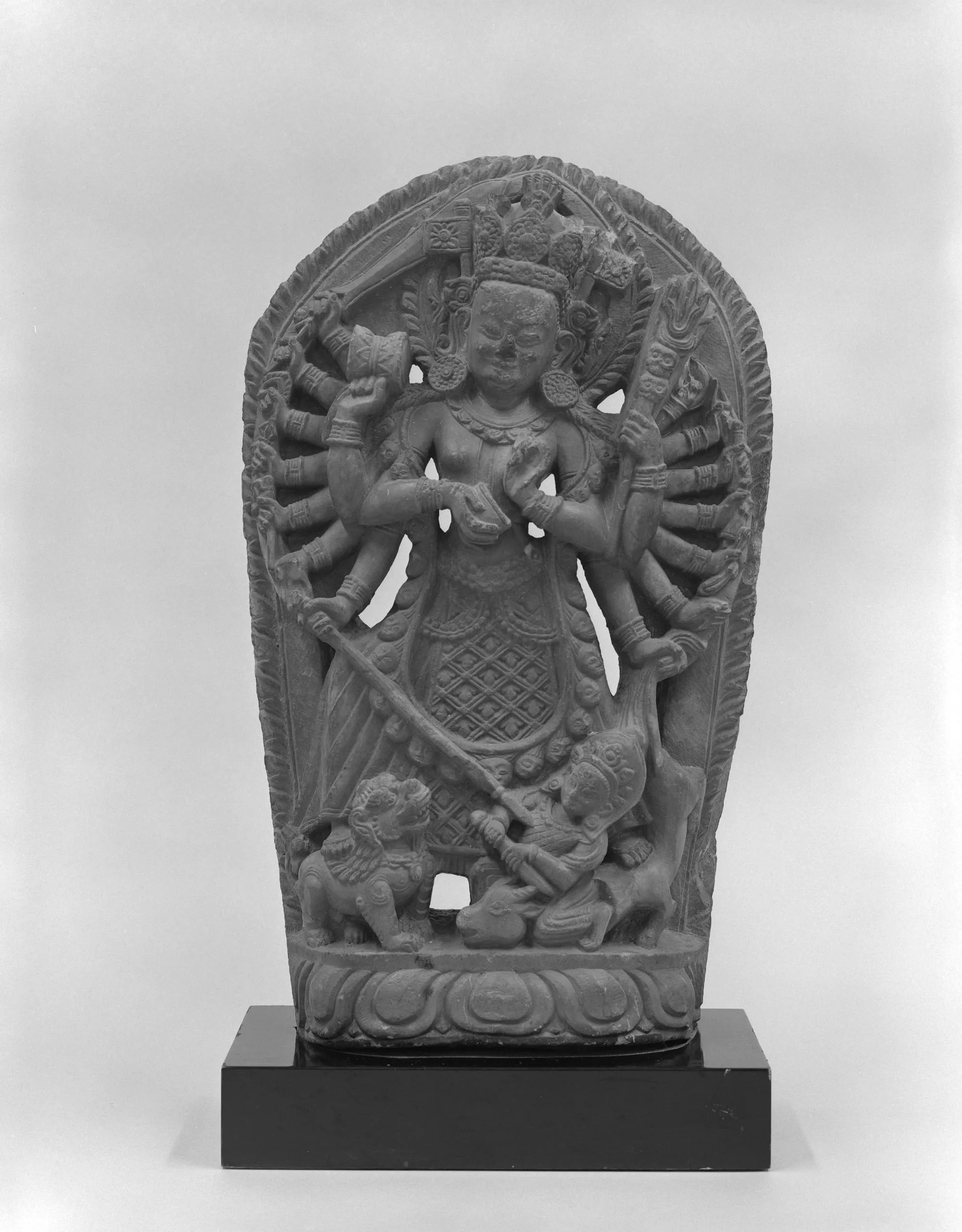
The Hindu goddess Durga (Unconquerable) is one of the most widely worshipped deities of Hinduism, especially among the warrior classes. She is the terrific aspect of Shiva’s spouse, Uma, and is the invincible goddess of the battlefield in playing a vital role in the eternal struggle between order and chaos. Although the Great Goddess can assume many guises, the most popular, and the form most often encountered in art, is that of the slayer of Mahisha, the buffalo demon. When the gods were unable to conquer the powerful Mahisha, Durga was created from the energy of their combined anger to fight for them. Each god gave her a portion of his powers, and she carries their various weapons in her multiple arms, including the discus of Vishnu, the trident of Shiva, and the spear of Karttikeya. Durga’s many triumphant battles with demonic adversaries to preserve world order are exalted in the Devimahatmya (Glory of the Goddess) composed in circa 550 CE. The myth of Durga' s slaying of the buffalo demon may be interpreted primarily in sectarian terms, as proclaiming the powers of the goddess over those of the gods; anthropologically, however, it may also represent the assimilation into mainstream Hinduism of a totemistic buffalo cult. Variances in the artistic depictions of the myth may also reveal additional layers of interpretation and inherent cultural symbolism.
Durga is represented here as elaborately crowned, nimbate, and exalted by a flaming aureola (prabhavali). She wears copious jewelry, including a long garland of severed skulls (mundamala). The Great Goddess has eighteen arms brandishing her various weapons. Her two principal hands hold a skull cup (kapala) and display the gesture of exposition (vitarka mudra). Durga stands in a militant posture (alidha asana) with her right foot on her snarling lion mount and the left foot on the back of the buffalo from whose severed neck emerges the human form of the demon being impaled by Durga’s spear. See also M.70.1.1, M.70.42.7, M.77.19.27 and M.84.153.1.