LACMA

ShopMembershipMyLACMATickets
LACMA
Los Angeles County Museum of Art
5905 Wilshire Blvd.
Los Angeles, CA 90036
info@lacma.org
(323) 857-6000
Sign up to receive emails
Subscribe
© Museum Associates 2025

Museum Hours

Monday

11 am–6 pm

Tuesday

11 am–6 pm

Wednesday

Closed

Thursday

11 am–6 pm

Friday

11 am–8 pm

Saturday

10 am–7 pm

Sunday

10 am–7 pm


  • About LACMA
  • Jobs
  • Building LACMA
  • Host An Event
  • Unframed
  • Press
  • FAQs
  • Log in to MyLACMA
  • Privacy Policy
© Museum Associates 2025
Collections

Unidentified artists
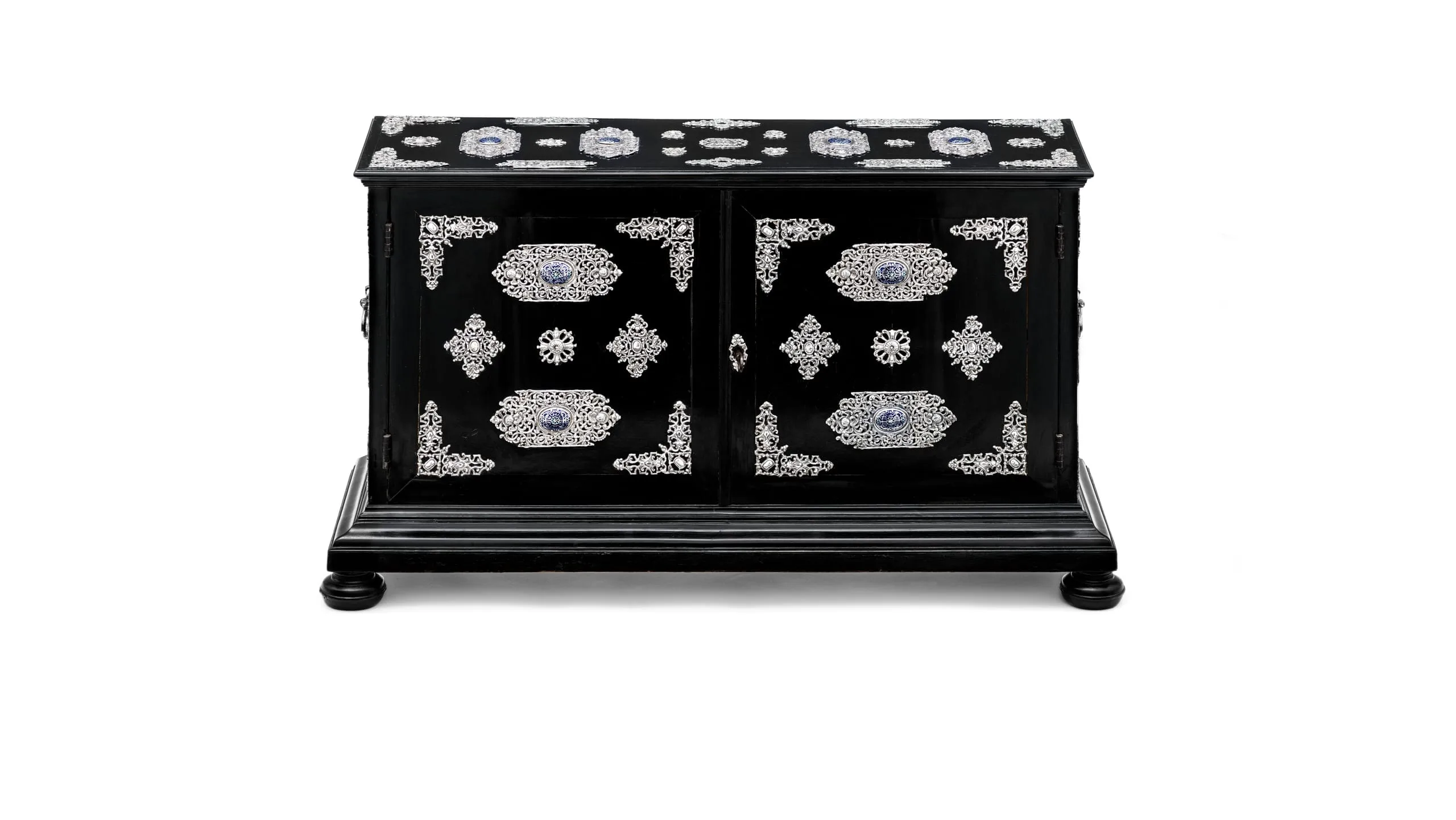
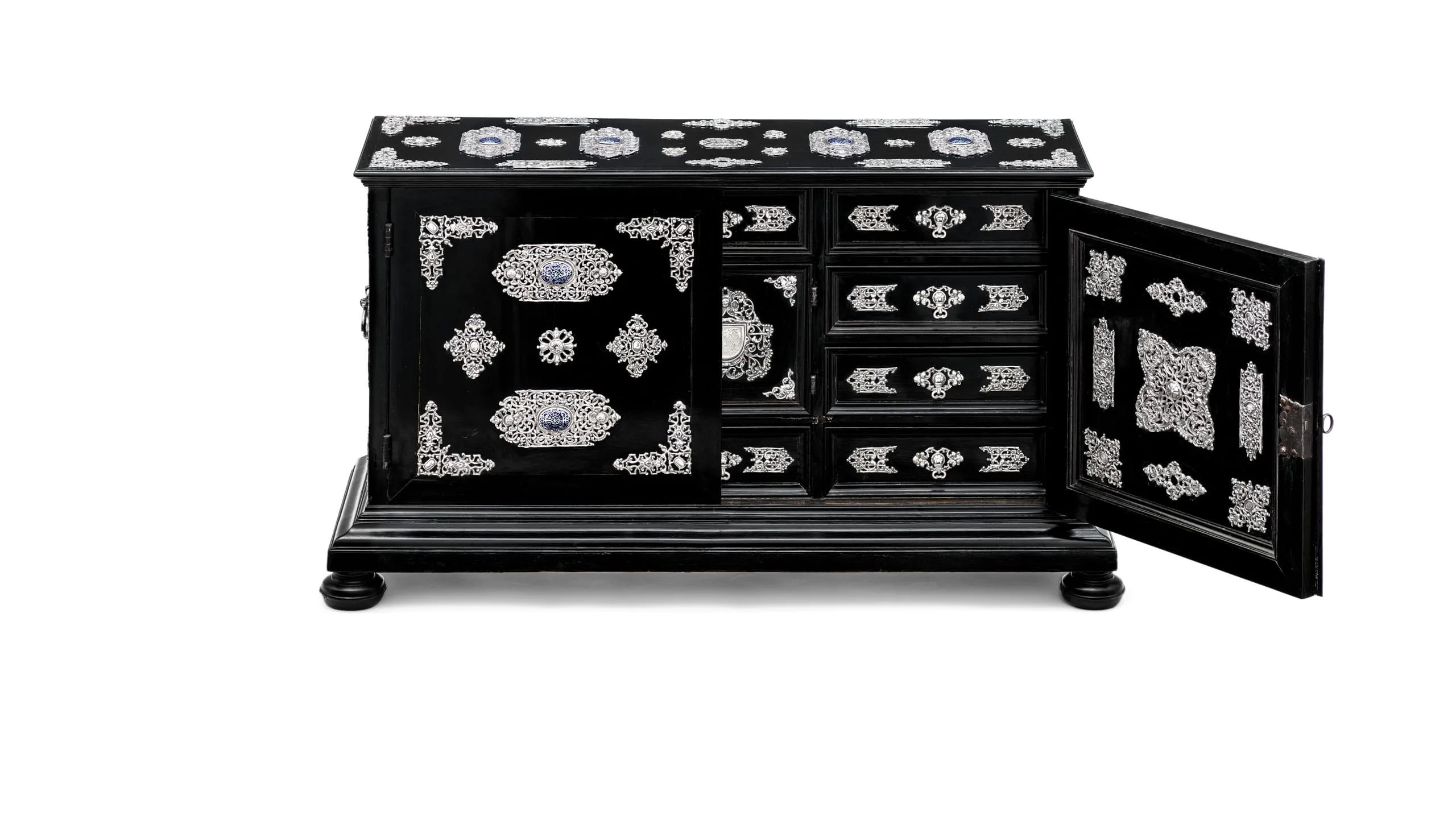
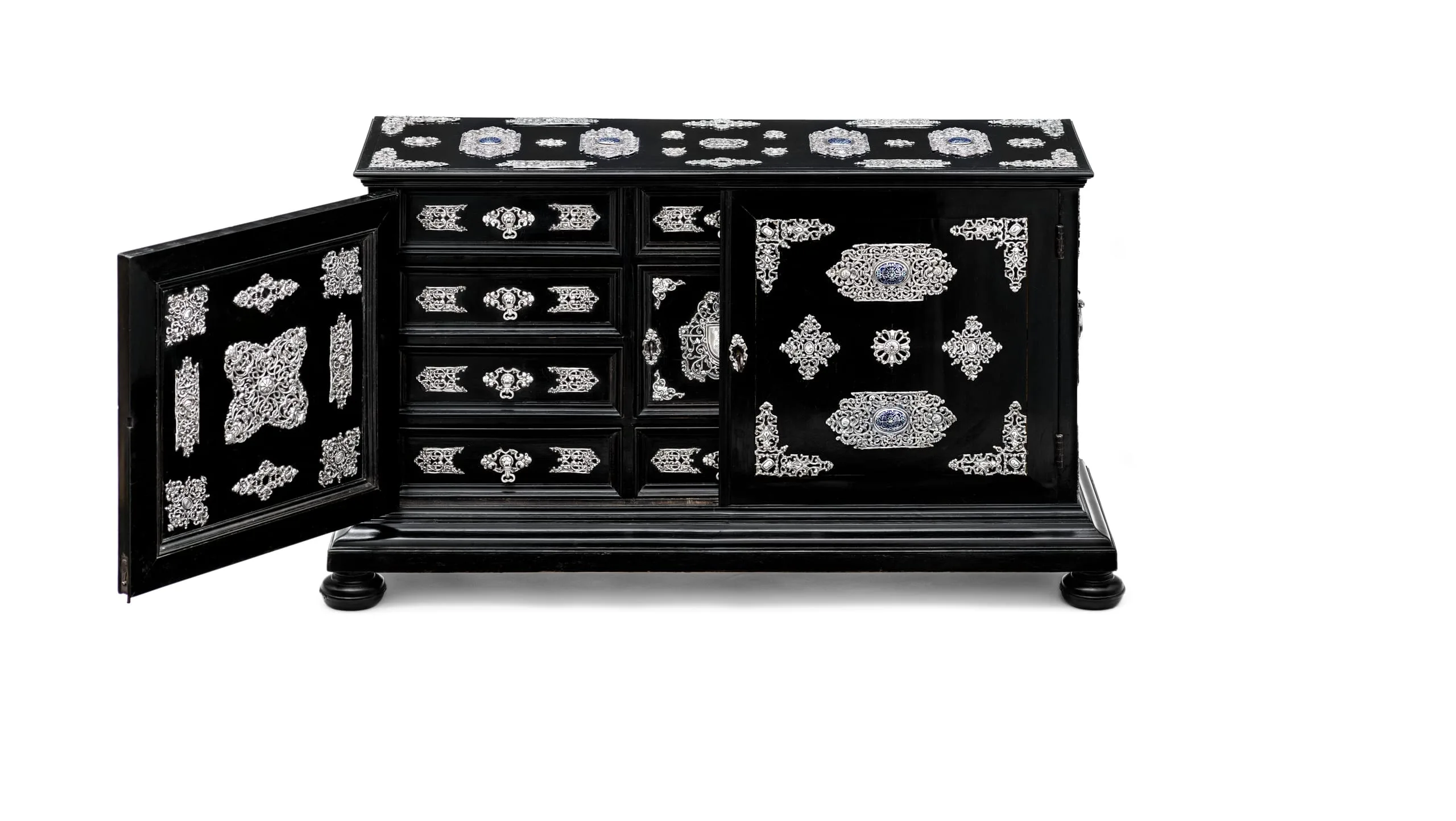
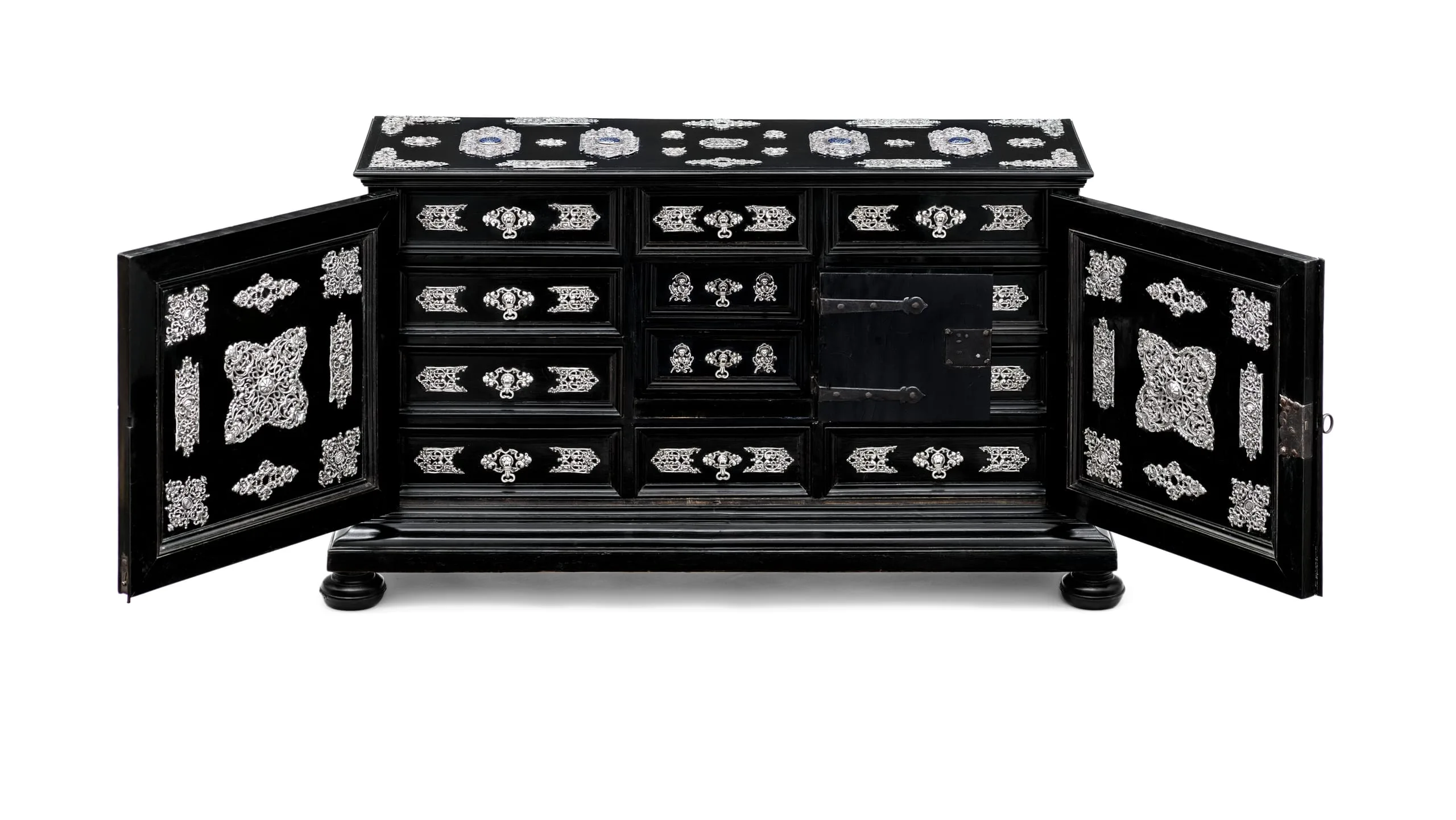
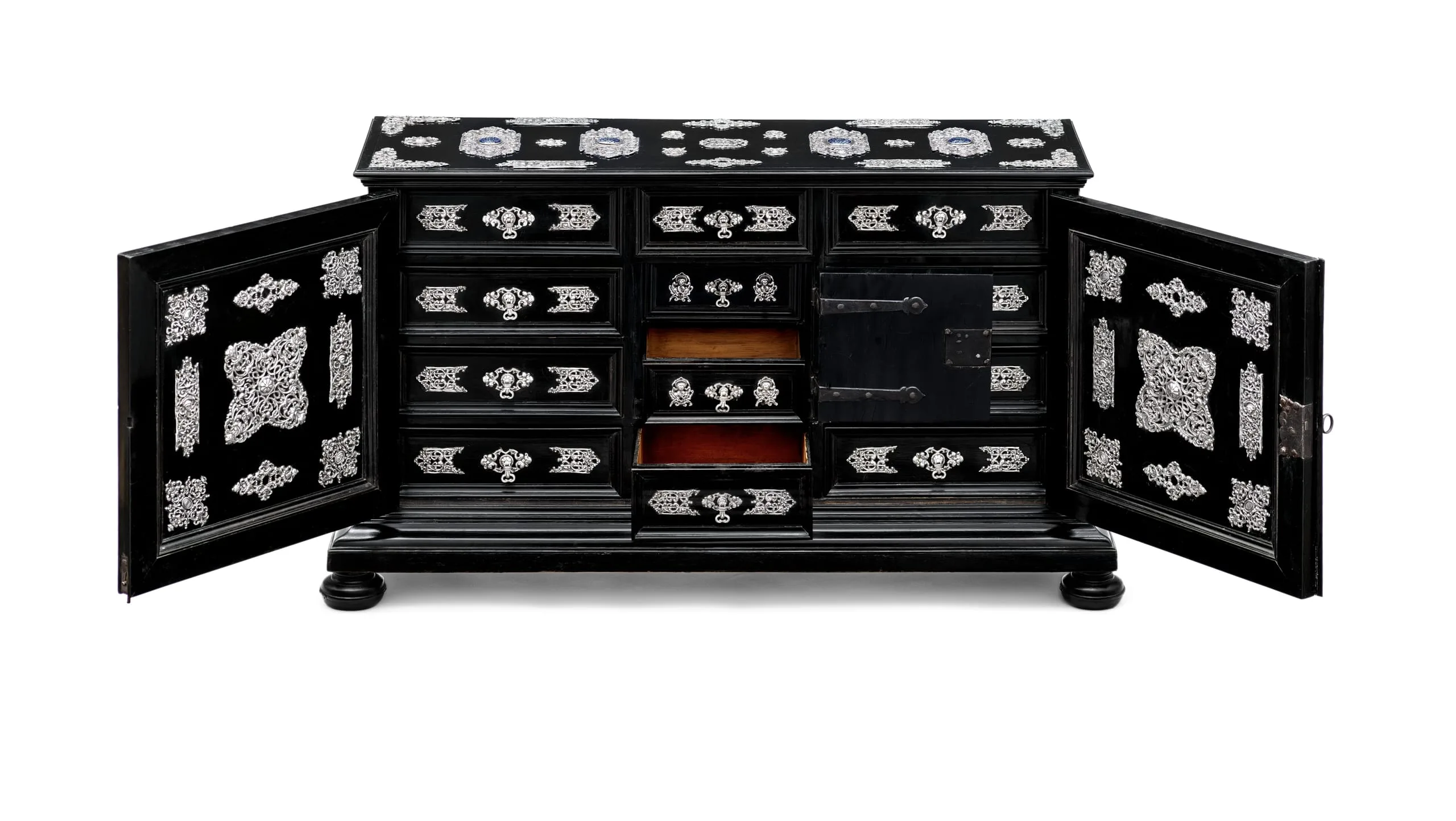
Cabinet (Papelera)circa 1700

On view:
Geffen Galleries, The Iberian World: From Spain to Spanish America
Ebonized wood cabinet with open doors, densely inlaid with cream-white mother-of-pearl or ivory strapwork and medallions, revealing multiple small drawers inside
Ebonized wood cabinet with two doors, densely inlaid with ivory or bone scrollwork and floral arabesques, accented with small blue stone medallions, resting on turned bun feet.
Ebonized wood table cabinet with dense white inlay, likely ivory or bone, in scrolling foliate and geometric patterns; two exterior doors flank a central section of small drawers, right door shown open; rests on turned bun feet.
Ebonized wood table cabinet with two doors, one open to reveal small interior drawers, densely decorated with intricate white mother-of-pearl and ivory marquetry in scrolling foliate and geometric patterns, with blue hardstone roundel accents, resting on turned bun feet.
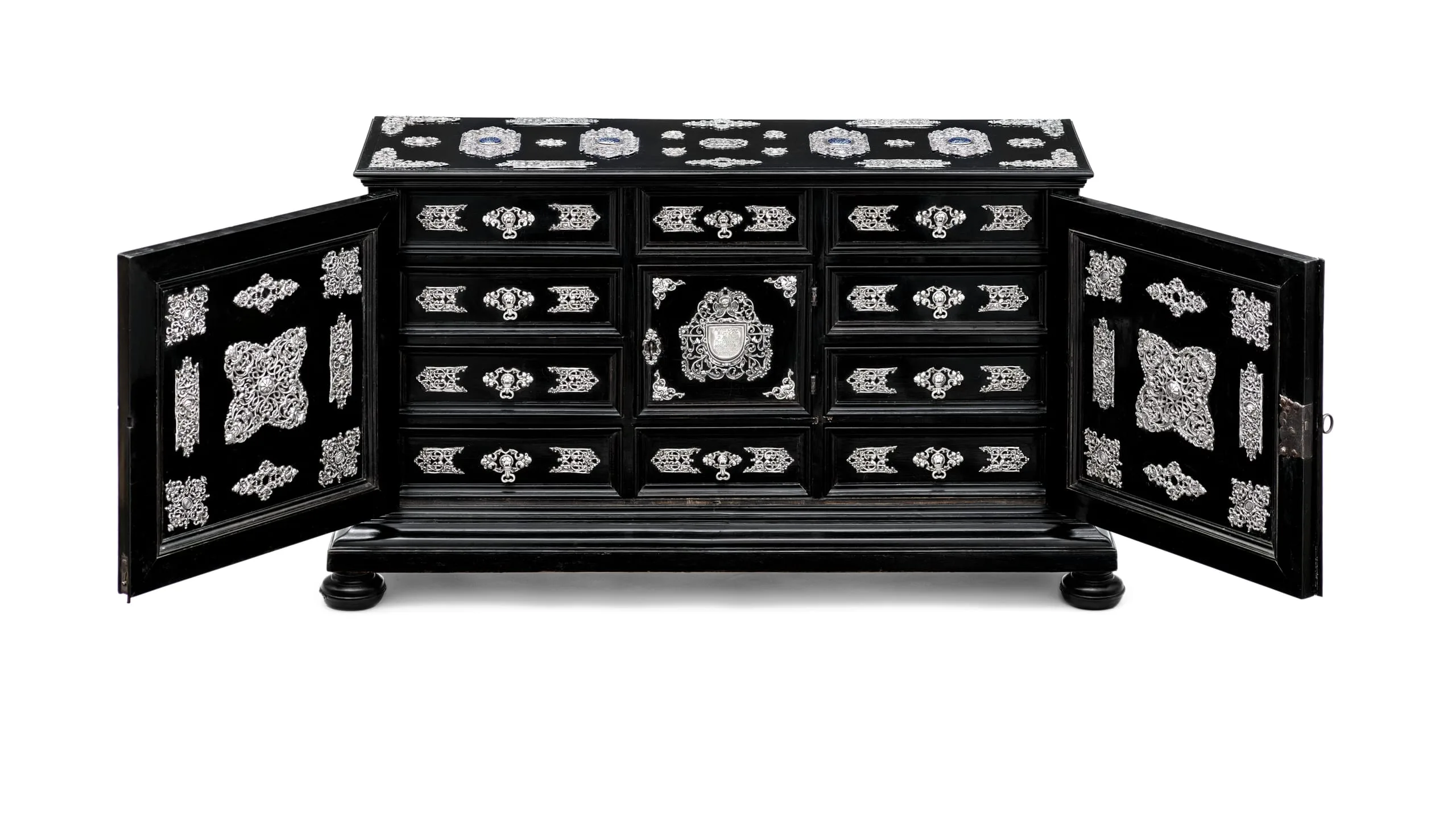
Ebonized wood table cabinet with two open doors, revealing multiple small drawers decorated with elaborate white bone or ivory inlay in floral and geometric patterns; matching inlay covers the door interiors and flat top surface; raised on turned bun feet.
Ebonized wood cabinet with two open doors revealing multiple small drawers, densely inlaid with white mother-of-pearl floral and geometric medallions across doors, drawer fronts, and top surface; resting on turned bun feet.
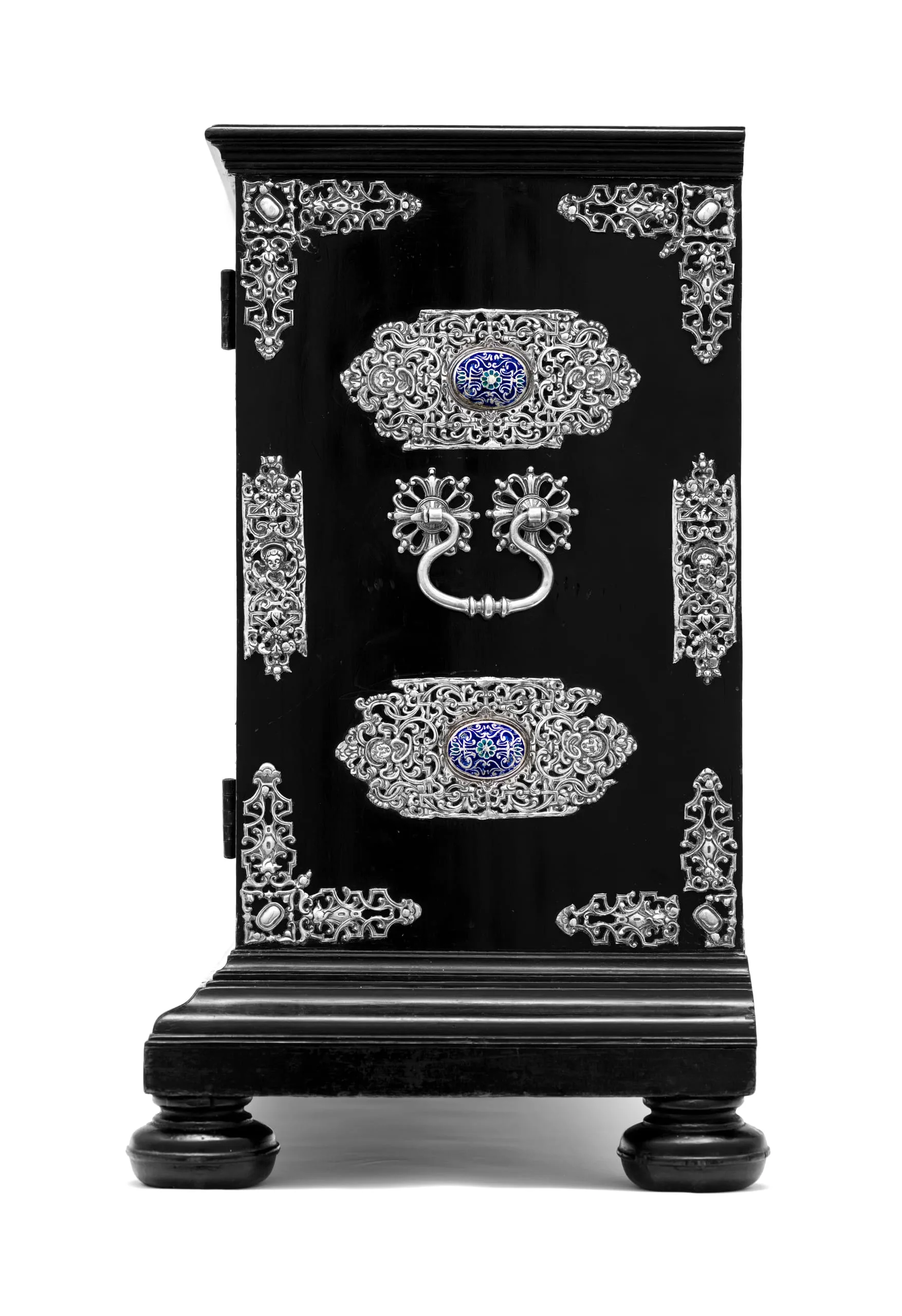
Small black lacquered cabinet on turned bun feet, front face adorned with elaborate pierced silver mounts at corners and center, two large ornate silver escutcheon plates each set with a blue enamel oval medallion, and a silver bail-ring handle between them.
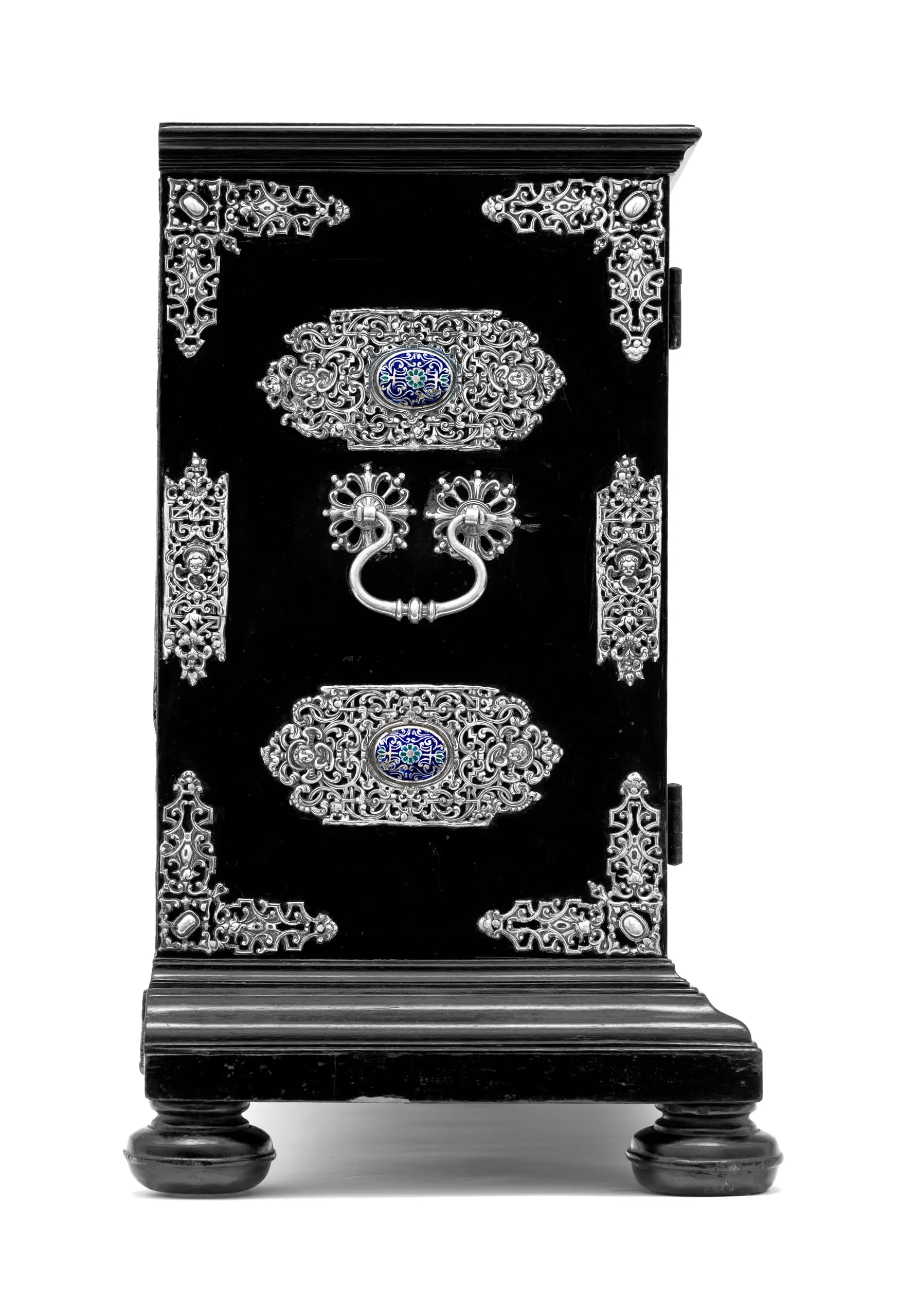
Ebonized wood cabinet on bun feet, front face mounted with elaborate pierced silver filigree escutcheons and corner mounts, two oval blue enamel medallions at center, and a silver bail handle.
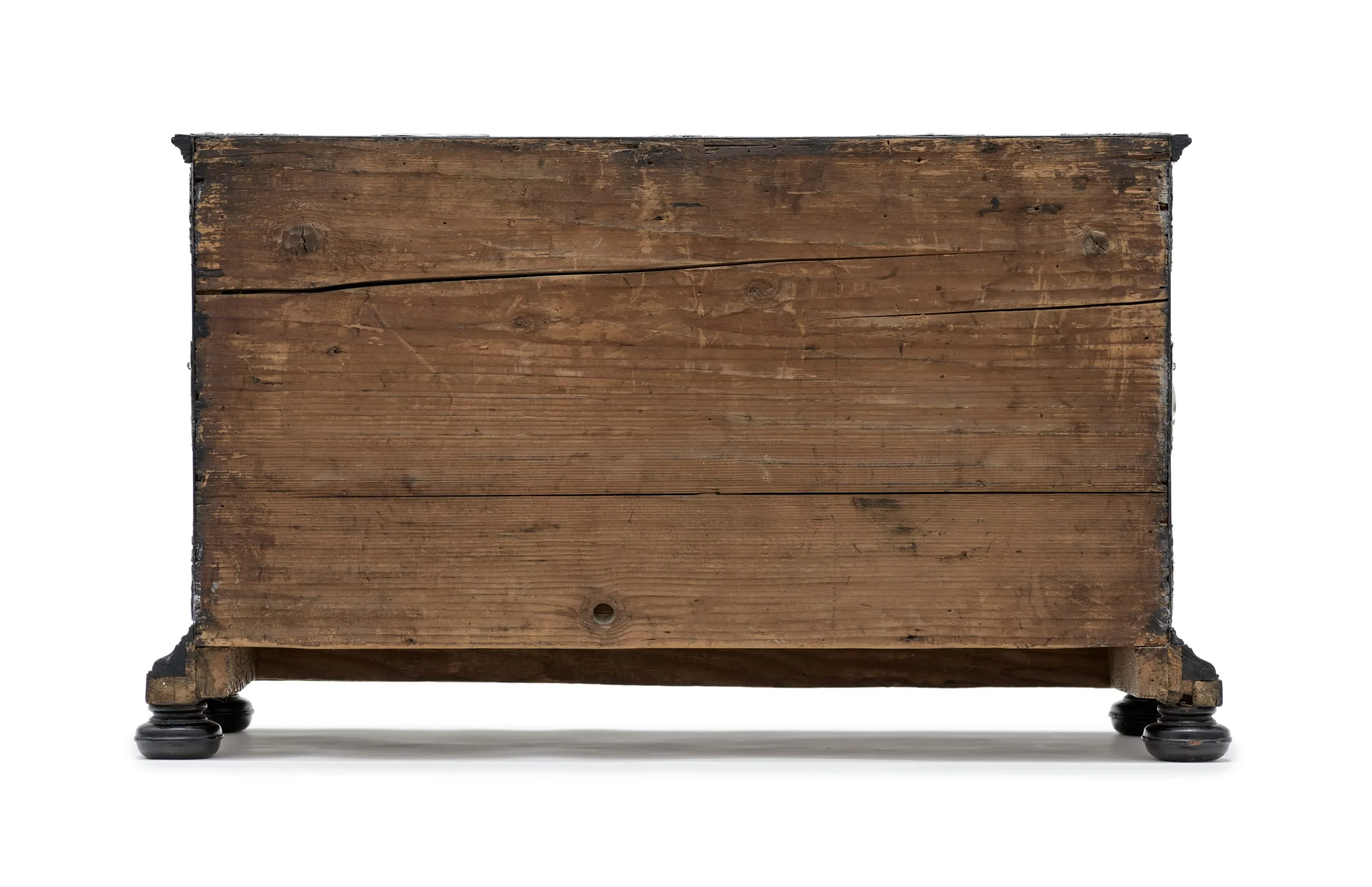
Wooden chest seen from the back, revealing unfinished pine planks with a visible horizontal crack and surface wear, resting on turned ebonized bun feet.
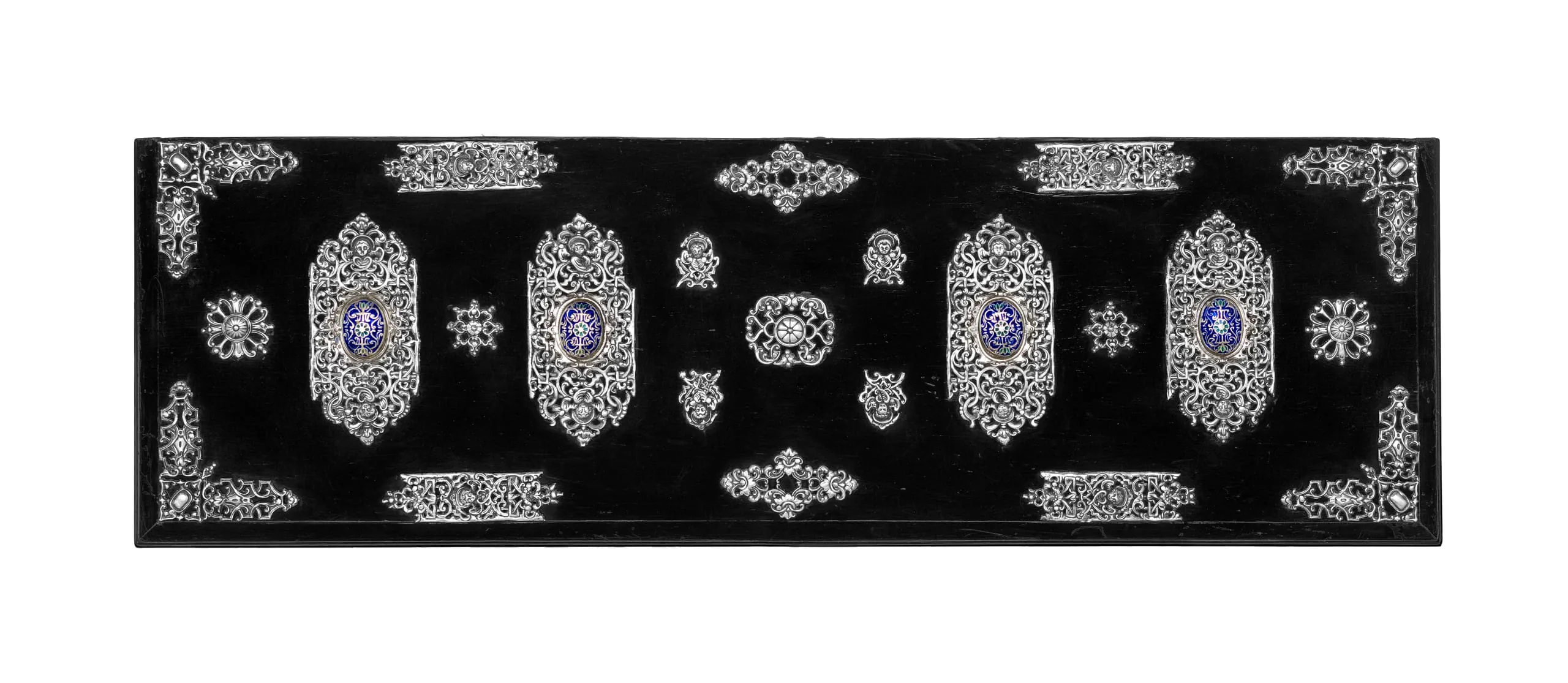
Rectangular black lacquered panel with symmetrical silver inlaid arabesque and floral motifs, featuring four central oval cartouches with pierced filigree-style decoration and blue enamel or stone medallion centers, with corner ornaments.
Artist or Maker
Unidentified artists
Title
Cabinet (Papelera)
Place Made
Possibly Antwerp (cabinet) and Lima (silver applications and enamel)
Date Made
circa 1700
Medium
Ebonized wood, cast and chased silver, and enamel
Dimensions
Doors closed: 18 3/4 × 33 1/2 × 11 1/2 in. (47.63 × 85.09 × 29.21 cm); doors open: 18 3/4 × 55 × 11 1/2 in. (47.63 × 139.7 × 29.21 cm)
Credit Line
Gift of the 2023 Collectors Committee
Accession Number
M.2023.51.1-.13
Classification
Furnishings
Collecting Area
Latin American Art
Curatorial Notes

Cabinets took Europe by storm in the middle of the 16th century, and remained furniture makers’ most prestigious product throughout the 1600s. This was largely due to their ingenious decoration and their costly and rare materials. Cabinets with multiple drawers derived from the Spanish escritorio or papelera. This furnishing type was originally used to store papers, and eventually evolved to enclose all sorts of collectibles and valuable possessions. Traded as works of art, cabinets often featured in https://collections.lacma.org/node/2302744" >Spanish still life paintings alongside other precious items from across the globe.

Fine examples, many exported across Europe, were produced in Antwerp, which is where this cabinet was most likely created. Ebony was a costly, tropical wood imported mostly from Southeast Asia that became an immediate sensation in Europe, and was widely imitated. This ebonized cabinet opens up to reveal a set of drawers bedecked with intricately cast and chased openwork silver applications. The exterior is decorated with a multiplicity of silver ornaments, enhanced with vivid blue and green champlevé enamel work, that mirror one another and cover the piece like a precious skin, creating an entrancing effect.

An interior medallion bears a “talking” inscription in Spanish that reads: “Me fiso Enjoyar / Mi Sor. EXMO.. / D. Melchor / Portocarrero / Lasso de la Vega / Conde de la Monclova” (I was bejeweled at the behest of my master His Excellency Don Melchor Portocarrero Lasso de la Vega, Count of Monclova). The Count of Monclova had a distinguished military career serving the Spanish crown. In 1658 he lost an arm in a calamitous battle against the French, earning him the moniker “Silver Arm” (Brazo de plata). As a reward for his loyalty, he was appointed viceroy of Mexico from 1686 to 1688, and of Peru (where he died) from 1689 to 1705. In Lima, he faced the daunting job of rebuilding the city after the devastating earthquake of 1687. A profoundly religious man, during his long tenure as Peru's governor he supported the establishment of several convents and oversaw the construction of numerous churches.

Silver was closely associated with empire building in the early modern world. In 1545, the Spaniards stumbled upon the world’s richest silver deposit, the Cerro Rico or “Rich Hill” of Potosí (in present-day Bolivia), which fueled a veritable silver bonanza and drove the global economy for nearly three centuries, turning Spain into the envy of the world. Silver objects fulfilled both practical and symbolic functions. They were used to embellish churches and the homes of the elite and to signal the proverbial wealth of viceregal society.

It is not surprising that when the newly appointed viceroy arrived in Lima, possibly carrying the cabinet as part of his personal household items, he would have had it enhanced with Peru’s legendary

silver by local master silversmiths. The profusion of winged angels tucked in the silver strapwork, was a motif used across a range of https://collections.lacma.org/node/212705" >Peruvian objects. Their abundance might suggest that the viceroy gifted the cabinet to a convent he supported, or that he commissioned it for someone he cherished as an outward symbol of his esteem. (The cabinet does not feature in the viceroy’s probate inventory following his death.)

Whatever the case, everything about this piece is aimed at creating an overwhelming first impression, revealing the virtuosity with which it was embellished, its costly materials, and the role of the viceroy in its creation. The work is a brilliant example of how objects could be altered and reactivated as they moved about the world.


Ilona Katzew, Curator and Department Head, Latin American Art, 2023

Provenance
Carlos Washington Aliseris (1898–1974), Montevideo, Uruguay, first half of the 20th century; by inheritance to his daughter Raquel Aliseris Bernadá, Montevideo, 1974; by inheritance to her son Ignacio Labaure Aliseris, Montevideo, 1986; Jaime Eguiguren - Art & Antiques, Buenos Aires, 2016; LACMA, 2023.
Selected Bibliography
  • Ilona Katzew, “New Acquisition: A Cabinet (Papelera) Enhanced in Peru,” Unframed, April 28, 2023, https://unframed.lacma.org/2023/04/28/new-acquisition-cabinet-papelera-enhanced-peru.

Selected Exhibition History
  • Archive of the World: Art and Imagination in Spanish America, 1500–1800. October 20, 2023 - January 28, 2024
  • Archive of the World: Art and Imagination in Spanish America, 1500–1800. October 20, 2023 - January 28, 2024
  • Archive of the World: Art and Imagination in Spanish America, 1500–1800. June 22, 2024 - September 08, 2024
  • Archive of the World: Art and Imagination in Spanish America, 1500–1800. June 22, 2024 - September 08, 2024