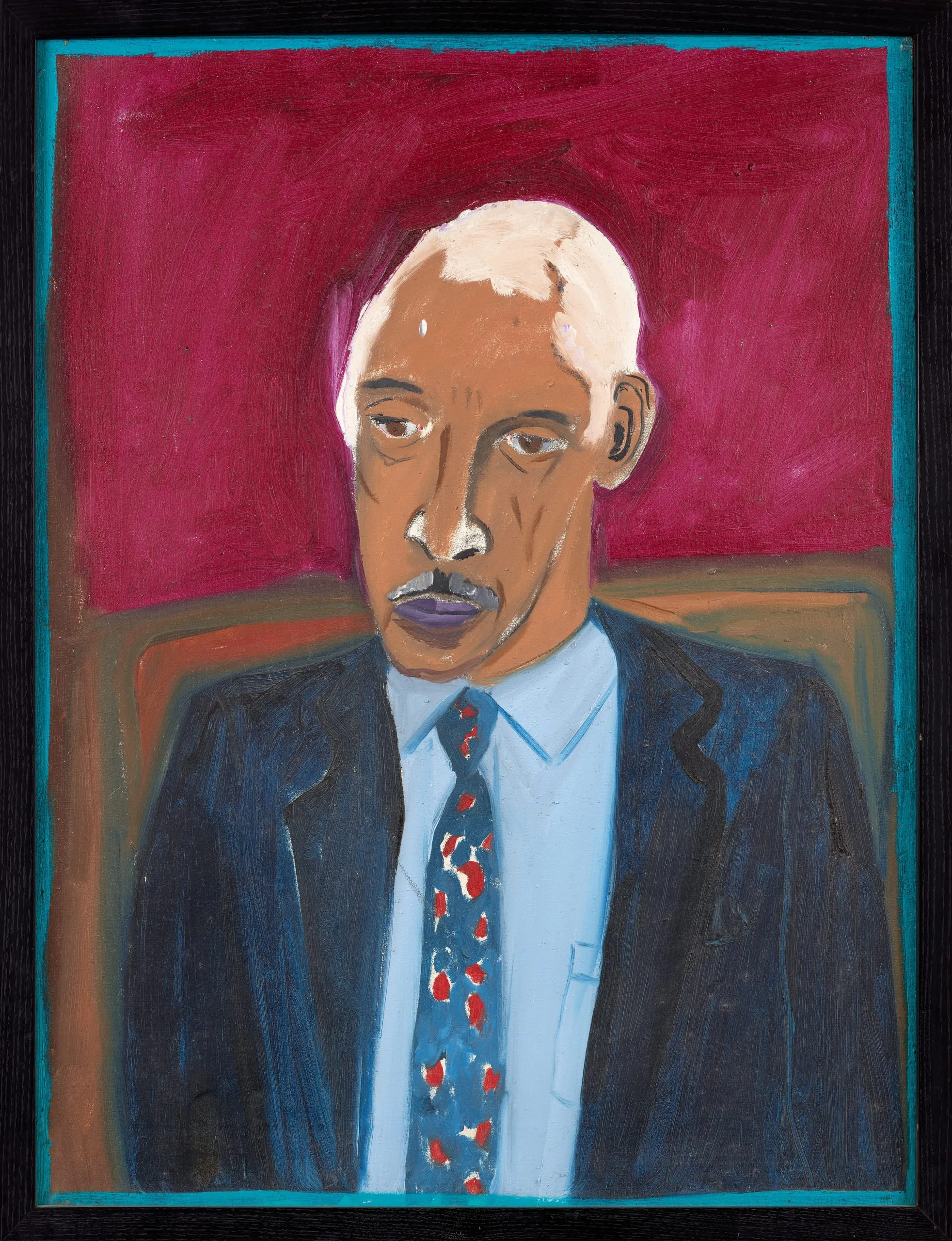
A long-standing interest in the kinship between painting and music, particularly the improvisatory rhythms of blues and jazz, informed Frederick Brown’s practice. Born in Georgia, Brown came of age in a working-class neighborhood on Chicago’s South Side, where he encountered music through blues legends Muddy Waters, Howlin’ Wolf, and Lightnin’ Hopkins, all friends of his parents.
In 1970, the artist moved to New York City and settled in a loft in SoHo. The neighborhood had become a gathering point for musicians and visual artists, such as Andy Warhol and Larry Rivers, and the site of various multimedia collaborations, including performances with jazz giants Ornette Coleman and Anthony Braxton. Inspired by the eclectic rhythms of the “loft jazz” that often filled his studio, Brown painted large, gestural, quasi-abstract paintings throughout the 1970s. Beginning late in the decade, he gradually reintroduced figural elements in a series of portraits of mentors, friends, and icons of Black history, deploying a loose, brushy style that emphasized the abstract relationship between colors, like chords in a song.
In 1982, Brown painted a portrait of Dr. Leon Banks in preparation for a larger rendition of the Last Supper, which he completed the following year. A pediatrician by profession, Banks settled in Los Angeles in the 1950s, where, alongside his medical practice, he became a significant patron of the arts. He acquired works by New York−based artists including Romare Bearden, Robert Rauschenberg, and Mark Rothko, and by Los Angeles−based artists including John Altoon, Melvin Edwards, David Hammons, David Hockney, Daniel LaRue Johnson, and Betye Saar. He helped found the California African American Museum (CAAM) in the late 1970s and supported the construction of its current home in Exposition Park in 1984. He was also a member of LACMA’s Contemporary Art Council (now the Modern and Contemporary Art Council) and served as a mentor to younger generations of Black collectors in Los Angeles.
Frances Lazare