- Artist or Maker
- Margaret De Patta
United States, California, San Francisco and Napa, 1903-1964 - Title
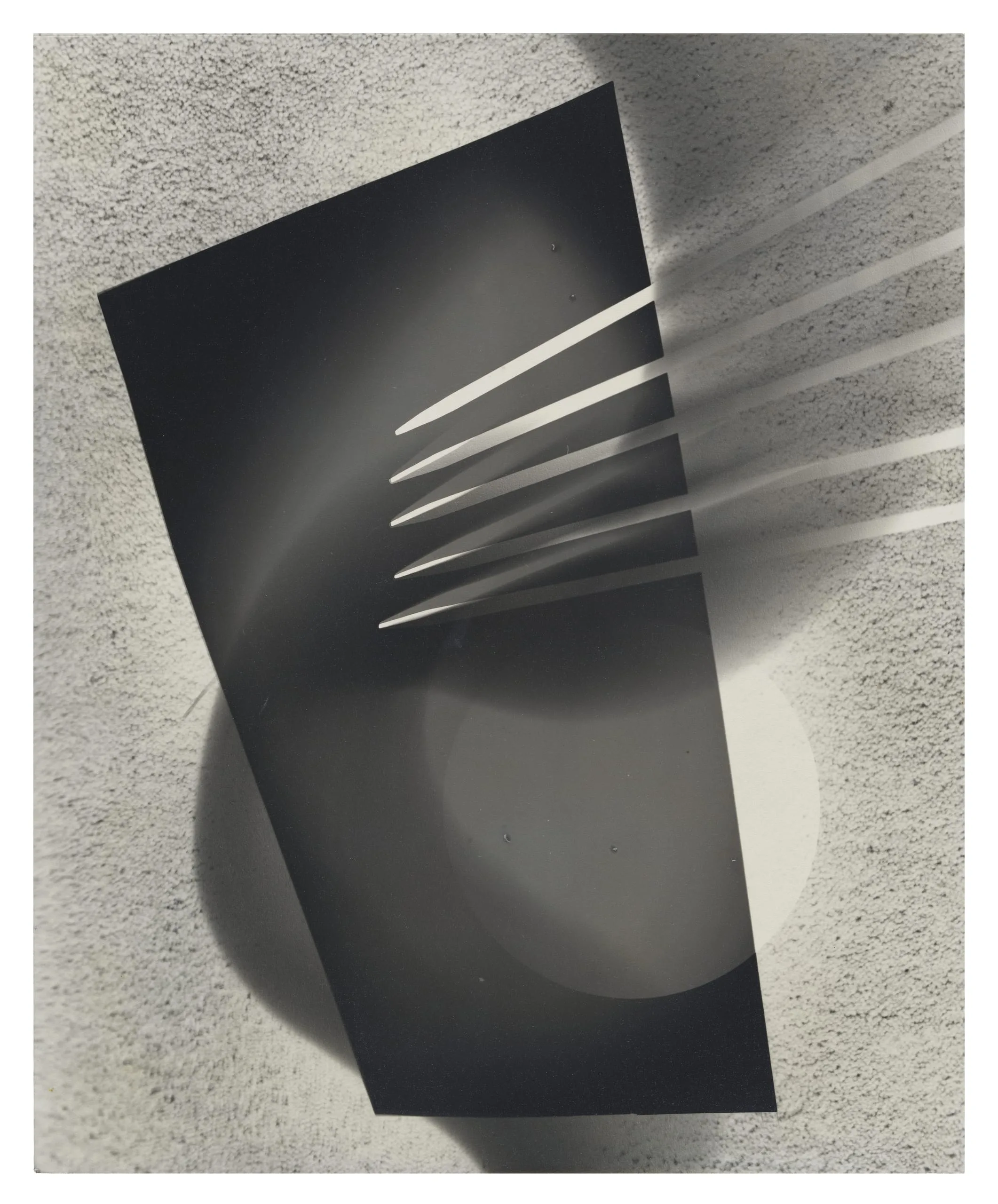
- Photogram 39-2
- Date Made
- 1939
- Medium
- Gelatin silver print
- Dimensions
- Image: 9 × 7 3/8 in. (22.86 × 18.73 cm)
Primary support: 9 × 7 3/8 in. (22.86 × 18.73 cm)
Secondary support: 18 × 14 in. (45.72 × 35.56 cm)
Mat: 20 × 16 in. (50.8 × 40.64 cm)
- Accession Number
- M.2021.223.1
- Curatorial Notes
Margaret De Patta made her reputation as a jewelry designer. She was born in San Francisco and began her art studies there. She encountered the European avant-garde while on scholarship at the Art Students League in New York (1926–29) and brought those ideas back to the Bay Area, where she apprenticed with Armin Hairenian at the Art Copper Shop and devoted herself to jewelry making. In the summer of 1939, De Patta had a formative meeting with László Moholy-Nagy in the Bay Area. She took courses with him at Mills College that year and at the Illinois Institute of Technology (Institute of Design) in 1941. Moholy’s emphasis on light and movement, translucency and dimensionality carried over from photography and film to De Patta’s materials, metal and quartz. In particular, Moholy advocated the technique of the photogram—a cameraless photograph made by arranging objects on a piece of sensitized paper and exposing them to light—as a primary exercise in form and composition. For De Patta, photograms also functioned as blueprints for jewelry designs. This signed and dated example is among the earliest she made, and she continued to employ the technique into the 1950s.
Britt Salvesen
2021/2024
- Copyright
- © Estate of Margaret De Patta