LACMA

ShopMembershipMyLACMATickets
LACMA
Los Angeles County Museum of Art
5905 Wilshire Blvd.
Los Angeles, CA 90036
info@lacma.org
(323) 857-6000
Sign up to receive emails
Subscribe
© Museum Associates 2025

Museum Hours

Monday

11 am–6 pm

Tuesday

11 am–6 pm

Wednesday

Closed

Thursday

11 am–6 pm

Friday

11 am–8 pm

Saturday

10 am–7 pm

Sunday

10 am–7 pm


  • About LACMA
  • Jobs
  • Building LACMA
  • Host An Event
  • Unframed
  • Press
  • FAQs
  • Log in to MyLACMA
  • Privacy Policy
© Museum Associates 2025
Collections

Unknown
The Buddhist Meditational Deity Vajrakila/Vajrakumara13th century

Not on view
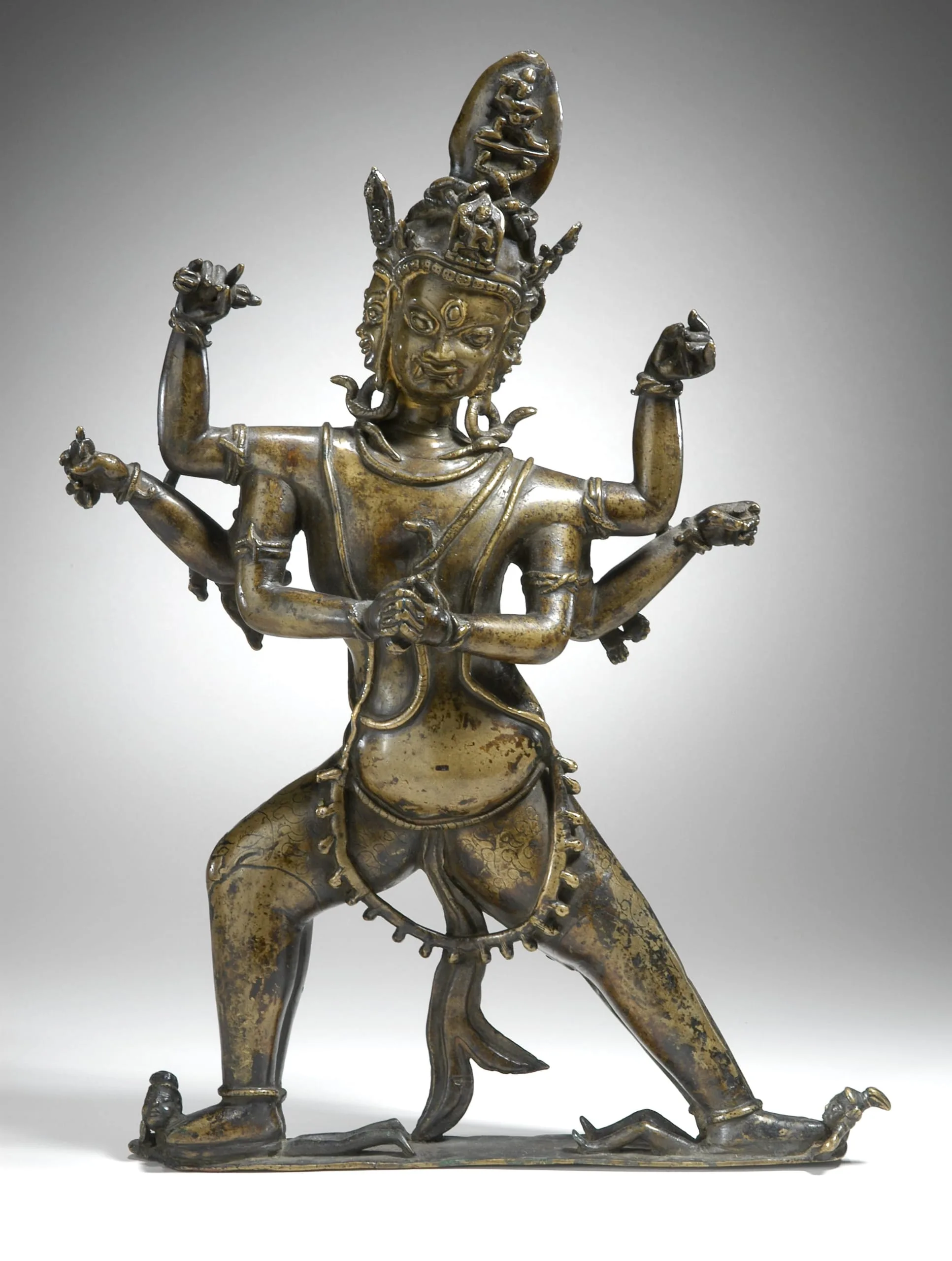
Bronze sculpture of a six-armed deity in a wide dancing stance, wearing a pleated skirt and tall crown, with a deep olive-brown patina
Artist or Maker
Unknown
Title
The Buddhist Meditational Deity Vajrakila/Vajrakumara
Place Made
Tibet
Date Made
13th century
Medium
Brass with traces of paint
Dimensions
13 3/8 x 10 1/4 x 4 5/8 in. (33.97 x 26.03 x 11.74 cm)
Credit Line
From the Nasli and Alice Heeramaneck Collection, Museum Associates Purchase
Accession Number
M.70.1.6
Classification
Sculpture
Collecting Area
South and Southeast Asian Art
Curatorial Notes

Vajrakila (Adamantine Stake), also known as Vajrakumara (Adamantine Youth), is the deification and embodiment of Tibetan ritual daggers (phurpa). Accordingly, in Tibetan he is called Dorje Phurpa. During the period of the Brahmanas (a body of Indian ritual literature dating from 1200-800 BCE), the priests used kilas (pegs) to cast out obstructions (mara). By the 7th-8th century, an array of Buddhist techniques of benefaction including the personification of the kila, Vajrakumara, had been incorporated into Tantric doctrine and practice. In the meditational context, kilas as triangular pegs are used to secure sacred space from the influences of negative influences and local spirits.

Vajrakila is depicted here with three wrathful faces, six arms, and four legs. He stands on the recumbent Shaiva Rudras, Ishvara and Uma, who symbolize delusion and ego. Stretched over his back are the flayed skins of an elephant and human, and he wears a tiger skin around his waist. These three skins symbolize Vajrakila’s overcoming of ignorance, desire, and anger—the three poisons of attainment. He also wears a long garland of severed skulls (mundamala) and serpents for ornaments. He has a diminutive wrathful figure surmounting each of his three faces, one on the back of his front face, and one supported by serpents on his chignon. Vajrakila stands in a militant posture (alidha asana) with his right leg bent and his left leg extended. With his two principal hands he rolls a phurpa between his palms in a traditional method used to cast a curse upon an enemy. In his upper right hand, he holds a nine-pronged thunderbolt (vajra), while in his lower right hand he holds a five-pronged thunderbolt. The attributes in his analogous left hands are now lost but were likely a blazing mass of fire and a ritual staff (khatvanga). Holes in the backs of two arms were used to attach now-missing wings indicative of his heruka (wrathful compassion) nature in the Nyingma iconographic tradition.

See Himalayan Art Resources, no. 85706, https://www.himalayanart.org/items/85706

Selected Bibliography
  • Huntington, John C. and Dina Bangdel. The Circle of Bliss: Buddhist Meditational Art. Columbus: The Columbus Museum of Art; Chicago: Serindia Publications, 2003.
  • Pal, Pratapaditya; Dehejia, Vidya; Slusser, Mary Shepherd; Fisher, Robert E.; Brown, Robert L. Arts of Asia 15 (6): 68-125 (November- December 1985).
  • Beguin, Gilles. Dieux et Demons de l'Himalaya: Art du Bouddhisme Lamaique. Paris: Grand Palais, 1977.
  • Pal, Pratapaditya. Art of Tibet. Expanded edition. Los Angeles: Los Angeles County Museum of Art, 1990.
  • Pal, Pratapaditya. Art of Tibet. Los Angeles; Berkeley, CA: Los Angeles County Museum of Art; University of California Press, 1983.
  • Fisher, Robert E. Mystics and Mandalas: Bronzes and Paintings of Tibet and Nepal. Redlands, CA: University of Redlands, 1974.
  • Fisher, Robert E. Art of Tibet. London: Thames and Hudson, 1997.
  • Reedy, Chandra L. Himalayan Bronzes: Technology, Style and Choices. Newark: University of Delaware Press, 1997.