LACMA

ShopMembershipMyLACMATickets
LACMA
Los Angeles County Museum of Art
5905 Wilshire Blvd.
Los Angeles, CA 90036
info@lacma.org
(323) 857-6000
Sign up to receive emails
Subscribe
© Museum Associates 2025

Museum Hours

Monday

11 am–6 pm

Tuesday

11 am–6 pm

Wednesday

Closed

Thursday

11 am–6 pm

Friday

11 am–8 pm

Saturday

10 am–7 pm

Sunday

10 am–7 pm


  • About LACMA
  • Jobs
  • Building LACMA
  • Host An Event
  • Unframed
  • Press
  • FAQs
  • Log in to MyLACMA
  • Privacy Policy
© Museum Associates 2025
Collections

Jasper Francis Cropsey
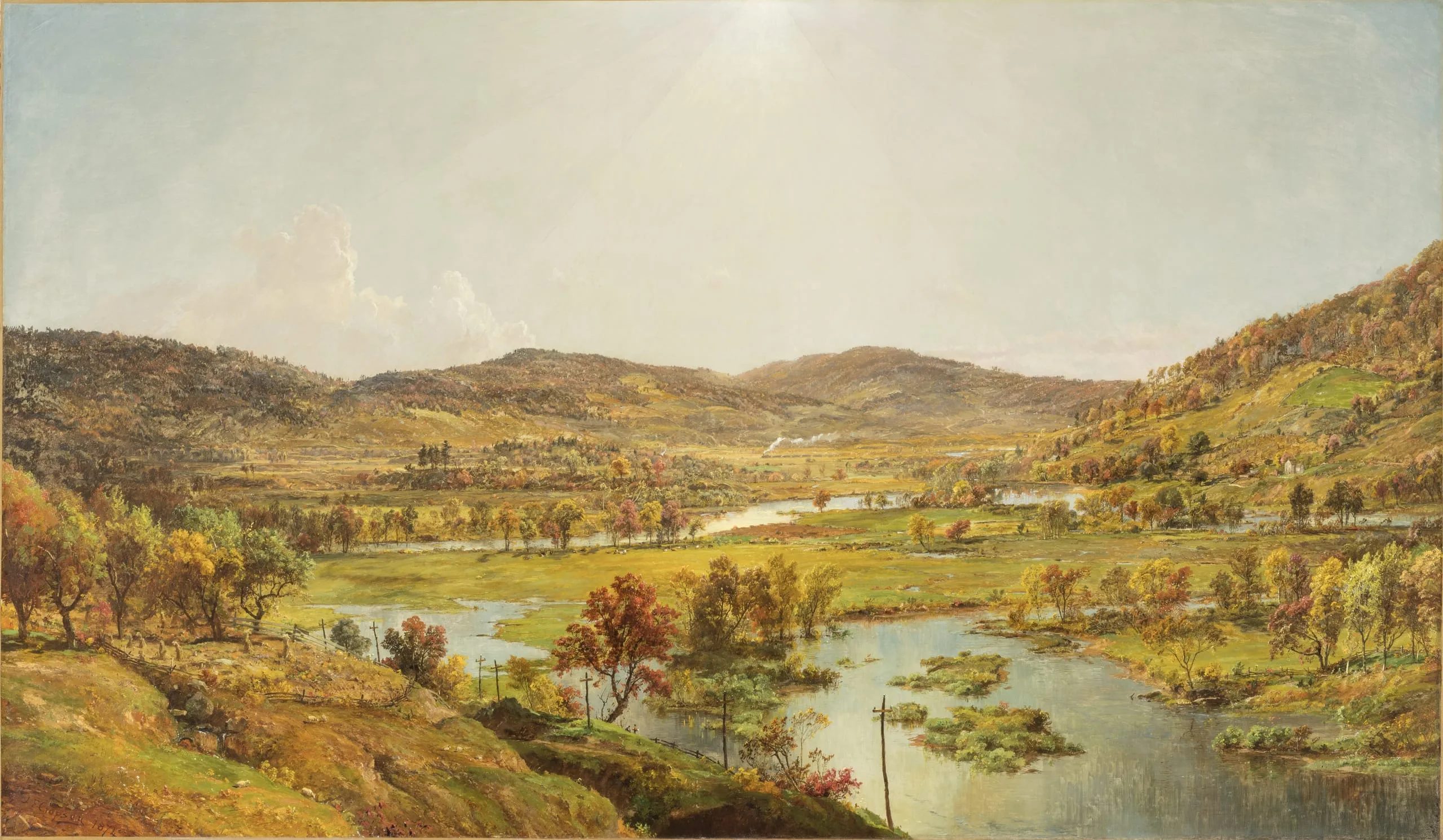
Sidney Plains with the Union of the Susquehanna and Unadilla Rivers1874

Not on view
Oil painting of an autumn river valley with winding waterways, russet and golden trees, and rolling hills receding to a pale horizon
Artist or Maker
Jasper Francis Cropsey
United States, New York, Rossville, 1823-1900
Title
Sidney Plains with the Union of the Susquehanna and Unadilla Rivers
Place Made
United States
Date Made
1874
Medium
Oil on canvas
Dimensions
Canvas: 42 1/16 × 71 7/8 in. (106.84 × 182.56 cm) Frame: 56 1/4 × 86 × 5 1/4 in. (142.88 × 218.44 × 13.34 cm)
Credit Line
Jessie R. McMahan Memorial and Museum Acquisition Fund
Accession Number
M.70.2
Classification
Paintings
Collecting Area
American Art
Curatorial Notes
Sidney Plains is an area in south-central New York State, between Binghamton and Oneonta, that Cropsey visited frequently on his trips to Niagara Falls and the Susquehanna River Valley. In the middle ground, at the extreme right, just below the hill with the white farmhouse flows the Unadilla River. A pencil drawing dated 1873 locates the exact spot Cropsey chose to delineate. In fact, the painting deviates little from the preparatory drawing and consequently takes on the character of a topographical record. It was just such numerous details presented on a large scale that critics such as Henry James found fault with when the painting was exhibited at the annual exhibition of the National Academy of Design in 1875.
During the eleven years following his return from England in 1863, Cropsey added to his growing reputation with a number of largescale, panoramic landscapes of northeastern American scenery. In Sidney Plains, as in the earlier Valley of Wyoming, 1865 (Metropolitan Museum of Art, New York), he attempted to epitomize the settling of the wilderness. Cropsey depicted man’s encroaching on the wild landscape as he fenced in orchards and grazing fields for cows and sheep. Such expansion was then seen as "progress" and was associated with the advancement of modern technology, here indicated by the presence of telegraph poles and a distant train. The completion of the Erie Railroad line to Binghamton through the Alleghenies in 1848 had made the area more accessible to New York City.
Cropsey’s landscape represents a nostalgic image of the settling of the American frontier. The railroad was crucial to the settlement of the American wilderness and in this painting may have had more than iconographic significance. Cropsey may have painted Sidney Plains for the railroad magnate John Taylor Johnston. There is conflicting information concerning the name of the original owner: when the landscape was exhibited at the National Academy of Design in 1875, the owner was listed as John H. Johnston, and literature thereafter referred to the owner as John N. Johnston or John J. Johnston. John T. Johnston was a collector of American painting and the first president of the Metropolitan Museum of Art. If he were the owner, Sidney Plains was not sold in 1876 when business circumstances forced him to sell much of his collection. John T. Johnston may have kept the painting or given it to his son, John Herbert Johnston, owner of the Tenth Street Studio Building, where many New York artists rented studios. Although John Taylor Johnston did not own the Erie Railroad pictured in Cropsey’s landscape, his Lehigh and Susquehanna line provided one of the links from the seaboard to the inland.
Sidney Plains is painted in Cropsey’s characteristic autumnal palette, which, according to the color notes written on the preparatory drawing, he found in nature. The sun breaking through the moist haze has the appearance of shafts of light. Although they can be explained as a natural phenomenon, these pearly hued rays imply a divine blessing on the land and its settlement.
Selected Bibliography
  • Kim, Woollin, Jinmyung Kim, and Songhyuk Yang, eds. Art Across America. Seoul: National Museum of Korea, 2013.
  • Miller, Angela, and Chris McAuliffe, eds. America: Painting a Nation. Sydney: Art Gallery of New South Wales, 2013.
  • Speiser, Anthony M., ed. Jasper Francis Cropsey: Catalogue Raisonné: Works in Oil: Volume Two: 1864-1884. Hastings-on-Hudson, NY: Newington-Cropsey Foundation, 2016.