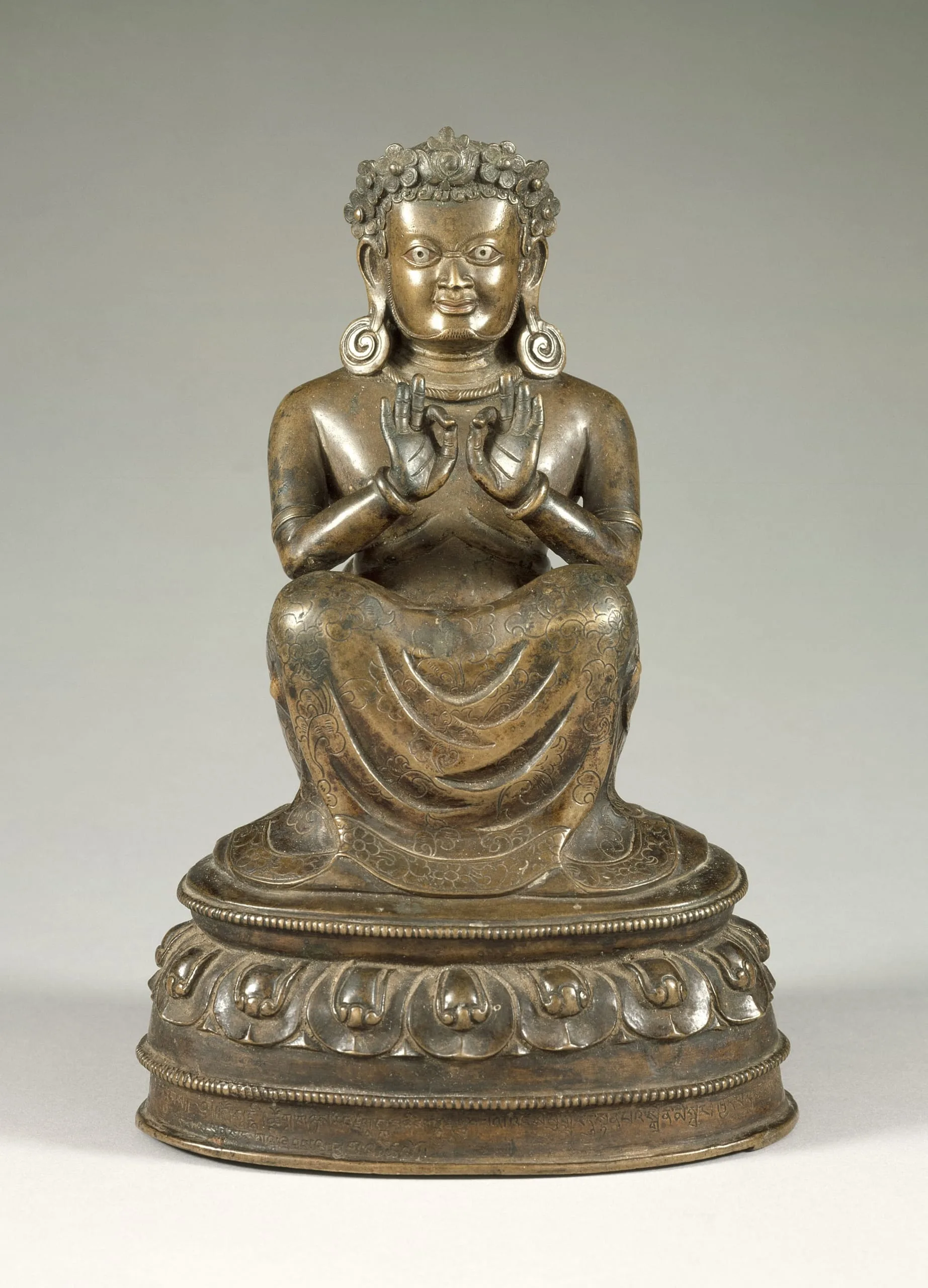
This is an idealized portrait of the great South Indian Mahasiddha (Great Adept), Dampa Sangye (also known as Nagpopa (Black One; d. 1117). He was likely born in present-day Andhra Pradesh and studied at the Vikramashila monastic university in Bihar. Dampa Sangye and the great Tibetan yogini, Machig Labdron (1055-11533), are credited with the introducing the Chö (Spiritual Self-Dissection) meditative practice, which involves the "cutting away" of all egoistic desire.
Powerfully frontal and symmetrical in composition, Dampa wears spiral round earrings (kundala) typical of the Tantric yogins, an unusual tiara of flowers signifying his initiation by mystical female "sky-goers" (Dakinis), and a rhythmically cascading lungi with incised floral scrolls. Both hands raised in mirrored gestures of discussion (vitarka mudra), indicating his role as an eminent teacher. Sitting on his haunches, his drawn-up legs reflect the yogic practice of inner psychic heat (Sanskrit: chandali; Tibetan: tummo). This technique involves meditations on the wrathful goddess, Chandali, who ultimately bestows great bliss on the practitioner. Adepts would test their ability at producing such internal heat by virtually disrobing in severely cold weather and meditating on the production of an inner fire that would rise through the body’s psychic energy system.
The Tibetan inscription around the bottom of the lotus base reads,
Headed by the Nun, the disciples have set up this holy image as a support for faithful prayers for the memorial service of the glorious Lama (Palden Lama). By its merit mail creatures attain Buddhahood. Good luck, good fortune.
Om siddha. Homage to the feet of Dampa’i Sangs rgyas (Dampa Sangye)! Fully accomplished the two spheres, miraculously perfected in two bodies, who lights the lamp of faith in the world and especially in the land of snow has brought about salvation, who has become a master of the scriptures and attained liberation and become clear light. Relying on his mastery of means he brings under his power all that go in the sky and has planted the banner of victory for the accomplishment of the purpose of living beings. Homage to the feet of dPal ldan Seng ge (Palden Sangge) (d. 1342). (Translation by H. E. Richardson.)
See Himalayan Art Resources, no. 85705, https://www.himalayanart.org/items/85705