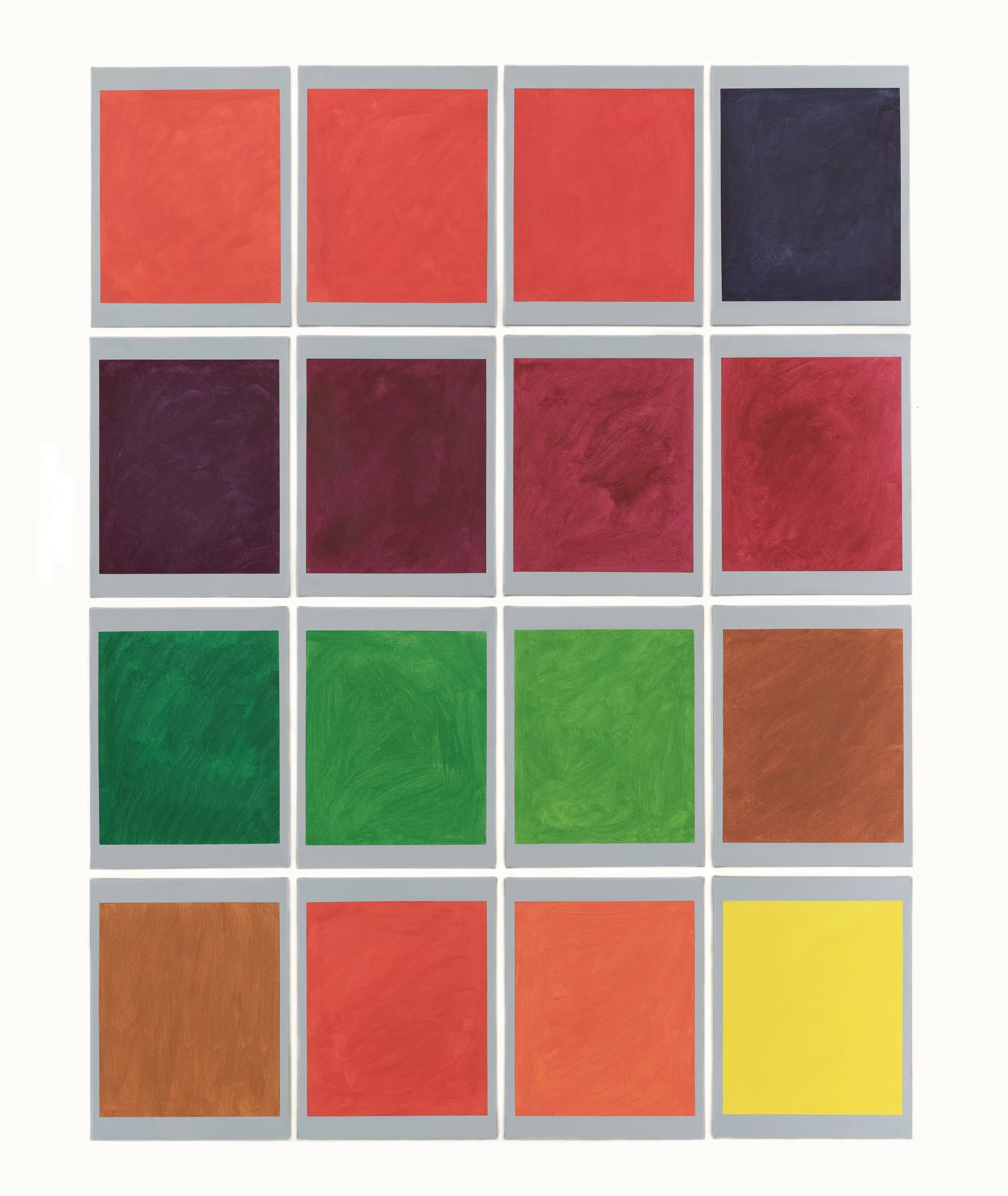
Since 2015, the contemporary Venezuelan artist Emilia Azcárate has been fascinated by the historic pictorial genre known as castas (castes). Created as sets of multiple images, casta paintings document the process of racial mixing among Indians, Spaniards, and Africans. Each scene portrays a family group with parents of different races and one or two of their children. Most works were created as sets of sixteen scenes, although the number could vary. The genre’s premise, reinforced by the inscriptions, was that successive combinations of Spaniards and Indians resulted in a vigorous race of “pure” or white Spaniards, while the mixing of Spaniards and Indians with Africans led to racial degeneration. This series references the famous casta set by Miguel Cabrera (c. 1715–1768), of which LACMA recently acquired one of two the long-lost paintings.
Drawing on the formal language of abstraction, repetition, and seriality at the core of her practice, Azcárate references and transforms some of the premises underlying this historical genre and ultimately lays bare the impossibility of distilling society into a fixed number of variables. Extraordinarily methodical in concept and execution, Azcárate invented a color system to identify the different social groups and their mixtures. For example, she assigned yellow to Indians, a color that she argues was historically associated with gold and the sun; cyan to Africans to symbolize their strength and resistance, which she associate with the ocean and the sky; and magenta to the Spaniards, to allude to their obsession with limpieza de sangre (“purity of blood”), Old Christian ancestry, and superior status. The colors are then precisely mixed to symbolize the various racial combinations presented in casta paintings.
Azcárate’s work is both an investigation into the genealogy of people and color—even when the human figure is entirely absent. Through her systematic color distillations, and drawing on the color theories of Newton (1643–1727) and Goethe (1749–1832), Azcárate sets out to show the positive aspects of color mixing. (For Goethe black was the sum of all colors, while for Newton black was the absence of all color.) According to the artist, “this project proves that the different racial groups can mix, take up the same amount of space, and stand next to one another in perfect harmony—the same as with colors. In my work, all the colors derive from the same matrix: yellow, cyan, and magenta (Amerindians, Africans, and Spaniards). What I try to convey through this body of work is that people and colors are mutable and constantly evolving, and that in the end the only power that matters is the power to be.” The surface of this set’s pictures are coarsely painted to hint at the figures from the historic images. As Azcárate explained, “these rough stains create the sensation that figures can suddenly emerge from the blotches. Conceptually, what I intend to say is that this type of abstraction derives from figuration and moves again toward it.”
Ilona Katzew, Department Head and Curator, Latin American Art, 2023