LACMA

ShopMembershipMyLACMATickets
LACMA
Los Angeles County Museum of Art
5905 Wilshire Blvd.
Los Angeles, CA 90036
info@lacma.org
(323) 857-6000
Sign up to receive emails
Subscribe
© Museum Associates 2026
  • About LACMA
  • Jobs
  • Building LACMA
  • Host An Event
  • Unframed
  • Press
  • FAQs
  • Log in to MyLACMA
  • Privacy Policy
© Museum Associates 2026
Collections

Master of the St. Lucy Legend
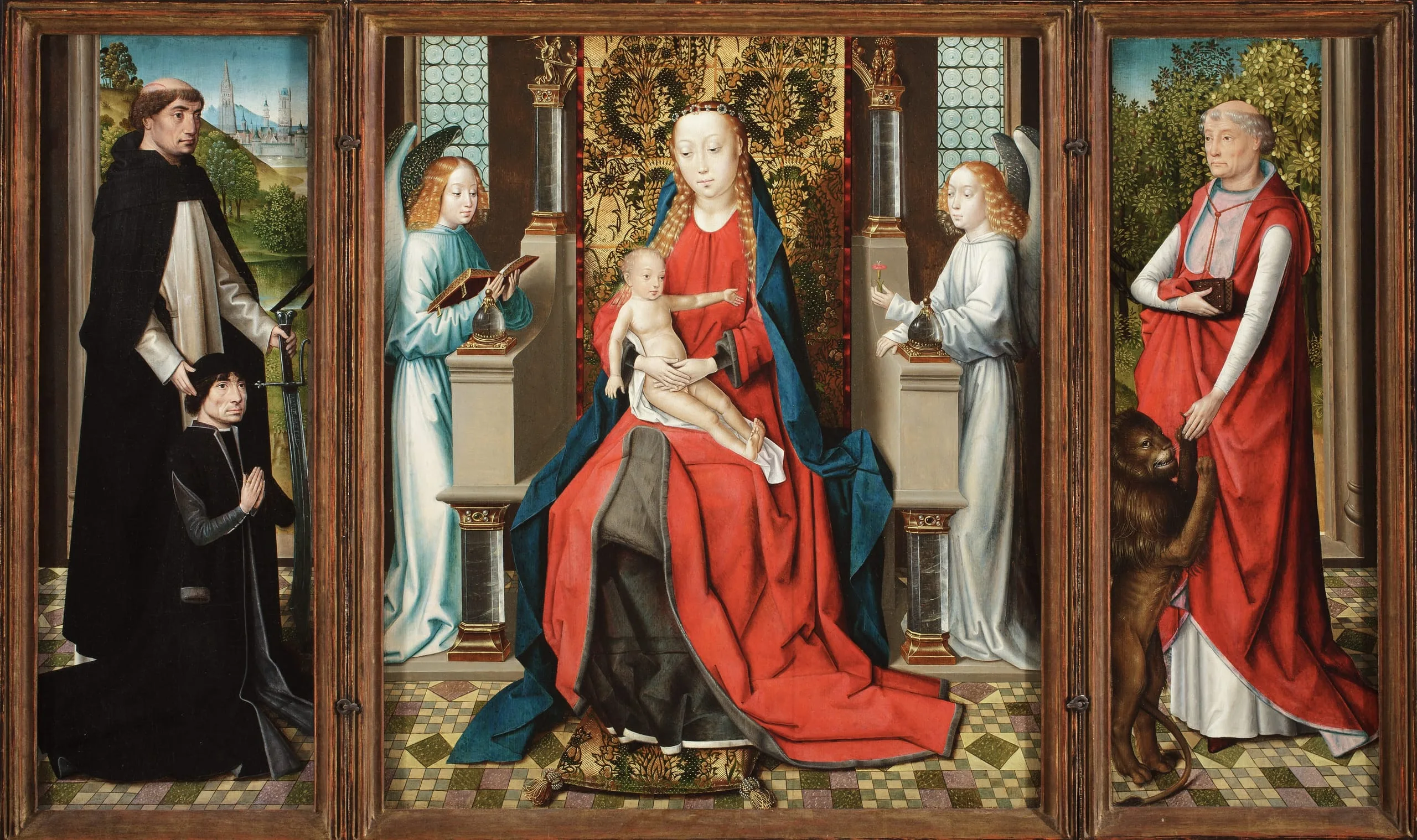
Triptych of Madonna and Child with Angels; Donor and His Patron Saint Peter Martyr; and Saint Jerome and His Lionbefore 1483

On view:
Geffen Galleries
Oil painting triptych; central panel shows a crowned woman in red and blue holding an infant on a throne flanked by two angels; left panel depicts a robed monk and kneeling donor; right panel shows a crowned figure in red with a lion at his feet
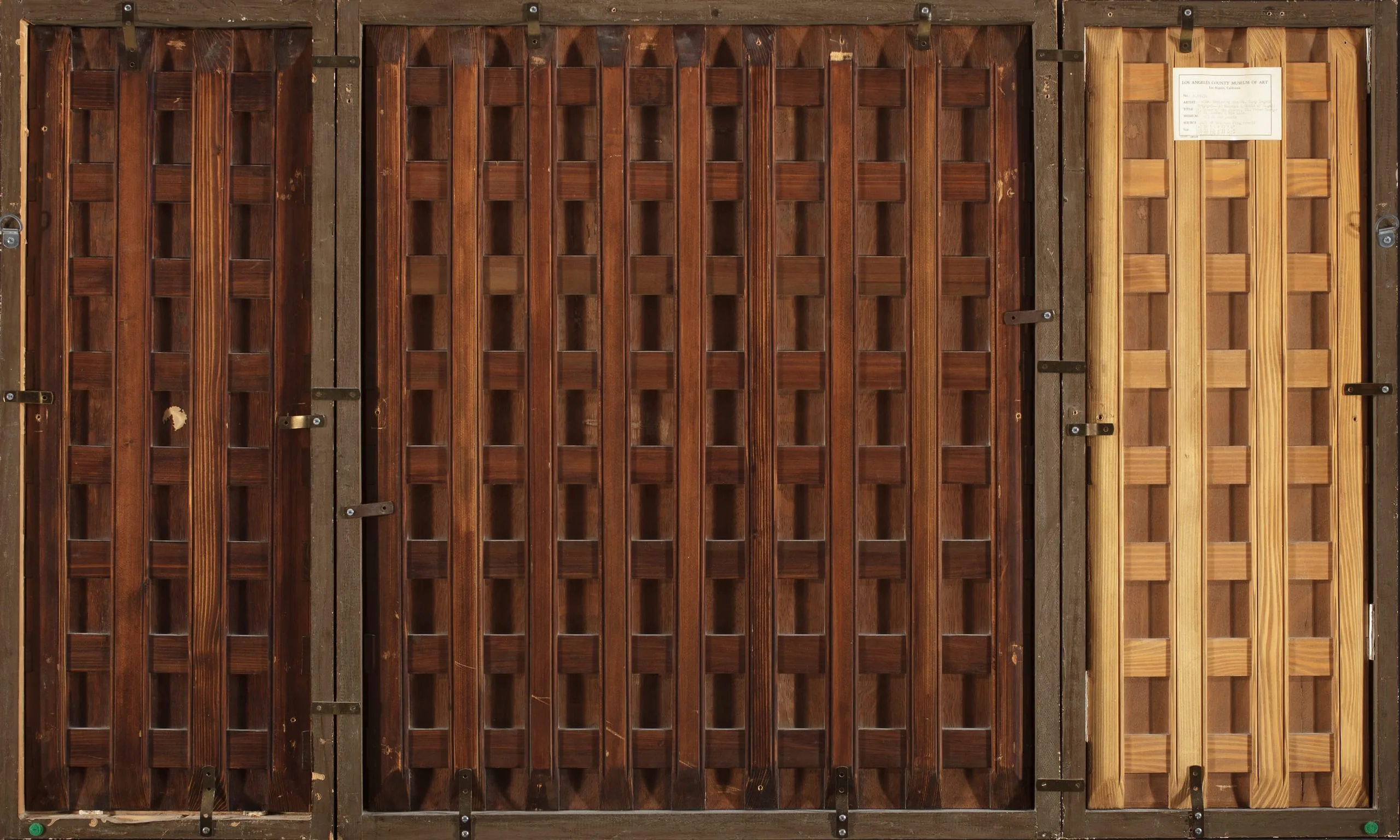
Reverse of a large wooden panel construction showing an interlocking lattice framework of dark and light wood strips, with metal hardware and a paper label at upper right.

Master of the St. Lucy Legend, Triptych of Madonna and Child with Angels; Donor and His Patron Saint Peter Martyr; and Saint Jerome and His Lion, before 1483, Los Angeles County Museum of Art, Gift of Anna Bing Arnold, photo © Museum Associates/LACMA

Artist or Maker
Master of the St. Lucy Legend
Northern Netherlands, active circa 1475-circa 1501
Title
Triptych of Madonna and Child with Angels; Donor and His Patron Saint Peter Martyr; and Saint Jerome and His Lion
Date Made
before 1483
Medium
Oil on oak panels
Dimensions
Each left and right panel: 33 1/4 × 11 1/4 in. (84.5 × 28.6 cm) Center panel: 33 1/4 × 27 1/4 in. (84.5 × 69.2 cm) Overall (incl all 3 panels): 33 1/4 × 49 3/4 × 2 in. (84.5 × 126.4 × 5.1 cm)
Credit Line
Gift of Anna Bing Arnold
Accession Number
M.69.54a-c
Classification
Paintings
Collecting Area
European Painting and Sculpture
Curatorial Notes

In fifteenth-century Europe, devotional triptychs made for churches, chapels, or private patrons became increasingly personalized, often reflecting the cityscape in which they were painted or portraying the donor who financed the artwork in a side panel. In the left panel of this triptych, for instance, the patron kneels beneath Saint Peter, a Dominican friar or preacher of the Catholic church who lived in thirteenth-century Verona. The central panel features the Madonna and Child, while the right panel presents Saint Jerome accompanied by his lion. Given the convention that donors often shared their first name with the saint presenting them, it is plausible that the donor was named Peter. Furthermore, the fact that his body shares space with the religious figures throughout the triptych elevates the commissioner’s piety. If the triptych was gifted to a chapel in a cathedral, as was likely, the display of the donor’s portrait constituted an expression of social status in a public place. The triptych thus memorialized the donor and helped solicit prayers for him in perpetuity after death.

As the patron knelt before this altarpiece in pious devotion, he would have recognized and felt a deep connection with the background cityscape, which is identifiable as Bruges. The triptych was painted by the Master of the Legend of Saint Lucy—an anonymous artist named after an altarpiece in a Bruges church. The Master skillfully incorporated the cityscape, featuring two distinct and prominent towers: Notre-Dame on the left and the Belfry on the right. The meticulous depiction of the Belfry indicates that the triptych was created before 1483, as the tower underwent alterations in that year.

2024
Selected Bibliography
  • Schaefer, Scott, and Peter Fusco. European Painting and Sculpture in the Los Angeles County Museum of Art: an Illustrated Summary Catalogue. Los Angeles: Los Angeles County Museum of Art, 1987.
  • Raguin, Virginia Chieffo. Stained Glass before 1700 in the Collections of the Los Angeles County Museum of Art and the J.Paul Getty Museum. Vol. 1, Los Angeles County Museum of Art. London: Harvey Miller Publishers for American Corpus Vitrearum, Inc., 2024.

Related Unframed

A Closer Look at Italian and Northern Renaissance Paintings
  • January 24, 2017
  • Chi-Young Kim