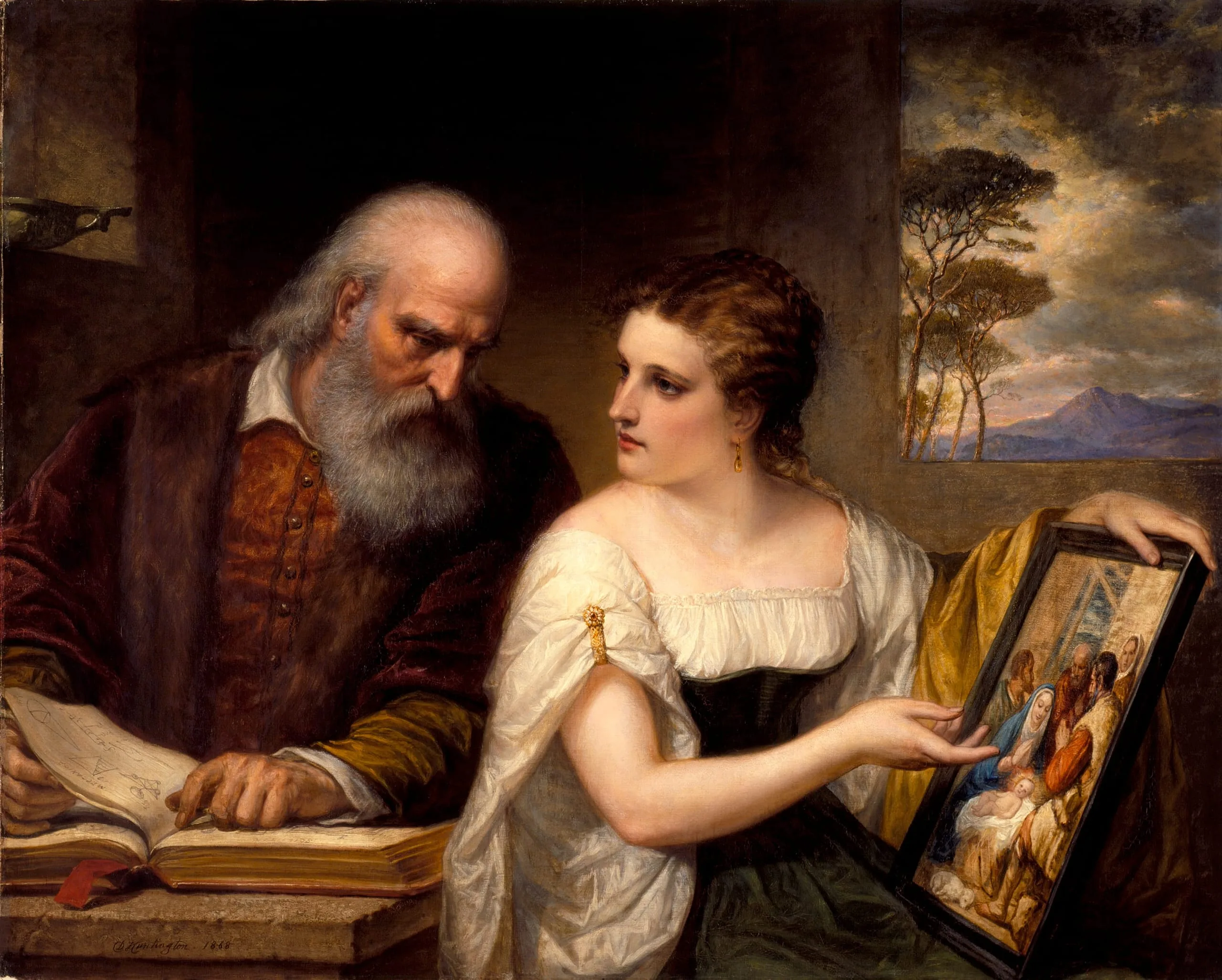
Although most of Huntington’s long career was taken up in painting more than one thousand portraits, he also painted landscapes and probably thought of himself as a painter of allegories and ideal subjects. His interest in religious and allegorical painting had been kindled by the Raphaelesque Italian and German ideal subjects he had seen in Rome on his first trip to Europe in 1839. By the 1860s his models were the Venetian artists of the High Renaissance, especially Titian (c. 1488-1576), whose example can be seen in the costumes and figure types depicted in Philosophy and Christian Art. The model or the type of the old man also appears in Huntington’s Sowing the Word, 1868 (New-York Historical Society). The influence of the Venetian school can also be seen in the rounder forms and richer palette of his paintings of this period. Even the halflength format seems to echo Venetian examples. The model for the painting to which the young lady gestures, however, appears to be The Adoration of the Shepherds, 1650, by José Ribera (1588-1652) in the Louvre, Paris.
The painting is conceived as a conversation between embodiments of opposing, but equally worthy points of view. The wisdom of the aged scholar, reading a book by lamplight, is contrasted with the intuitive perceptions of the young woman who examines a work of art by the daylight signified by the window. Huntington has cast in terms of ideal figures one of the pressing problems of his own times, when scientific findings seemed to challenge the truth and wisdom of religion conveyed by artistic and other nonscientific forms of perception.