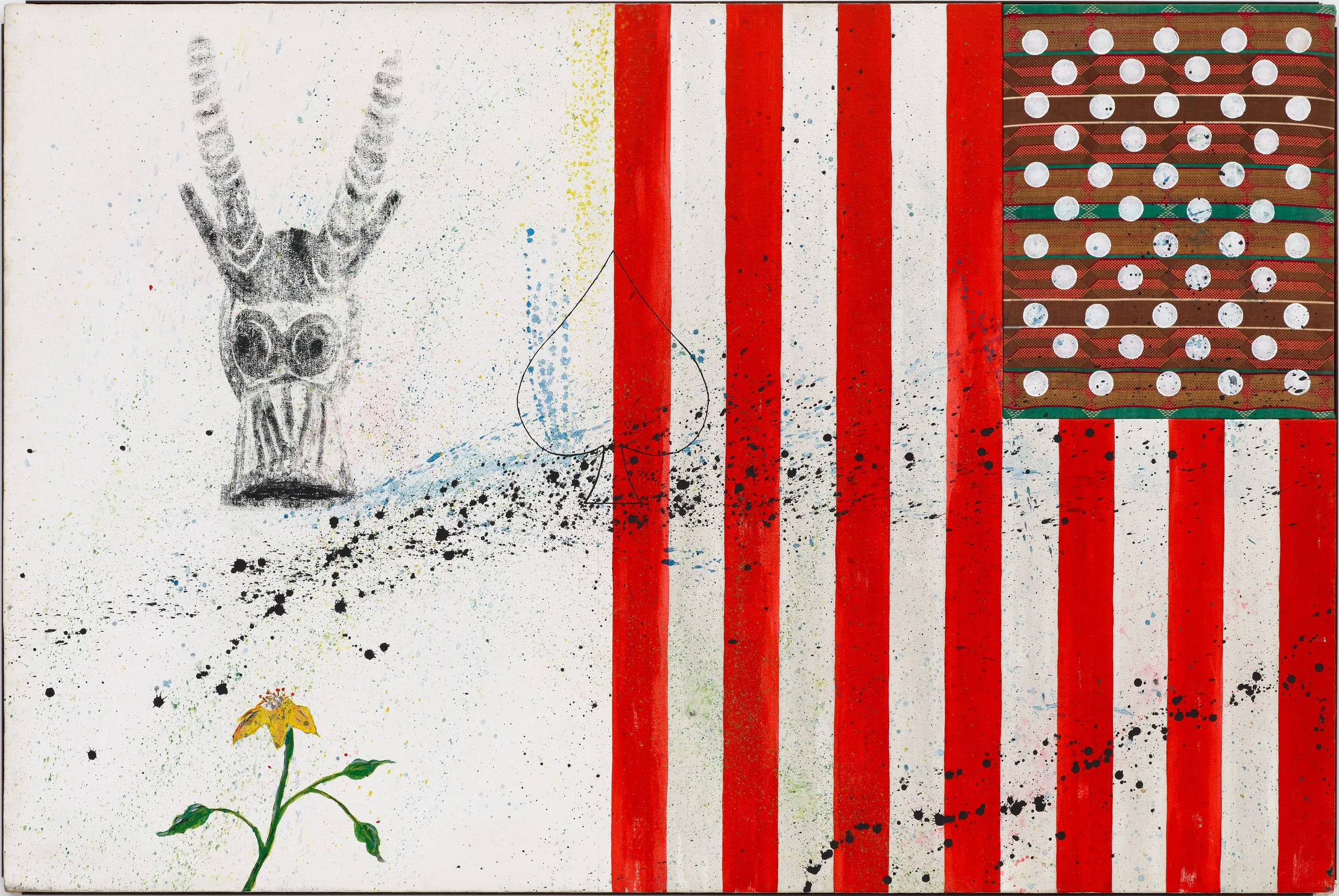
Joe Ray’s work, never tethered to a specific medium, has consistently addressed issues of concern to the Black community, both locally and across the country. A balance of abstraction and representation persists throughout his paintings, photography, and sculptures. Born in Louisiana, Ray has lived and worked in Los Angeles since 1963. After serving in Vietnam, he became active in the South Los Angeles art community, participating in the 4th Annual Watts Summer Festival Art Exhibition in 1969. Even before completing his studies, Ray received LACMA’s Young Talent Award in 1970. He went on to earn his BFA from the California Institute of the Arts (CalArts) in 1973, where he was mentored by John Baldessari and Nam June Paik.
In 1993, in the wake of the 1992 civil unrest in Los Angeles after the acquittal of the police officers accused of beating Rodney King—a traumatic moment in the city’s history—Ray created a body of work concerned with equality and inclusion. US is a prime example from that body of work. The title of the painting refers both to the United States and to “us.” This purposefully vague pronoun can function inclusively—denoting anyone viewing the canvas, along with the artist—but can also suggest the divisive notion of “them” as opposed to “us.” The gazelle head on the left serves as a symbol of the African continent, while the flower below is what Ray describes as an urban plant growing from cracks in the concrete, a flower that precedes fruit. In the middle of the painting is the outline of a spade, with all that evokes: a racial slur, the high suit in a deck of cards, a leaf, the tree of life, a tool for digging and planting, even a spear point. In the American flag on the right, the normally blue background behind the stars (now circles) is made of Kente cloth, a textile that originated in Ghana and is significant to the West African diaspora. The gestural splashes of paint across the canvas reference Abstract Expressionism—conventionally viewed as the quintessential moment when the United States became the leading power in the international art world—as well as marks on urban sidewalks or paint that might have been thrown in a protest. By presenting the American flag along with the African mask and splashes of black paint, Ray points to a Black community buckling under the pressure of two oppositional realities—one that emphasizes the freedom and equality that the American flag should represent, and the other evoking the actual history and ongoing treatment of Black Americans. In US, Ray reminds us that where there is anger (represented by the black paint splatter), there is also hope, seen in the flower that blooms even in the harshest environment.