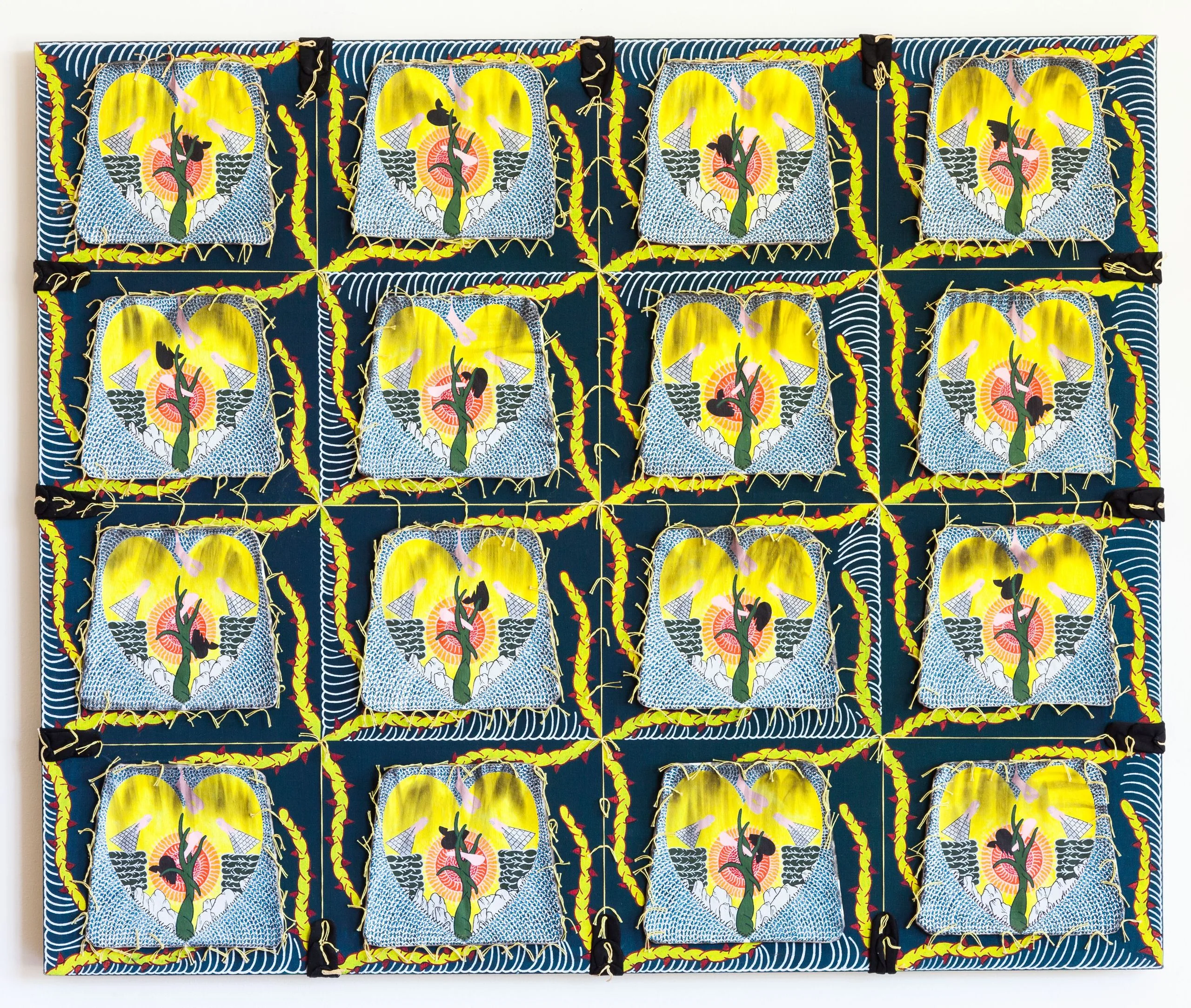
Franklin Williams creates visionary abstractions that are made out of the most mundane and tactile of materials; at the same time, he has broken new ground as to how one can make a painting or a sculpture. Born in Utah, Williams grew up surrounded by the natural beauty of the high desert surrounded by mountains and yet near a river and flowering fruit tree orchards. His mother, grandmother, and other female relatives in his close-knit family were all avid quilt makers as well as skilled in sewing, knitting, and crocheting, all of which Williams participated in as a boy. Williams’s father was an amateur sculptor, using scraps of wood to build cartoon characters, and his beloved Uncle George was a prolific though unacknowledged (other than, later, by Williams himself) folk artist. Williams received his BFA and MFA from the California College of Arts and Crafts (now California College of the Arts or CCA) in Oakland, where in 1963 guest instructor and critic John Coplans convinced him to abandon the then-dominant mode of expressionist oil painting on large canvases in favor of working small and more intimately—a vocabulary that Williams favored but had kept hidden from his teachers. He soon purchased a sewing machine and began stitching quilt-like fabrics, often adding daubs of paint, beading, or tufting to the surfaces of his works. Over time Williams embraced ever-expanding sources for his work—in his own words, “mosaics, tiles, Chinese brocades—all kinds of textiles…carpets, and painted china. Anything decorative I love,” including Islamic calligraphy, Spanish iron grillwork, and Japanese lacquerware along with American handicrafts. Though idiosyncratic, his work has been seen in the context of Bay Area Funk as well as the Pattern and Decoration movement.
Sixteen Sweet Moments, 1972, is both exemplary of and distinctive for Williams’s work. Typical for the artist, it is a painting—figurative but not narrative—made largely from sewn and layered, intricately patterned and brightly colored fabrics along with hand-tied crochet thread, rather than with paint. Its grid structure, however, is rare for Williams, though it references not only his early fascination with traditional quilt structures but also the Minimalist grid and serial structure prevalent in art of the late 1960s and early 1970s. In adapting the Minimalist grid to his maximalist vocabulary of vibrant and fecund forms and colors, Williams shows the power of his idiosyncratic style to take on and hold its own with the mainstream art world.