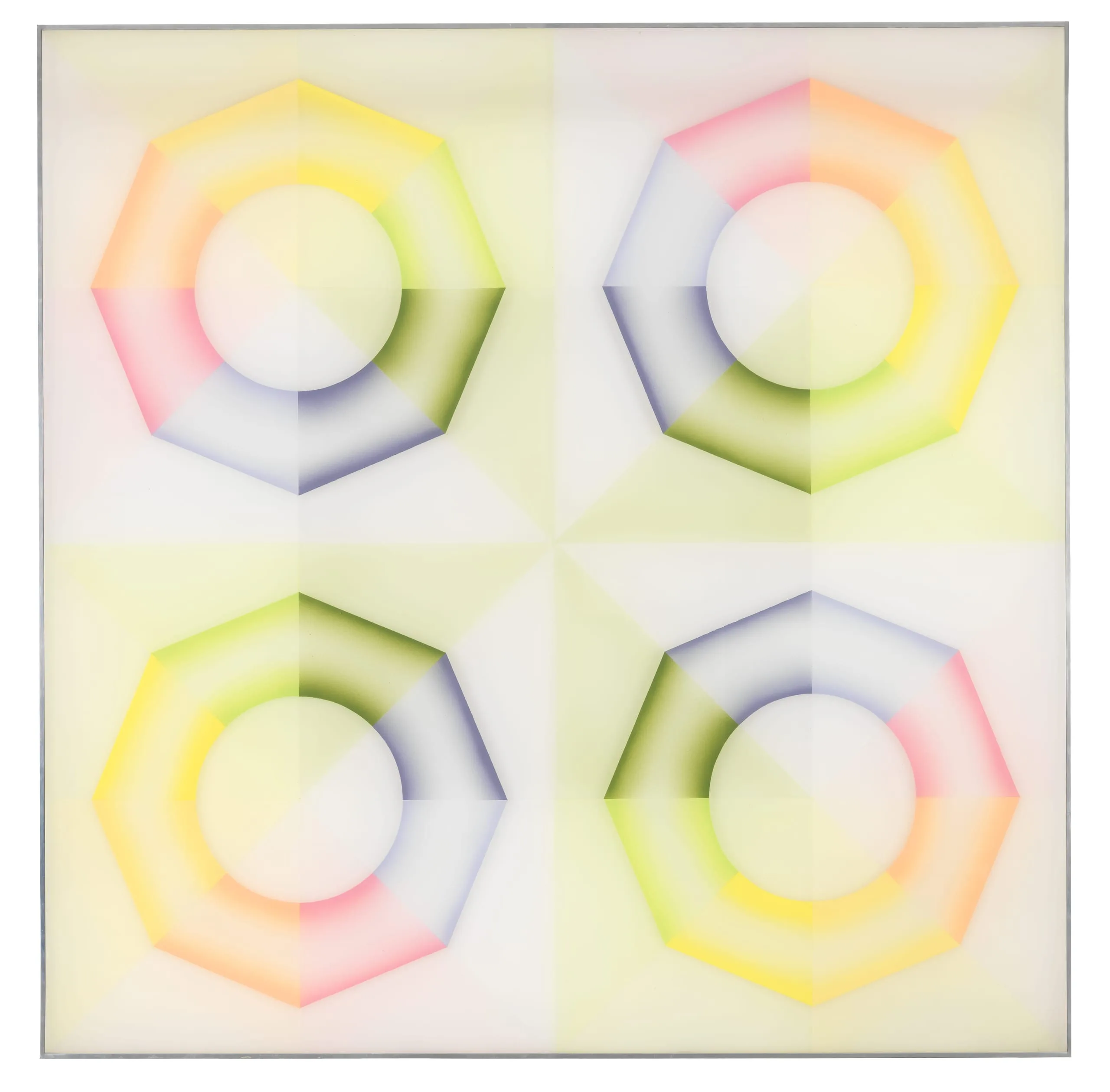
In 1964, Judy Chicago enrolled in auto body school (the only woman among some 250 men), where she learned spray painting techniques. She began painting car hoods and subsequently acrylic surfaces, which fuse chemically with the automotive lacquers; for Chicago, this fusion became like skin. Each work in Chicago’s Pasadena Lifesavers series, begun in 1969, features a kaleidoscopic pattern of geometric shapes airbrushed onto sheets of acrylic. The series comprises three groups of five paintings that follow a specific system of color (red, yellow, blue) and form. As in Pasadena Lifesavers Yellow #4, the fourth work in each group portrays a circle within an octagon.
While incorporating the repetitive grid structure of contemporary Minimalism, a field dominated by male artists, the Pasadena Lifesavers anticipate the overtly feminist work that brought Chicago to fame later in the 1970s. Between 1970 and 1973 Chicago founded the Feminist Art Program at California State University-Fresno, the first of its kind in the United States, moved the program to the California Institute of the Arts (CalArts), and cofounded the Women’s Building in Los Angeles, which played a key role in the development and support of feminist art.
Wall label, 2021.