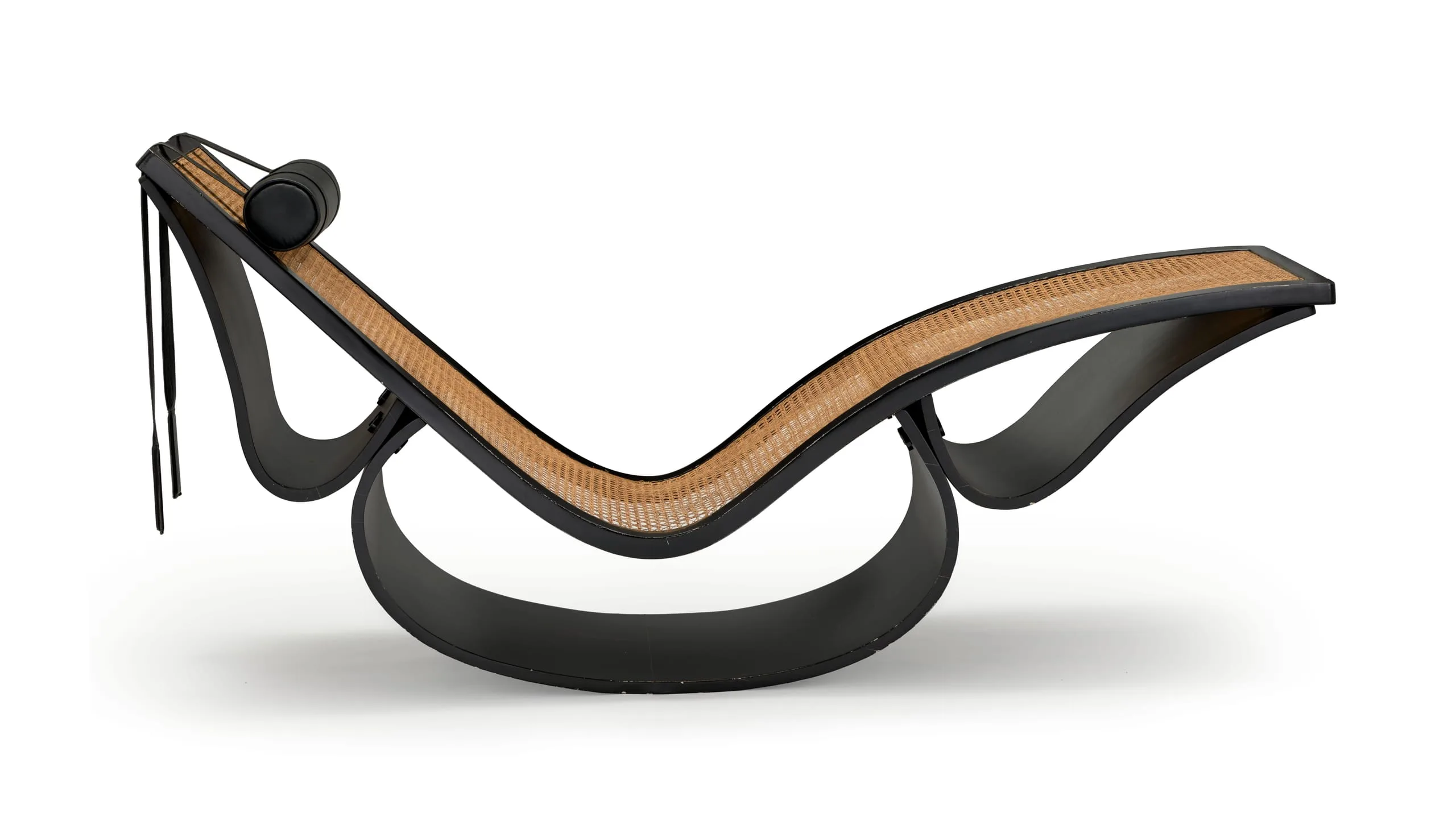
The Rio Chaise is one of the most important furniture designs by the Brazilian architect Oscar Niemeyer. It was produced in collaboration with his daughter Anna Maria Niemeyer during their years in Paris. With its interplay of solid elements and empty areas, the voluptuous chair resembles a drawing in space. The materials—plywood, cane, and leather—are masterfully balanced to create a functional and sculptural form that does not overwhelm the space around it—an important concern for Niemeyer. The chair’s fluid, sinuous lines reflect his preference for organic forms. “I am not attracted to straight angles or to the straight line, hard and inflexible, created by man,” Niemeyer stated. “I am attracted to free-flowing, sensual curves. The curves that I find in the mountains of my country, in the sinuousness of its rivers, in the waves of the ocean, and the body of the beloved woman. Curves make up the entire universe.”
Early in his career, Niemeyer worked as a draftsman for Le Corbusier (1887–1965) in Rio de Janeiro. His most emblematic project of the 1950s was Brasília, which represented the ultimate rebuttal of functionalism in favor of a more ductile and organic approach to architecture. Brazil’s military coup of 1964 brought the country to its knees, ushering in a period of increased repression, violence, and instability. In 1967, Niemeyer—a vocal member of the Brazilian communist party—left for Paris, where he lived for the next twelve years. It was in the French capital that he began designing furniture in 1971 in collaboration with his daughter.
Ilona Katzew
2024