LACMA

ShopMembershipMyLACMATickets
LACMA
Los Angeles County Museum of Art
5905 Wilshire Blvd.
Los Angeles, CA 90036
info@lacma.org
(323) 857-6000
Sign up to receive emails
Subscribe
© Museum Associates 2025

Museum Hours

Monday

11 am–6 pm

Tuesday

11 am–6 pm

Wednesday

Closed

Thursday

11 am–6 pm

Friday

11 am–8 pm

Saturday

10 am–7 pm

Sunday

10 am–7 pm


  • About LACMA
  • Jobs
  • Building LACMA
  • Host An Event
  • Unframed
  • Press
  • FAQs
  • Log in to MyLACMA
  • Privacy Policy
© Museum Associates 2025
Collections

Kay Sekimachi
Wall hanging1959

Not on view
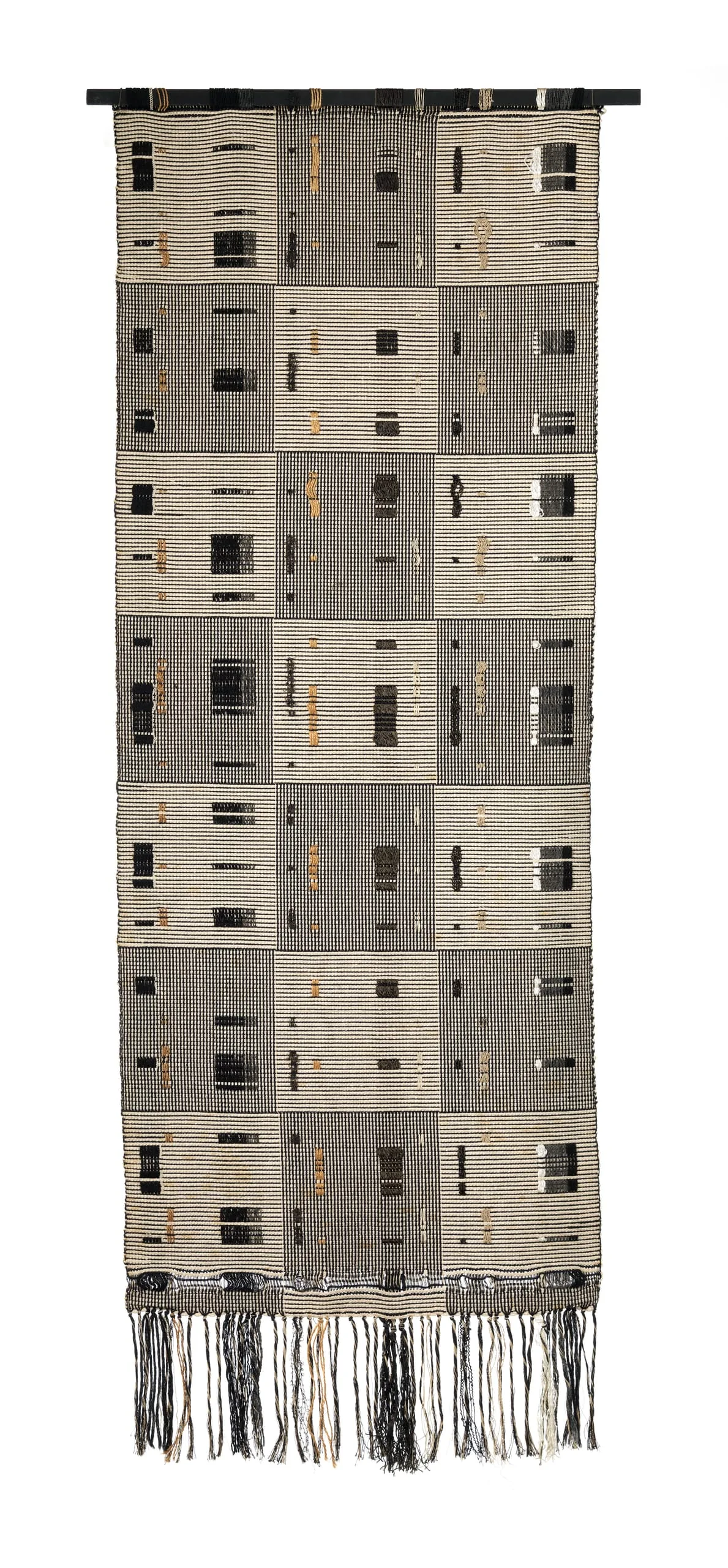
Woven textile wall hanging with ivory and charcoal horizontal stripe ground, grid of black rectangular forms and gold-toned accents, suspended from a black rod with a long knotted fringe below
Artist or Maker
Kay Sekimachi
United States, California, San Francisco, active California, Berkeley, born 1926
Title
Wall hanging
Date Made
1959
Medium
Cotton, rayon, wool, jute, wood
Dimensions
Textile Structure: 62 × 21 1/2 in. (157.48 × 54.61 cm)
Credit Line
Gift of Margaret and Joel Chen through the 2020 Decorative Arts and Design Acquisitions Committee (DA²) in memory of Peter Loughrey
Accession Number
M.2020.140
Classification
Textiles
Collecting Area
Decorative Arts and Design
Curatorial Notes

Kay Sekimachi is a towering figure of California fiber, a master of both traditional weaving techniques and experimental fiber constructions. Born in San Francisco to Japanese immigrants, Sekimachi and her family were sent to internment camps during World War II. After the war, Sekimachi studied weaving with Trude Guermonprez, who taught experimental techniques and complex structures such as double weaves. Guermonprez had studied weaving in Germany with several Bauhaus alumni and brought that influence to California when she moved to the state in 1949. This 1959 neutrally-toned wall hanging is Sekimachi’s most sophisticated geometric design from the 1950s, her first decade of weaving. Sekimachi recalls that its composition was inspired by the paintings of Piet Mondrian, but it also resembles the skillful interlocking designs of other Bauhaus weavers such as Gunta Stölzl, Benita Otte, and Anni Albers, whose work Sekimachi may have known through Guermonprez. Sekimachi used the warp brocade technique, adding supplemental warps to create the complex geometries.

Bobbye Tigerman, Marilyn B. and Calvin B. Gross Curator, Decorative Arts and Design, 2020
Selected Bibliography
  • Savig, Mary, editor. State Fairs: Growing American Craft. Washington, DC: Smithsonian Books, 2025.