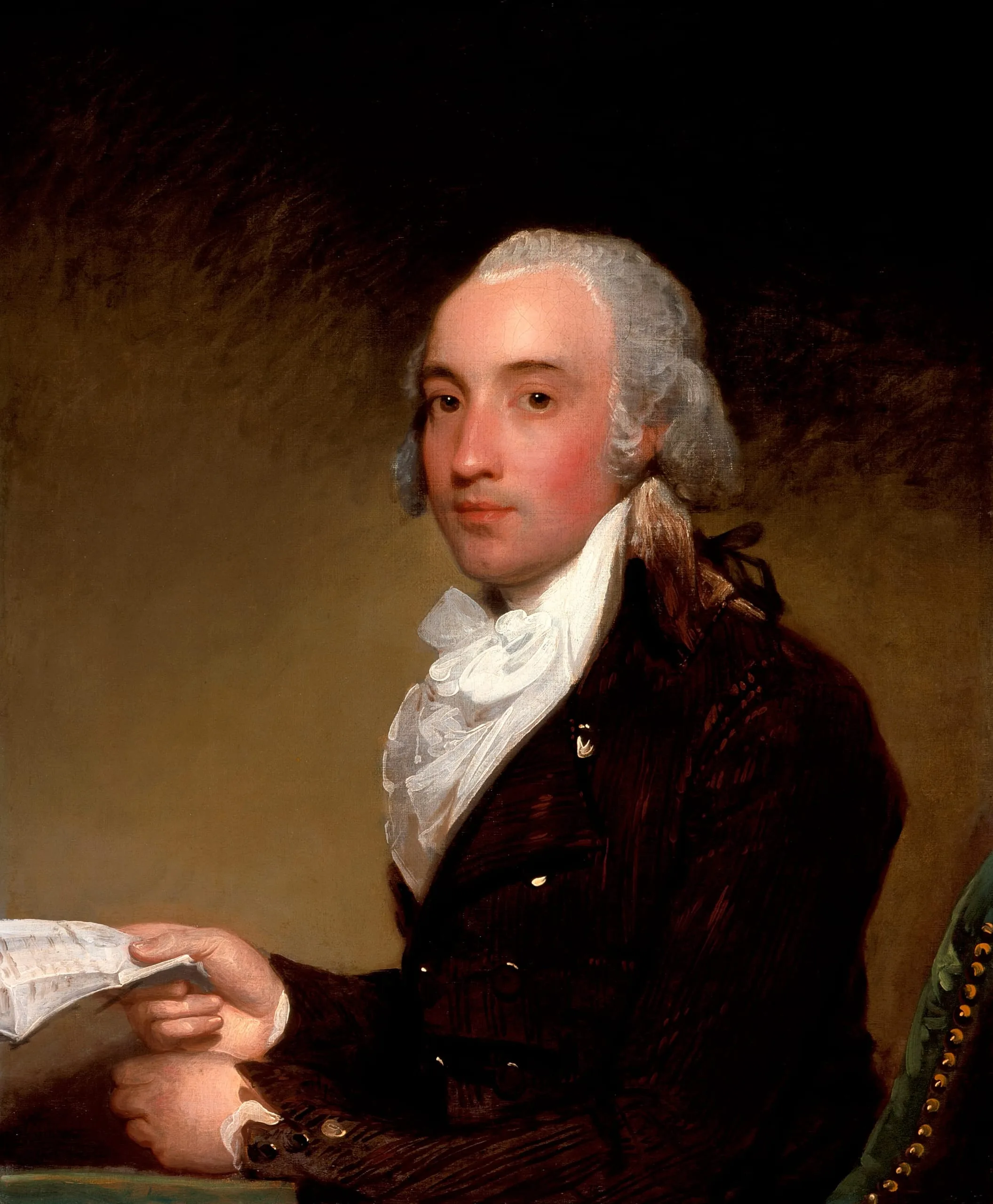
Gilbert Stuart, who was born in Rhode Island, studied with the American-born artist Benjamin West at the Royal Academy of Arts in London. Traveling across the Atlantic to learn how to paint in traditions that revered the classical past, Stuart and his teacher demonstrate the hold that European artistic practices continued to have on aspiring artists in the British American colonies and, later, the United States. This portrait of the young aristocrat Richard Barrington was likely painted in New York upon Stuart’s return from overseas. As in his other portraits from this period, the figure is drawn flush against the picture plane, a silhouette established from an indefinite backdrop.
The son of a British major general and member of a family that owned plantations and used enslaved labor in Jamaica and elsewhere, Barrington would gain the title Richard Lord Viscount Barrington (4th) in 1801. Stuart’s portrait asserts his sitter’s privilege and authority, conveyed through a resolute posture and a firm grasp on an illegible document. Attention to detail and dynamic brushwork emphasize the subject’s finery, while the textures and colors of his gray wig, bright white jabot, and deep brown frock coat reinforce an aura of propriety and decorum.
But all may not be as it appears. Though biographical details are sparse, Barrington seems to have faced a host of financial and personal problems. In 1783, in a pleading letter to an unknown recipient, possibly Benjamin Franklin or William Temple Franklin, he confesses a tendency to “extravagance and dissipation,” disclosing that his family has severed financial ties and mentioning a gunshot wound sustained while serving with the East India Company. He hopes to “settle in America,” but due to a limited allowance that barely “inables [sic] Me to make the appearance of a Gentleman,” he seeks “employment in the Army of the United States.” Around the same time, Barrington married an American woman born in Philadelphia, Susan (or Susannah) Budden. Years later, even after securing his title, he continued to complain about a shortage of funds and sought assistance from British officials. Despite these predicaments, Stuart’s painting permanently confers upon Barrington the “appearance of a Gentleman” that he so desired to maintain.
Selected Bibliography
Barratt, Carrie Rebora, and Ellen Gross Miles. Gilbert Stuart. Metropolitan Museum of Art, 2004.
DeAngelis, Caitlin, Carla D. Martin, Rayshauna C. Gray, Aabid Allibhai, and Eshe Sherley. “Black History at the Vassall Estate: Special History Study.” Longfellow House–Washington’s Headquarters National Historic Site, Cambridge, Massachusetts, September 15, 2025.
Maw, Neil B., and Vivien Moss. Beckett and The Barringtons. Shrivenham Heritage Society, 2020, http://publications.shrivenhamheritagesociety.co.uk/beckett--the-barringtons.pdf.
Selected Exhibition History
A Decade of Collecting: 1965−1975, LACMA, April−June 1975.