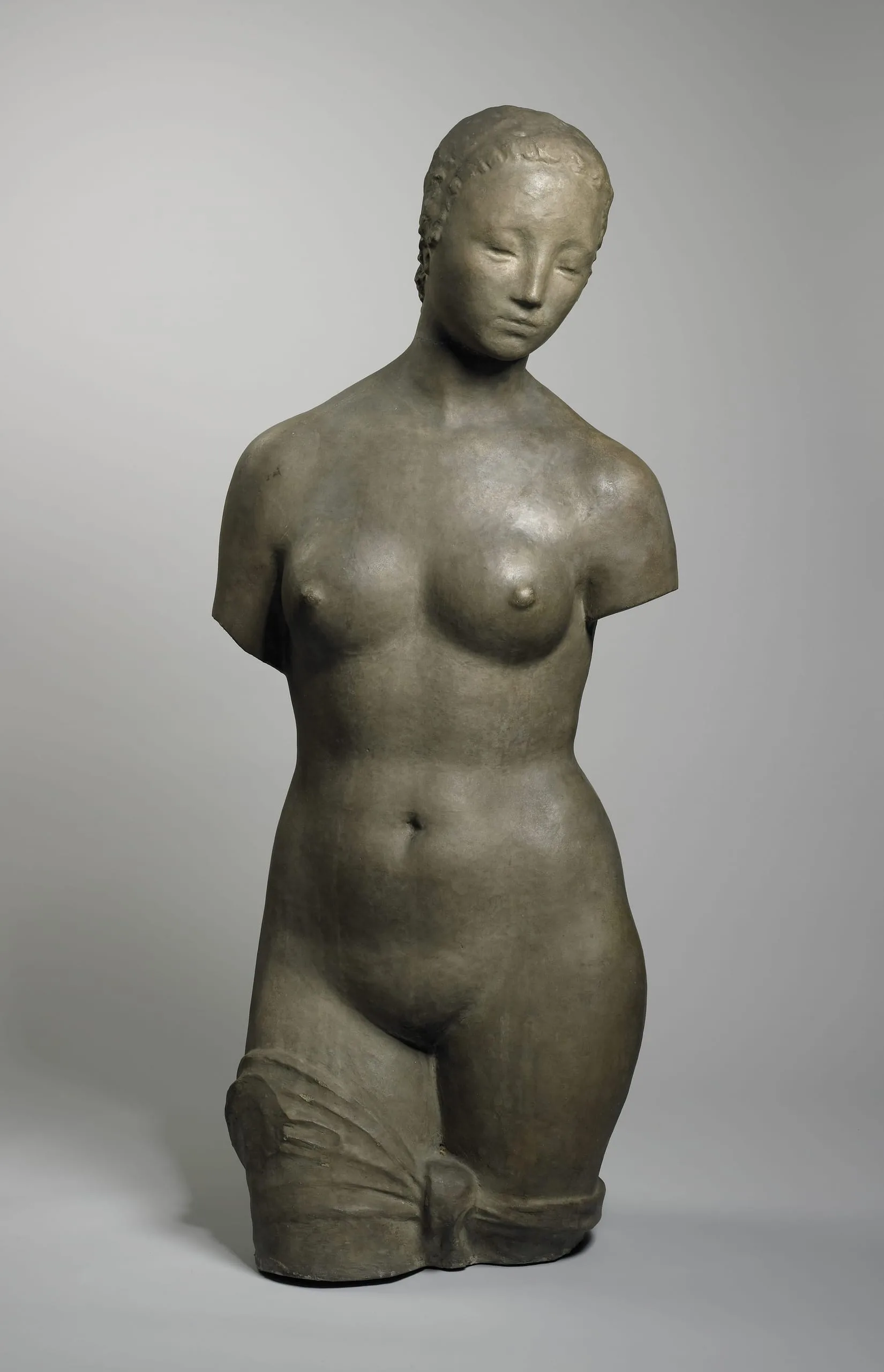
Wilhelm Lehmbruck’s Torso of a Young Woman is a posthumous cast-stone version of Standing Woman (1910), a work first shown in plaster at the Salon d’Automne in Paris in 1910 and later included in the 1913 Armory Show in New York. As in many of Lehmbruck’s sculptures, the model was likely his wife Anita Kaufmann, whose presence lends the figure a quiet intimacy and naturalism. The work belongs to a crucial moment in the artist’s development, produced in the year he moved from Germany to Paris and entered an international avant-garde milieu. It marks a significant shift away from the academic classicism of his early training toward the elongated, emotionally charged figuration that would define his mature style.
Even in this abbreviated form, the sculpture demonstrates Lehmbruck’s distinctive approach to the human body. The softened transitions of surface, the elongated proportions, and the restrained yet expressive modeling give the figure both physical grace and psychological presence. Lehmbruck frequently reworked subjects across multiple versions and materials, and Standing Woman existed in full-length and torso formats, cast in plaster, stone, and bronze. This process of repetition and variation allowed him to refine the expressive possibilities of the form while moving between naturalistic observation and increasing abstraction.
Born into a working-class family in Germany, Lehmbruck pursued art with unusual determination, studying in Düsseldorf before traveling to Florence and then Paris. In Florence, he encountered Michelangelo’s sculpture, whose emotional intensity and monumental treatment of the human body left a lasting impression on his work. In Paris, he entered into dialogue with a wide range of artists and critics, including Aristide Maillol, Henri Matisse, Auguste Rodin, Alexander Archipenko, Constantin Brâncuși, Amedeo Modigliani, and Julius Meier-Graefe. Though aware of many currents in modern sculpture, Lehmbruck maintained a highly individual practice, producing figures that combine formal refinement with a profound sense of inwardness and empathy.
The outbreak of World War I forced Lehmbruck to leave Paris. During the war, he worked in a military hospital, caring for wounded soldiers while continuing to make art. The violence and devastation of those years deeply affected him, and he died by suicide in 1919 at the age of thirty-eight. That biography has often shaped interpretations of his work, but sculptures such as Torso of a Young Woman also make clear the rigor and originality of his artistic project: a modern language of the human figure capable of conveying vulnerability, introspection, and emotional depth.
The sculpture entered LACMA through the generosity of the Henry and Rose Pearlman Foundation. One of six gifts from the descendants of Henry and Rose Pearlman, it continues their long commitment to sharing major works of art with the public.