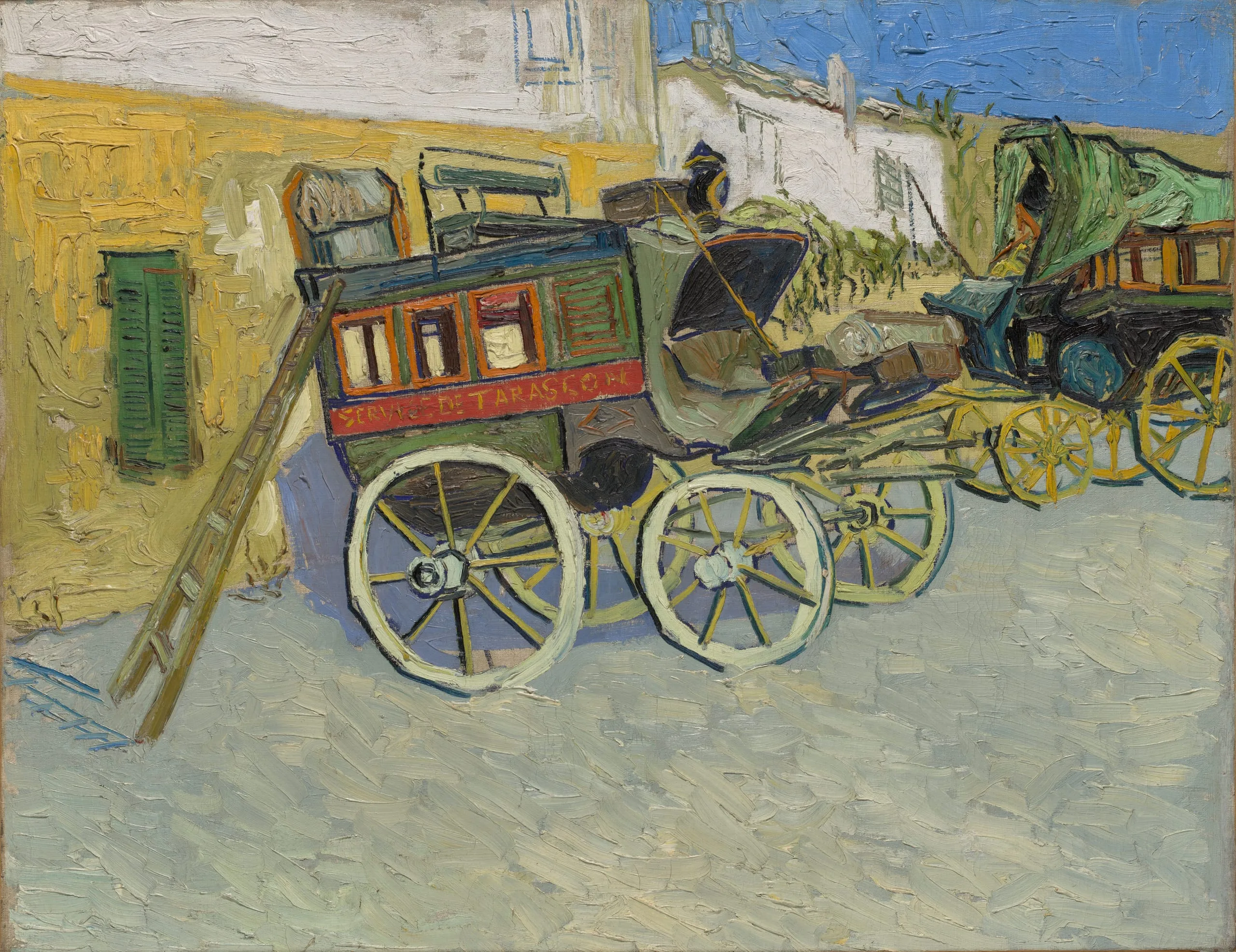
Vincent van Gogh described Tarascon Stagecoach in vivid detail in a letter to his brother Theo dated October 13, 1888: “I’ve just painted that red and green carriage in the yard of the inn. You’ll see. Simple foreground of grey sand. Background very simple too, pink and yellow walls with windows with green louvered shutters, corner of blue sky. The two carriages very colorful green, red, wheels yellow, black, blue, orange. A no. 30 canvas once again.” The letter also included a beautifully illustrated sketch, showing how closely Van Gogh moved between writing, drawing, and painting as he developed his ideas.
The picture was made in Arles, in the south of France, where Van Gogh had moved in February 1888 after leaving Paris in search of a warmer climate and a quieter pace of life. His time in Arles proved brief but extraordinarily productive. Many of his most celebrated works date from this period, including the Sunflowers series and portraits of the Roulin family. It was also during these months that he made both of LACMA’s drawings by the artist, The Langlois Bridge and The Postman Joseph Roulin. As these drawings and letters suggest, Van Gogh was closely observing the world around him while also pushing his painting in new directions, applying pigment more thickly and using color with increasing expressive and symbolic force.
Although Tarascon Stagecoach appears at first to be a straightforward depiction of a coach in an inn yard, it also reflects Van Gogh’s sensitivity to the changing conditions of modern life. By 1888, the stagecoach was already an outdated form of transportation. A decade earlier, rail service between Paris, Lyon, and Marseille had largely supplanted routes such as this one, leaving coaches to connect only smaller towns and villages beyond the rail lines. Van Gogh’s attention to this humble subject suggests a degree of nostalgia for a simpler, receding way of life, even as he rendered it in a strikingly modern language of flattened space and heightened color.
Tarascon Stagecoach is the first painting by the artist to enter the collection, and comes through the generosity of the Henry and Rose Pearlman Foundation. Henry and Rose Pearlman assembled one of the great American collections of Impressionist and modern art, and they were deeply committed to sharing those works with the public. This painting is one of six gifts from their descendants to LACMA, extending that legacy of stewardship and access.