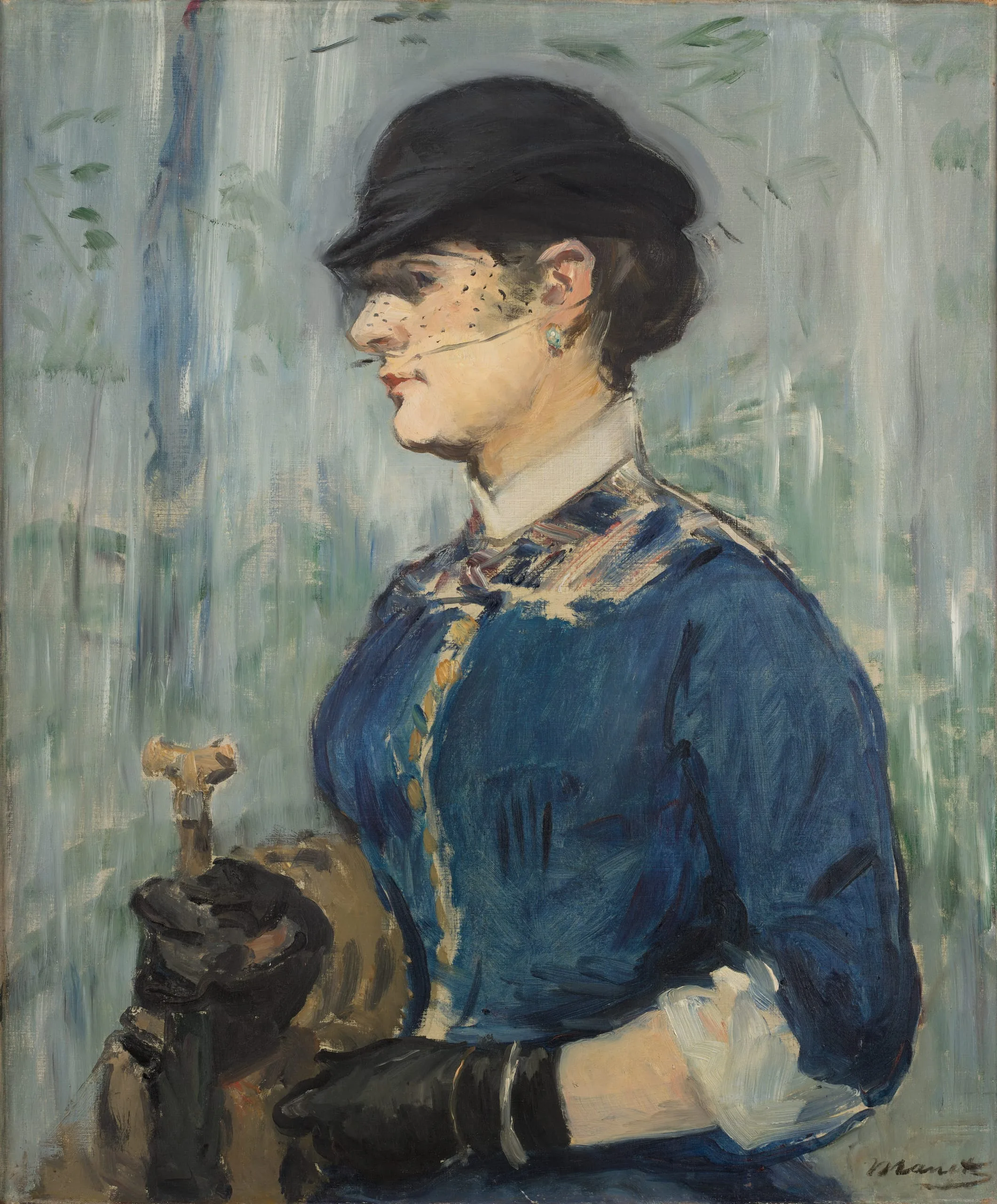
This painting belongs to a group of striking images of women that the Parisian-born Édouard Manet produced during the last years of his life. One of the bolder examples in oil from this late period, it presents an unidentified sitter or model as a vivid study of modern femininity. By the time Manet painted it, the provocative figure paintings that had first made him famous, such as Le Déjeuner sur l’herbe (1862–63; Musée d’Orsay) and Olympia (1863; Musée d’Orsay), were already more than a decade behind him. Yet even after pushing against artistic convention so forcefully, he continued to seek recognition from the official Paris Salon and the Academy of Fine Arts. He never joined the Impressionist exhibitions, despite his close ties to many of those artists and his shared interest in the representation of contemporary life.
Manet remained deeply engaged with the world around him, especially with the people, fashions, and urban experiences of modern Paris. Here, he depicts a woman dressed for the outdoors in a deep blue garment with black gloves, an umbrella, a black hat with a veil, and perhaps a muff over her arm. Her appearance conveys the elegance of bourgeois fashion, but the painting also points to the expectations placed on women within that world. Manet’s quick brushwork and sketchlike handling give the figure a sense of immediacy and liveliness, even as her pose remains composed and still. The result resembles a kind of fashion plate, recalling the illustrated journals and printed images that circulated widely in the late nineteenth century and helped define modern style.
The painting also belongs to a larger cultural conversation about modernity. Charles Baudelaire, Manet’s friend and one of the defining writers of the period, argued that modern life could not be separated from dress, adornment, and the fleeting impressions of urban experience. In that sense, this work can be understood as a particularly acute “painting of modern life,” one in which fashion is not merely decorative but central to the picture’s meaning. Costume, pose, and atmosphere all contribute to an image of femininity shaped by the visual culture of the modern city.
This is the first oil painting by the artist to enter the collection, and comes through the generosity of the Henry and Rose Pearlman Foundation. Henry and Rose Pearlman assembled one of the great American collections of Impressionist and modern art, and they were deeply committed to sharing those works with the public. This painting is one of six gifts from their descendants to LACMA, extending that legacy of stewardship and access.