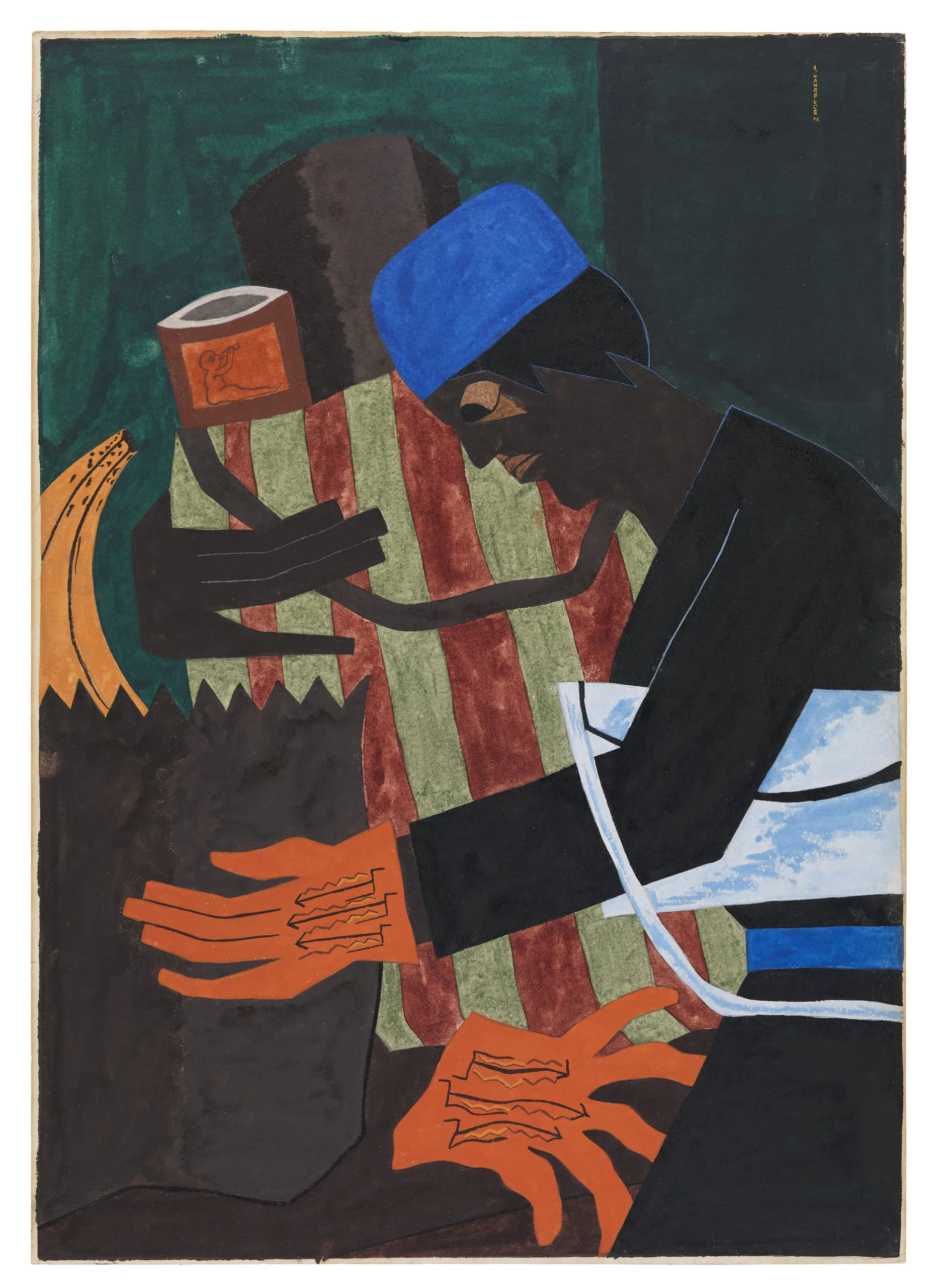
In a century that equated the evolution of modern art with the will toward abstraction, Lawrence navigated a space between abstract and figuration, using aesthetic values for social ends. Lawrence demonstrated a passionate interest in African American history and in his people's collective struggle for racial equality. Using bright primary colors and flat, cut-out shapes in a narrative representational style, Lawrence drew his subjects from the streets and interiors of Harlem and from his research into important subjects in African American history.
His series devoted to the lives of Toussaint l’Ouverture (1938), Frederick Douglass (1939), and Harriet Tubman (1940) preceded his best known series, “The Great Migration” (1941), sixty small tempera paintings with captions on the subject of the mass migration of Black Americans from the rural South to the urban North that began during World War I.
Although Lawrence believed that you cannot “tell a story in a single painting,” he occasionally worked outside the series structure. Woman with Groceries is a magnified close-up of large cubic forms, painted in bold, dynamic colors. The oversized hands that dominate the composition can be seen as symbols of labor, tenacity, and strength. While the work might initially appear abstract, the forms soon become recognizable: the red and white striped bag dominates the center, and the bright yellow banana counters the red glove, white purse, blue belt, and hat. The figure seems arrested in motion, accented by the elegant blue outlines. Lawrence’s characterization of women stems from his observation of the perseverance of the courageous women in the Harlem community, often poor, hard-working mothers raising their families.