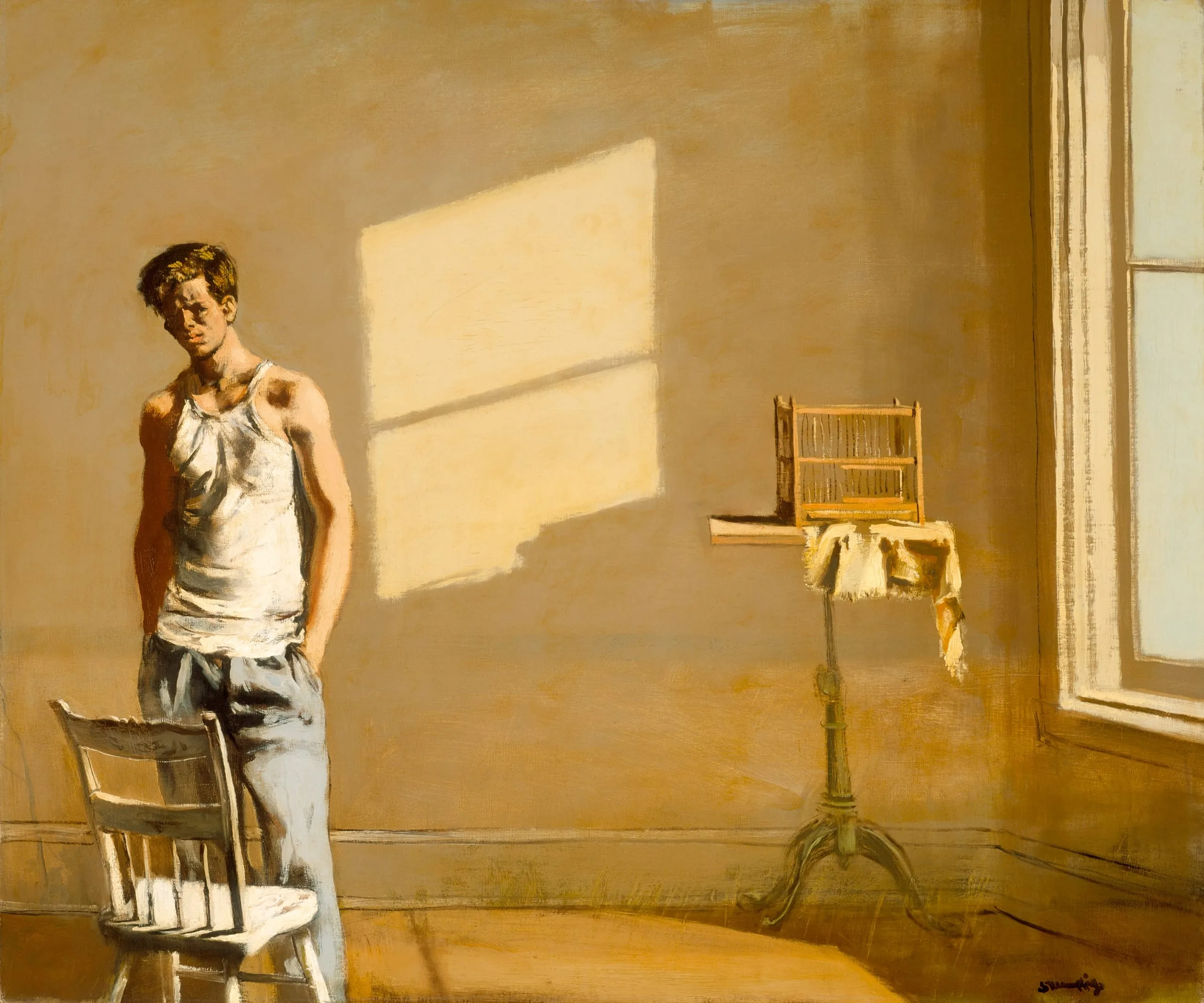
Although figures in landscapes are more common in Stuempfig’s work than figures in interiors, this painting’s imagery of loneliness and enigmatic suspense are central to his art.
Stuempfig’s themes and many of his formal devices are derived from surrealism and particularly from the variation of that movement most widely joined in the United Sates, magic realism. Like the work of this period by ANDREW WYETH, an artist living nearby in the Philadelphia area, Stuempfig’s paintings appear to be realistic but depict the world of dreams and fantasy. The objective of both painters was to evoke in the viewer a certain mood from that realm. Stuempfig freely manipulated formal devices to undercut the seeming realism of his paintings, subtly suggesting a haunting strangeness. Strong frameworks of verticals and horizontals make the space in his paintings seem clear and organized, but large, central, empty spaces and conspicuously large separations between presumably related elements give the space a dreamlike quality. Strong effects of light and shadow, often from a raking light, enhance the impression of realism by bringing out the texture of surfaces, but the overly strong contrast of light and shadow in the modeling of the figures, recalling the early baroque period, injects a note of drama and menace.
In this painting the extreme contrast in the modeling of the figure is particularly puzzling because the direct light from the window is shown to be striking the wall. A further quality of disquietude and unreality comes from the difficulty the viewer experiences in seeking to identify the subject of Stuempfig’s paintings. Almost always there are figures, typically tough, adolescent males, who stand about idly, lost in their own troubling thoughts, without a relationship of position or action to any other figure or object in the painting. In the museum’s painting this sense of thematic ambiguity is heightened by the familiar surrealist device of the juxtaposition of two conceivably related objects. The viewer must wonder about the relationship between the youth and the empty birdcage resting on an upturned music stand in this painting just as one wonders about the relationship between the similarly posed young man and the isolated houses in Stuempfig’s painting, Two Houses, c. 1940s (Corcoran Gallery of Art, Washington, D.C.). The stiles of the antique chair, behind which the boy stands, establish a visual metaphor for the bars of the birdcage, perhaps hinting at the youth’s spiritual captivity.
The settings of most of Stuempfig’s paintings are entirely imaginary or greatly transformed, but the titles of a certain number of them acknowledge that he has painted his studio, as he may have done in the present case. The same chair and a similarly spare interior are seen in his painting Solitary Figure, 1948 (Fine Arts Museums of San Francisco). The same model may be portrayed in Stuempfig’s painting Portrait of Charles, 1949 (art market, 1974).