LACMA

ShopMembershipMyLACMATickets
LACMA
Los Angeles County Museum of Art
5905 Wilshire Blvd.
Los Angeles, CA 90036
info@lacma.org
(323) 857-6000
Sign up to receive emails
Subscribe
© Museum Associates 2026
  • About LACMA
  • Jobs
  • Building LACMA
  • Host An Event
  • Unframed
  • Press
  • FAQs
  • Log in to MyLACMA
  • Privacy Policy
© Museum Associates 2026
Collections

Unidentified artist
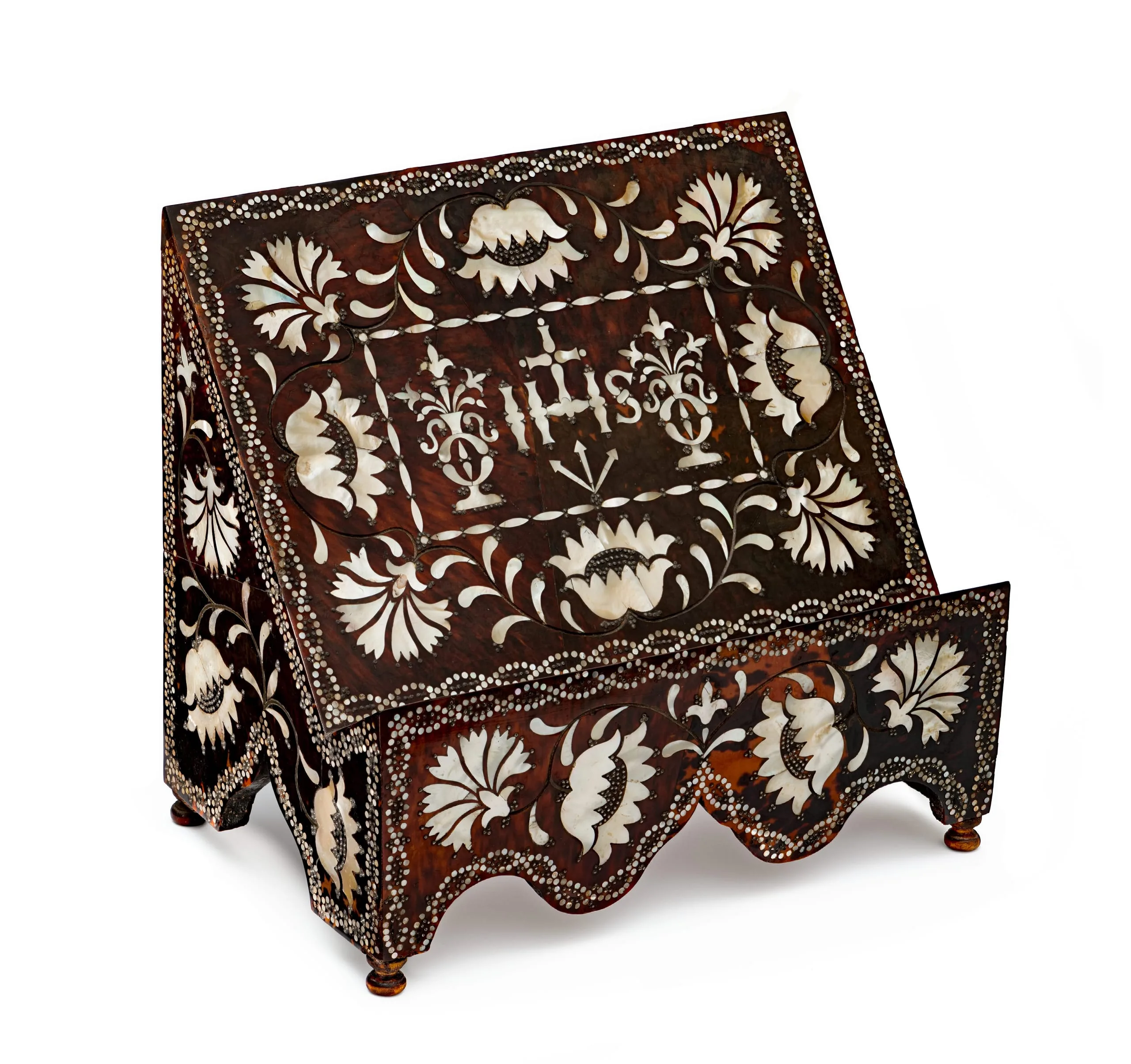
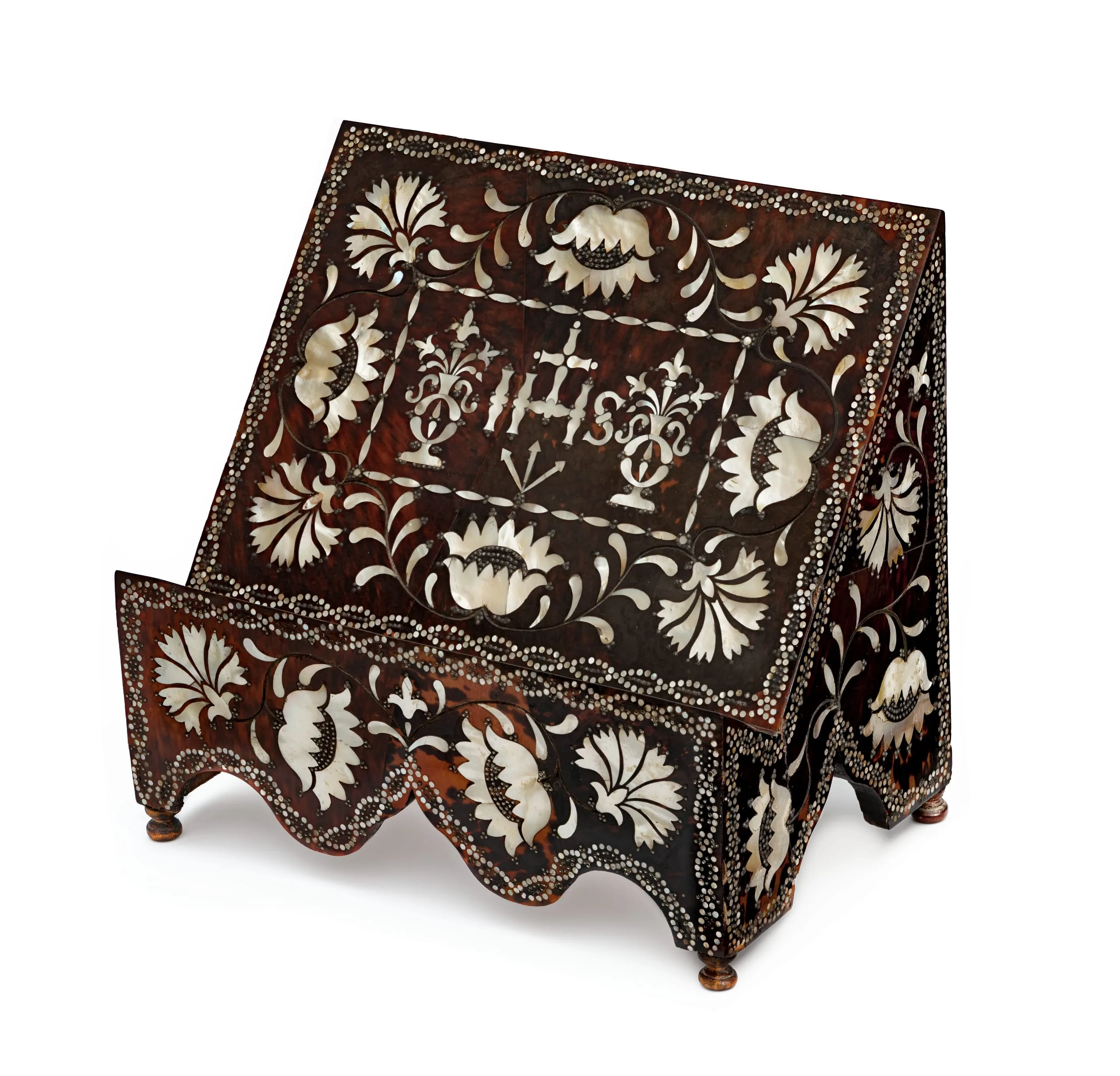
Missal Stand (Atril)18th century

Not on view
Book stand with tent-shaped profile, dark reddish-brown ground densely inlaid with mother-of-pearl floral motifs, central Christogram cartouche, and scalloped front apron
Tortoiseshell and mother-of-pearl inlaid lectern or book stand with scalloped base and small bun feet, densely decorated with floral and foliate motifs; central panel features the IHS monogram flanked by symmetrical botanical designs, all bordered by dot-inlaid edges.
Artist or Maker
Unidentified artist
Title
Missal Stand (Atril)
Place Made
Guatemala (for export market, possibly Peru)
Date Made
18th century
Medium
Wood, inlaid with tortoiseshell and mother-of-pearl, brass, and silver
Dimensions
13 1/4 × 14 1/2 × 9 1/4 in. (33.7 × 36.8 × 23.5 cm)
Credit Line
Purchased with funds provided by the Bernard and Edith Lewin Collection of Mexican Art Deaccession Fund
Accession Number
M.2019.264.3
Classification
Furnishings
Collecting Area
Latin American Art
Curatorial Notes

Missal stands were ubiquitous in churches and domestic altars to support the sacred books from which the priest read during Mass. Here, the central panel is decorated with the Jesuit monogram IHS, symbolizing Christ. The work was meticulously conceived to highlight the beauty of the contrasting materials and the blossoming vines with their bold flowers, including carnations and tulips.

Because of their materials and their designs that vaguely resemble Asian decorative arts, these works have been difficult to categorize. Scholars have suggested that they were imported aboard the famous Spanish trading ships—known as the Manila Galleons—that traveled annually between the Philippines and Mexico. But archival and material documentation suggests that such works originated in Guatemala, where mother-of-pearl and tortoiseshell were harvested locally and considered prized commodities. Many items made of these materials were exported to Mexico and Peru. The designs draw on a range of European and Asian sources, which local artists creatively reinterpreted.

Ilona Katzew

2024

Provenance
Carlos Washington Aliseris (1898–1974), Montevideo, Uruguay, first half of the 20th century; by inheritance to his daughter Raquel Aliseris Bernadá, Montevideo, 1974; by inheritance to her son Ignacio Labaure Aliseris, Montevideo, 1986; Jaime Eguiguren Art & Antiques, Buenos Aires, 2019; LACMA, 2019.
Selected Bibliography
  • Katzew, Ilona, ed. Archive of the World: Art and Imagination in Spanish America, 1500–1800: Highlights from LACMA’s Collection. Exh. Cat. Los Angeles: Los Angeles County Museum of Art; New York: DelMonico Books/D.A.P., 2022.
Selected Exhibition History
  • Archive of the World: Art and Imagination in Spanish America, 1500–1800. June 12, 2022 - October 30, 2022
  • Archive of the World: Art and Imagination in Spanish America, 1500–1800. October 20, 2023 - January 28, 2024
  • Archive of the World: Art and Imagination in Spanish America, 1500–1800. June 22, 2024 - September 08, 2024

Related Exhibitions