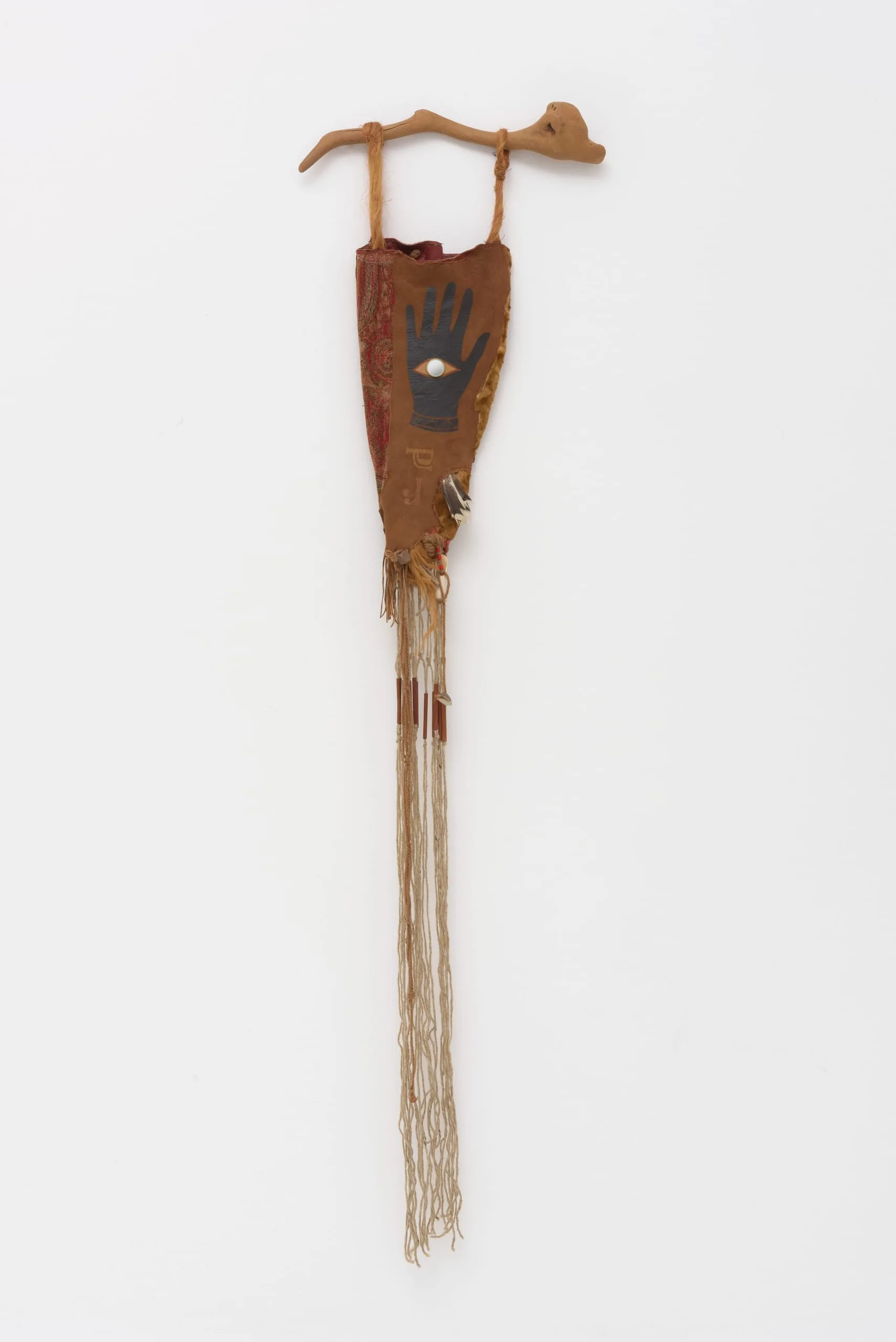
Mojo Bag #1 Hand is one of a number of works Betye Saar made in the early 1970s using a group of cowhides given to her by Alonzo Davis, co-founder of the Brockman Gallery in Los Angeles (which supported Black artists including Saar, Charles White, David Hammons, Maren Hassinger, John Outterbridge, Noah Purifoy, and Senga Nengudi). The piece reflects the influence of Saar’s visit in 1964, with her friend and fellow artist Hammons, to the Field Museum in Chicago. As the artist has described it, “Before [that visit], I was using symbols that were more Eurocentric. But when I went to the Field Museum, in the basement they had all this work from Africa, Oceania, and even China and Japan—everything that wasn’t European, which was displayed nicely upstairs. All this other strange stuff was in the basement…this weird, fetish, magic stuff. They were organic materials—leather, hair, shells, bones. So when I came back to Los Angeles, I started collecting this. When Alonzo gave me those animal hides, I just got into it.”
Mojo Bag #1 Hand is informed in part by Native American leather pouches, normally sewn by women. Traditional medicine pouches, typically made with soft hides and often decorated (as is Saar’s bag) with fringes, beads, feathers, and other materials, might include a small inner pouch designed to hold something sacred. Mojo Bag #1 Hand similarly has a small inner pouch with a bone. Rather than the traditional leather fringes, Saar's bag has macrame fringes, one of a number of techniques—including quilting, sewing, embroidery, and knitting—that numerous women artists used in the 1970s to open up conversations about the value of "women's work" and to critique modernist hierarchies of "art" vs. "craft." The hand/eye imagery on the front of Mojo Bag #1 Hand refers to the hamsa, a palm shaped amulet popular throughout the Middle East and North Africa. Hamsas show the palm of the hand, often containing an eye symbol, and are considered a defense against the evil eye. Both the hand (typically a silhouette of the artist’s own hand) and the eye are recurring motifs in Saar's work.