LACMA

ShopMembershipMyLACMATickets
LACMA
Los Angeles County Museum of Art
5905 Wilshire Blvd.
Los Angeles, CA 90036
info@lacma.org
(323) 857-6000
Sign up to receive emails
Subscribe
© Museum Associates 2025

Museum Hours

Monday

11 am–6 pm

Tuesday

11 am–6 pm

Wednesday

Closed

Thursday

11 am–6 pm

Friday

11 am–8 pm

Saturday

10 am–7 pm

Sunday

10 am–7 pm


  • About LACMA
  • Jobs
  • Building LACMA
  • Host An Event
  • Unframed
  • Press
  • FAQs
  • Log in to MyLACMA
  • Privacy Policy
© Museum Associates 2025
Collections

Wassily Kandinsky
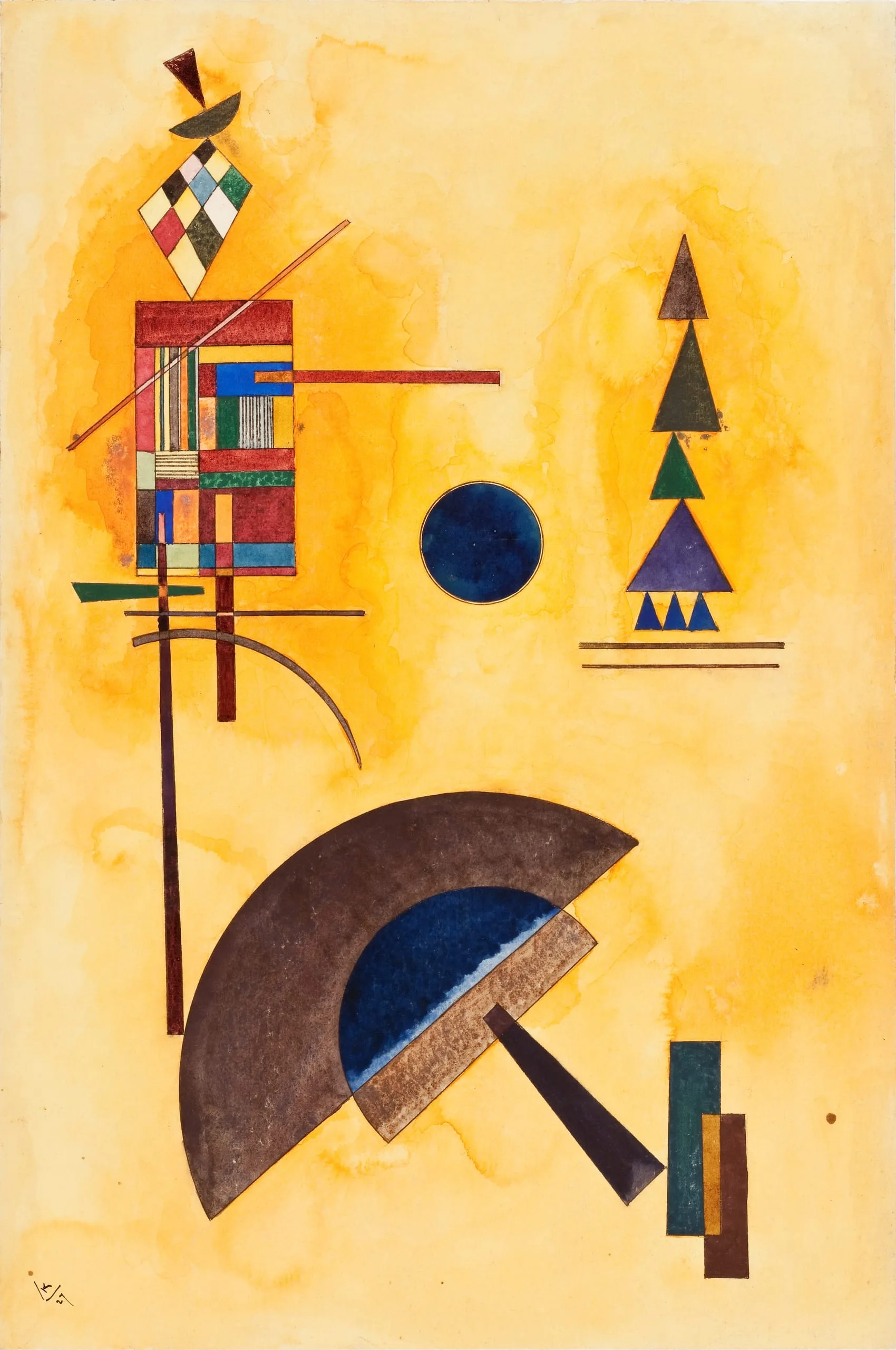
Semicircle1927

Not on view
Vertical abstract watercolor and gouache painting with geometric shapes — towers, triangles, circles, and arcs — arranged on a warm amber-yellow wash background
Artist or Maker
Wassily Kandinsky
Russia, also active Germany and France, 1866–1944
Title
Semicircle
Place Made
Russia
Date Made
1927
Medium
Watercolor and india ink on paper
Dimensions
Sheet: 19 1/8 × 12 5/8 in. (48.58 × 32.07 cm) Image: 19 1/8 × 12 5/8 in. (48.58 × 32.07 cm) Frame: 27 × 20 3/4 × 1 1/8 in. (68.58 × 52.71 × 2.86 cm)
Credit Line
Estate of David E. Bright
Accession Number
M.67.25.7
Classification
Drawings
Collecting Area
Prints and Drawings
Curatorial Notes
During the 1920s, Vasily Kandinsky was one of the most influential instructors at the Bauhaus, the experimental art school founded at Weimar, then later reestablished at Dessau. Previously in his native Russia during and after World War I, while under the influence of Constructivists Kasimir Malevich and Vladimir Tatlin, the artist began to move away from the freewheeling and organic abstraction of the prewar years toward a purer geometric language. Kandinsky produced Semicircle during his Bauhaus period, when his predilection for geometric forms had fully asserted itself.
The circles, semicircles, triangles, rectangles, checkerboards, and squares that populate Semicircle are all arranged according to strict color and compositional harmonies carefully worked out by the artist. Floating in a sea of liquid orange, his forms defy the traditional relationship in painting between figure and ground. For Kandinsky, the circle had symbolic and cosmic meaning: The circle is the synthesis of the greatest oppositions, he wrote in 1929. "I love the circle today as I formerly loved the horse." Significantly, Kandinsky's drawings, which were often preliminary studies for paintings, achieved an independent status during this period, perhaps to a greater degree than before or after.
Selected Bibliography
  • Cooke, Lynne, editor. Woven Histories: Textiles and Modern Abstraction. Washington: National Gallery of Art, 2023.