- Title
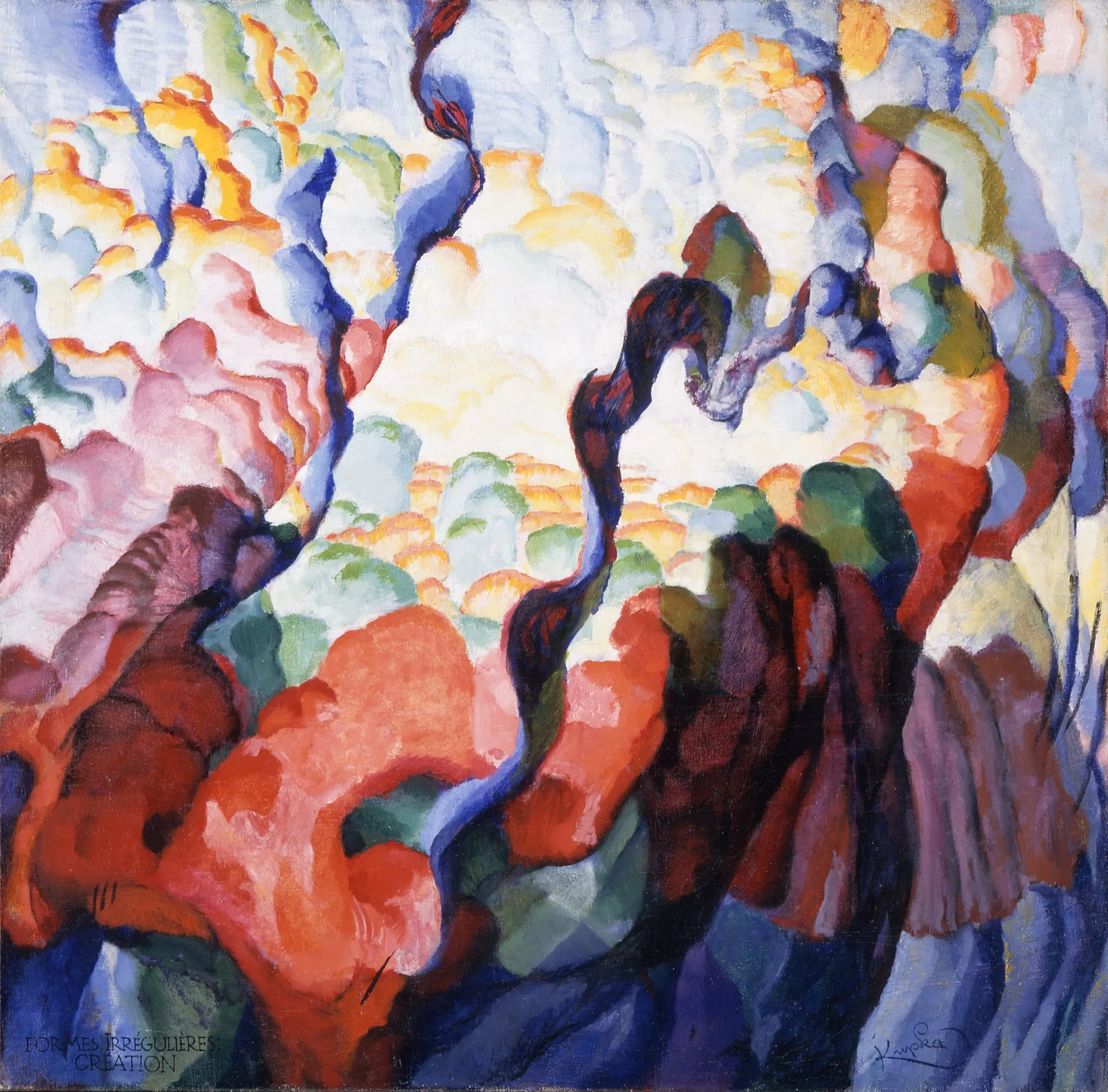
- Irregular Forms: Creation
- Date Made
- 1911
- Medium
- Oil on canvas
- Dimensions
- 45 1/8 × 45 3/4 × 2 3/4 in. (114.62 × 116.21 × 6.99 cm)
- Accession Number
- M.67.25.10
- Curatorial Notes
There is no recognizable subject matter in Irregular Forms: Creation; instead, the work features color gradients in a colorful palette, which mushroom in rounded, cloud-like formations or soar sinuously like smoke. The diagonal pull of the latter, combined with the concentration of lighter colors in the middle ground, translates to an abstracted sense of depth—what can be read as an ersatz horizon line.
The title and content of the work reflect Kupka’s theosophist inclinations—he was an avid reader of Helena P. Blavatsky and Rudolf Steiner—and may be related to his own soon-to-be published theory of art, Creation in the Plastic Arts, 1913. This was the culmination of Kupka’s studies of color theory, which was an increasingly significant preoccupation among the European avant-garde from Wassily Kandinsky to Piet Mondrian. Scientific developments such as the discovery of X-rays and recent theories around ether had proved the presence of a world beyond the visible for those with occultist leanings, and Kupka, like many other artists, vigorously sought this “beyond” in his own work. In an unpublished journal from 1910-1911, the artist wrote, “I used to strive to give form to an idea; now, it’s the idea of form I am striving towards.”
- Provenance
The artist (1871-1957); by inheritance to his wife Mme. Eugénie Kupka (1899–1981), Paris; [sold to Richard Feigen Gallery, Chicago]; sold to David E. Bright (1908–1965), Los Angeles; bequeathed in 1967 to LACMA.
- Selected Bibliography
- Powell III, Earl A., Robert Winter, and Stephanie Barron. The Robert O. Anderson Building. Los Angeles: Los Angeles County Museum of Art, 1986.
- Copyright
- © Artists Rights Society (ARS), New York / ADAGP, Paris