June Harwood was among a small group of loosely affiliated artists working in Los Angeles in the late 1950s and 1960s—often called the Abstract Classicists—who created hard-edge abstractions. Harwood has ascribed her interest in crisp geometric forms to her own personal logic: “In nature most shapes can be reduced to geometric forms. It seemed to me to be a logical approach to use geometric forms as a basis for painting.” Born in upstate New York, Harwood studied art at Syracuse University, where her teachers emphasized what she has called “formal, classical, structural composition…ordered composition. Cézanne and the Cubists were the hallmark of civilized painting.” After receiving her BFA, and seeking adventure, she moved to Southern California, where she later described the art scene of the mid-1950s as “about eight galleries in L.A. and not many showing women.” She became friendly with Lorser Feitelson and Helen Lundeberg, who were painting hard-edge compositions in those years. Feitelson became an avid supporter of Harwood’s, introducing her to Jules Langsner, one of Los Angeles’s most important writer-critics and art historians of the period as well as the champion of Abstract Classicism, who later became Harwood’s husband.
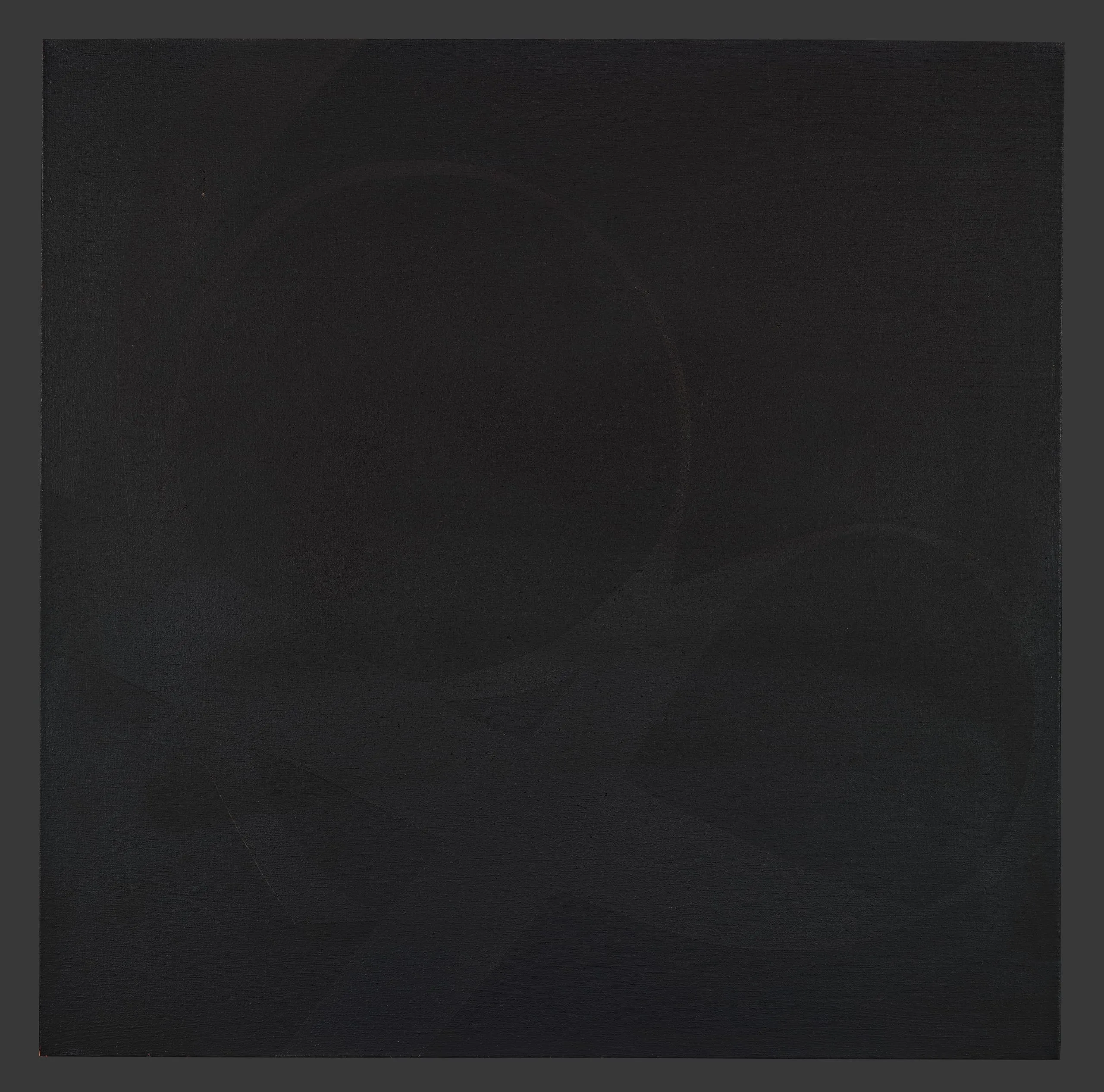
By 1960, Harwood’s vocabulary had become completely abstract. D1, from her Ephemeral Image Series, reflects the artist’s statement that as “light changes, the image appears or disappears—now you see it, now you don’t. This fascinates me.” The monochromatic canvases in this series not only hark back to Russian avant-garde painter Kazimir Malevich’s famous Composition: White on White of 1918 but also are in dialogue with contemporaneous 1960s monochrome works by John McCracken, Ad Reinhardt, Robert Ryman, and others. Harwood did not restrict her work to precise geometric forms. As critic Christopher Knight has described, she believed that “like jazz, the painting gives a platform to improvisation within an aggregate of formal rules.”
Harwood was consistently interested in the actual making of paintings. She often used tape in painting forms, and strove for impeccable, flat surfaces without any evident brushstrokes so that, in her words, “there would be no distraction from the intent, which was to create an interplay of ‘colorforms.’…Color and form are one. One would not exist without the other. These flat, abutting forms could be read as both positive and negative shapes.” It is worth noting that acrylic paint was a new artistic medium in the 1960s, originally developed as a house paint. The fact that it dried faster than oil paint and required only water to thin it and to clean brushes made acrylic attractive to Harwood.