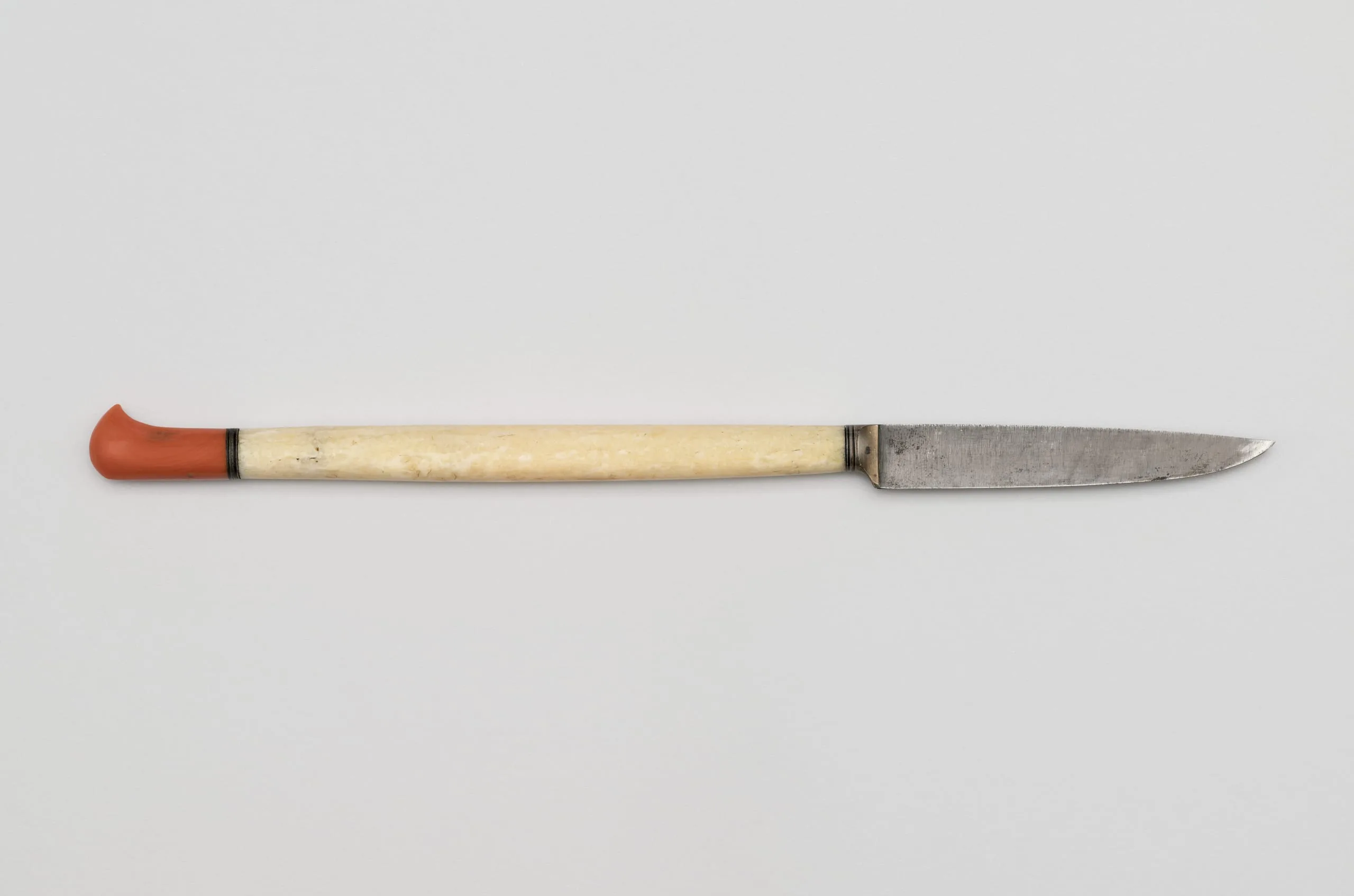
Revered as the visual embodiment of divine revelation, calligraphy was the most distinguished art form with a unifying aesthetic across the Islamic world. Therefore, despite the rise of print technology, calligraphy remained central as a form of Islamic artistic expression through the end of the Ottoman dynasty in 1922. While the reed pen, or qalam, is honored in the Qur’an (Sura Al-Qalam), the quality of the penknife is also crucial in calligraphy, as good writing depends on a good pen, and a good pen relies on a sharp penknife. Master calligrapher Yaqut al-Musta‘simi (d. 1298) credited his students’ excellence to the sharpness of their penknives. Most calligraphers used two: one for refining the tip and another for cutting the nib. Penknives were also used for scraping mistakes from the page, though calligraphers advised against relying on such corrections, instead emphasizing precision and discipline in their craft.
This nineteenth-century Ottoman penknife features a slender, elongated form with a sharp steel blade, ideal for precisely cutting and shaping the qalam. The handle, crafted from bone, provides a smooth grip, ensuring control and stability. The curved red tip made of coral adds a distinctive aesthetic touch, highlighting the knife’s refined craftsmanship and reflecting both functionality and elegance, essential for the art of calligraphy.
2025