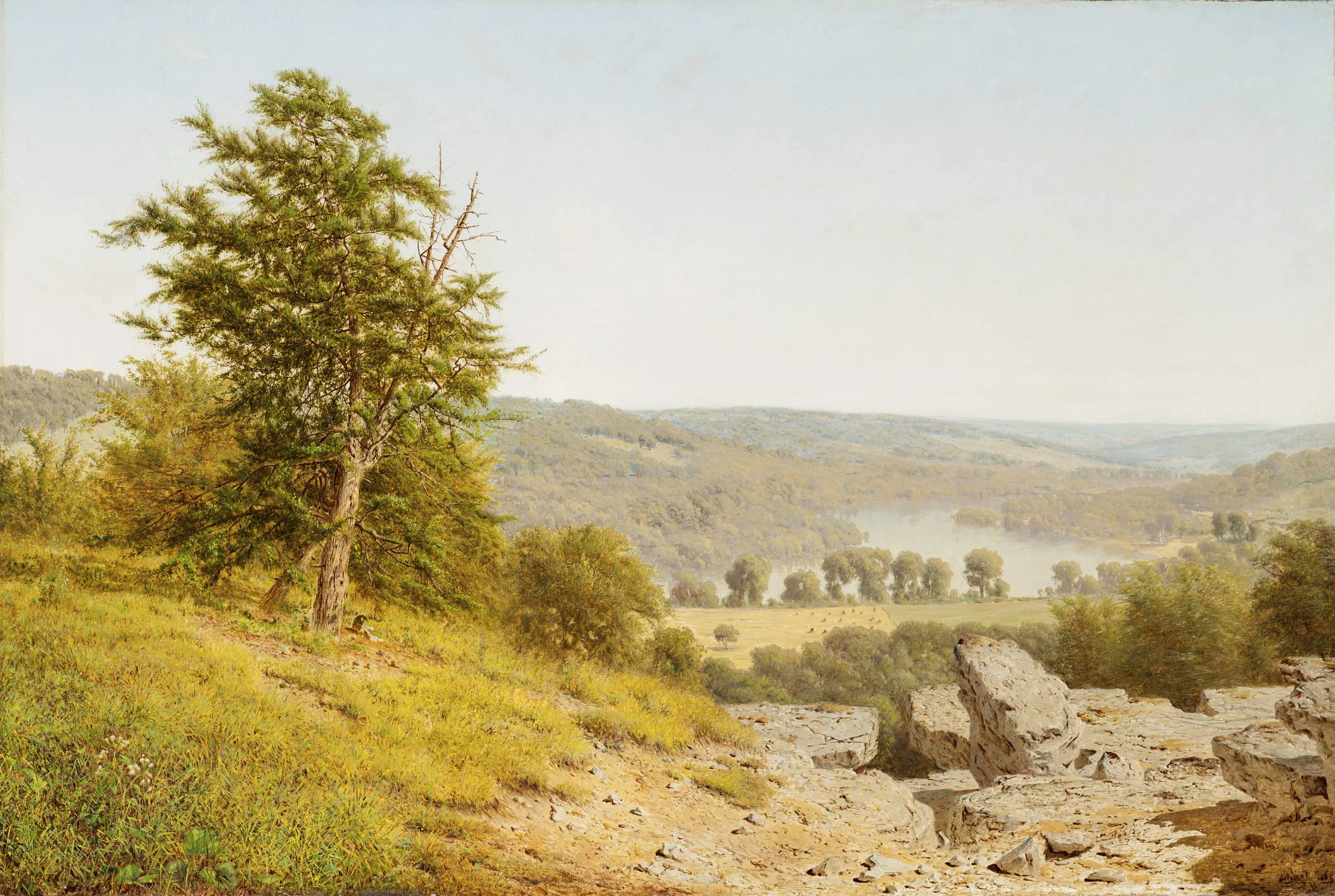
When this landscape surfaced in the 1940s it bore the title The Mohawk Valley because it resembled a landscape by that name in the Metropolitan Museum of Art, New York. Newly found documentary evidence has led to the identification of the Metropolitan Museum’s landscape as a painting titled Tennessee. Although contemporary references do not mention that Wyant was active in Tennessee, he may have visited the state when he was sketching in neighboring Kentucky during the late 1850s and early 1860s. In 1865 the artist traveled to Düsseldorf, and it was there in 1866 that he painted the Metropolitan’s painting.
The Los Angeles Museum’s Landscape resembles the Metropolitan Museum’s Tennessee in Wyant’s general approach to the mountainous landscape: taking an elevated perspective, the artist presented a broad view, delineating the meanderings of a river in the middle distance and placing to one side a single, tall tree that provides a point of entry for the viewer. Both paintings have a similar rocky ledge in the foreground on which the artist stood to view the scene, although in Tennessee the ledge is actually the escarpment of a river. Despite the similarities-many of which may have derived from traditional studio landscape devices there are enough differences to question whether the Los Angeles Museum’s painting is of the same scene of the Grand Canyon of Tennessee in the Cumberland Mountains that has been identified as the site depicted in the Metropolitan Museum’s painting. The distant mountains in Landscape do not have the same configuration as the mountains in Tennessee, in which the gorge between Signal and Lookout Mountains formed by the Tennessee River is delineated.
Although the date and size of Landscape suggest that Wyant may have intended it to be a study for Tennessee, there is no conclusive documentary evidence to prove such a link between the two paintings. Moreover, Landscape appears to be more complete in execution than a study might be.
Landscape is a highly finished, tightly painted work in which a brilliantly clear atmosphere and bright colors dominate. From its earliest days, Tennessee was criticized for its subdued colors and its style linked with the Düsseldorf school. Landscape, however, demonstrates that the crisp, linear quality of the Metropolitan Museum’s painting of 1866 may not have been due solely to the influence of German art. In the Los Angeles painting of the preceding year, Wyant was meticulous in his delineation of the blades of grass and occasional flower. He even conveyed the striations of the foreground rock formations. Such an exacting representation was extolled by John Ruskin and enthusiastically followed by the English critic’s American disciples in the late 1850s and early 1860s.
While Düsseldorf-trained artists shared with Ruskin’s followers an interest in a heightened technical realism, they did not use a similar palette. English Pre-Raphaelite painters, whom Ruskin held up as exemplifying the best in art, were noted for their brilliant hues. The Düsseldorf painters were usually criticized for their cold, colorless palette. The museum’s Landscape not only has a more varied and brighter palette than the somber browns and greens of the Metropolitan painting, more importantly it has the unique lavender-green combination found only in those mid-century American landscape paintings inspired by the English Pre-Raphaelites. Wyant briefly visited New York in 1857, the year of the first major showing of Pre-Raphaelite art in the United States, but it is more likely that he first came into contact with their art after his move to New York in 1863. Although it is not known exactly when in 1865 Wyant painted Landscape, most likely it was executed before his trip to Germany.
Due to the lack of early, dated Wyant landscapes, it is difficult to characterize the artist’s development before his European studies. If the museum’s Landscape is typical of the artist’s style immediately prior to his European travels, then the differences between the 1865 landscape and the larger 1866 painting demonstrate the alteration in Wyant’s approach that occurred as a result of his studies with Gude. The transformation of Wyant’s palette was not the only change. In the museum’s Landscape Wyant depicted a more natural, almost "accidental" view, the type that Ruskin extolled, but in Tennessee he adopted a traditional academic approach to landscape painting and presented a grand vista centered around a waterfall in the foreground. The other major difference between the two paintings is the overall mood the artist established through the meteorological conditions depicted. The sky in Landscape is clear and calm while that in Tennessee is stormy and overcast. Wyant’s emphasis on clarity and factual detail in the 1865 painting suggests an emphasis on accurate transcription, and his veiling of Tennessee in clouds and shadows reveals that subsequently, in Germany, he adopted the highly romantic approach of the Düsseldorf school.


![Artists Represent Themselves: Widline Cadet on “Seremoni Disparisyon #1 (Ritual [Dis]Appearance #1)”](/_next/image?url=https%3A%2F%2Funframed.lacma.org%2Fsites%2Fdefault%2Ffiles%2Fstyles%2Farticle_full%2Fpublic%2Ffield%2Fimage%2FM2023_47_1-20221007-Access.jpg%3Fitok%3DDEdu6xhk&w=828&q=75)
