LACMA

ShopMembershipMyLACMATickets
LACMA
Los Angeles County Museum of Art
5905 Wilshire Blvd.
Los Angeles, CA 90036
info@lacma.org
(323) 857-6000
Sign up to receive emails
Subscribe
© Museum Associates 2025

Museum Hours

Monday

11 am–6 pm

Tuesday

11 am–6 pm

Wednesday

Closed

Thursday

11 am–6 pm

Friday

11 am–8 pm

Saturday

10 am–7 pm

Sunday

10 am–7 pm


  • About LACMA
  • Jobs
  • Building LACMA
  • Host An Event
  • Unframed
  • Press
  • FAQs
  • Log in to MyLACMA
  • Privacy Policy
© Museum Associates 2025
Collections

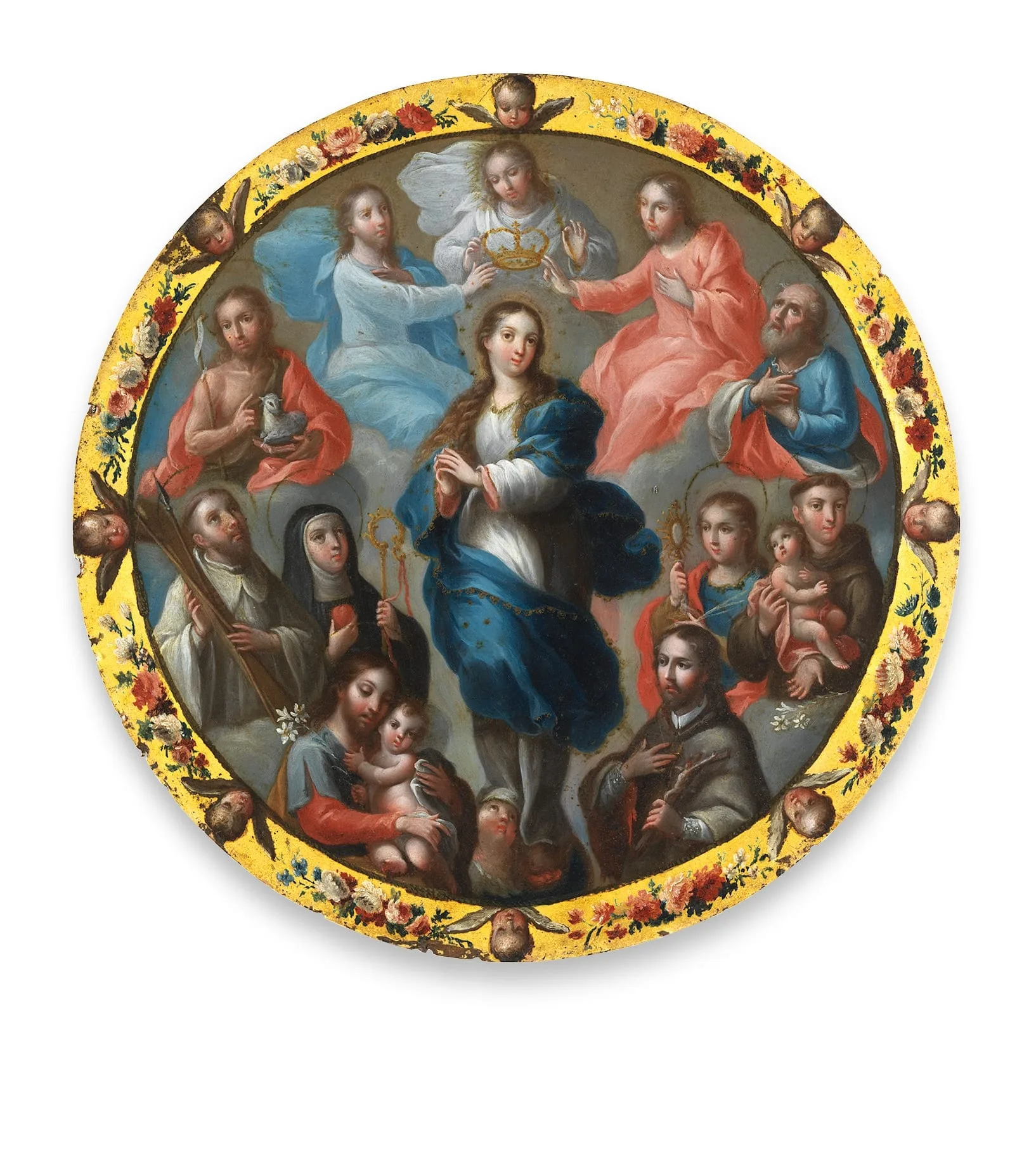
Attributed to José de Páez
Nun’s Badge with the Immaculate Conception and Saints (Medallón de monja con la Inmaculada Concepción y santos)circa 1770
Not on view
Circular oil painting with floral painted frame, central haloed female figure in blue mantle crowned by two figures above, surrounded by saints and cherubs
Artist or Maker
Attributed to José de Páez
Mexico, 1721–circa 1790
Title
Nun’s Badge with the Immaculate Conception and Saints (Medallón de monja con la Inmaculada Concepción y santos)
Date Made
circa 1770
Medium
Oil on copper
Dimensions
Diameter: 7 in. (17.8 cm)
Credit Line
Purchased with funds provided by the Bernard and Edith Lewin Collection of Mexican Art Deaccession Fund
Accession Number
M.2018.177.3
Classification
Paintings
Collecting Area
Latin American Art
Curatorial Notes

In Mexico, badges were a central ornament of a nun’s habit, especially on her day of profession. The most common themes are the Immaculate Conception and the Annunciation; the perimeter is typically crowded with a choir of saints, which includes the most important devotions for the order and cults of particular interest to the owner. Worn close to the body, badges often carried political messages and were painted by the best artists of the day.

José de Páez, favored by several convents, seems to have made a specialty of the genre. He created numerous badges with a near identical figure of the Immaculate Conception crowned by the Trinity and surrounded by saints. A number of them also include an elaborate decorative border of flowers and winged cherub heads. The inclusion of Saint John of Nepomuk on the lower right is a significant detail. The fourteenth-century saint from Prague was known for safeguarding the seal of confession and was especially promoted by the Jesuits. Leading up to and following the dramatic expulsion of the order from New Spain in 1767 by Charles III, images of the saint proliferated among Jesuit sympathizers as a form of protest. His inclusion in several contemporary badges may signal the nuns’ tacit support of their confessors and the Society of Jesus.


From exhibition Archive of the World, 2022 (for more information see the catalogue entry by Ilona Katzew in the accompanying publication, cat. no. 22, pp. 118–24)

Provenance
Private collection, New York; David Smernoff Fine Art, New Haven, Connecticut, 2010s; Osuna Art & Antiques Ltd. (Ramón Osuna), Washington, DC, 2010s; Peyton Wright Gallery, Santa Fe, New Mexico, 2018; LACMA, 2018.
Selected Bibliography
  • Katzew, Ilona, ed. Archive of the World: Art and Imagination in Spanish America, 1500–1800: Highlights from LACMA’s Collection. Exh. Cat. Los Angeles: Los Angeles County Museum of Art; New York: DelMonico Books/D.A.P., 2022.
Selected Exhibition History
  • Archive of the World: Art and Imagination in Spanish America, 1500–1800. June 12, 2022 - October 30, 2022
  • Archive of the World: Art and Imagination in Spanish America, 1500–1800. June 12, 2022 - October 30, 2022
  • Archive of the World: Art and Imagination in Spanish America, 1500–1800. October 20, 2023 - January 28, 2024
  • Archive of the World: Art and Imagination in Spanish America, 1500–1800. October 20, 2023 - January 28, 2024
  • Archive of the World: Art and Imagination in Spanish America, 1500–1800. June 22, 2024 - September 08, 2024
  • Archive of the World: Art and Imagination in Spanish America, 1500–1800. June 22, 2024 - September 08, 2024