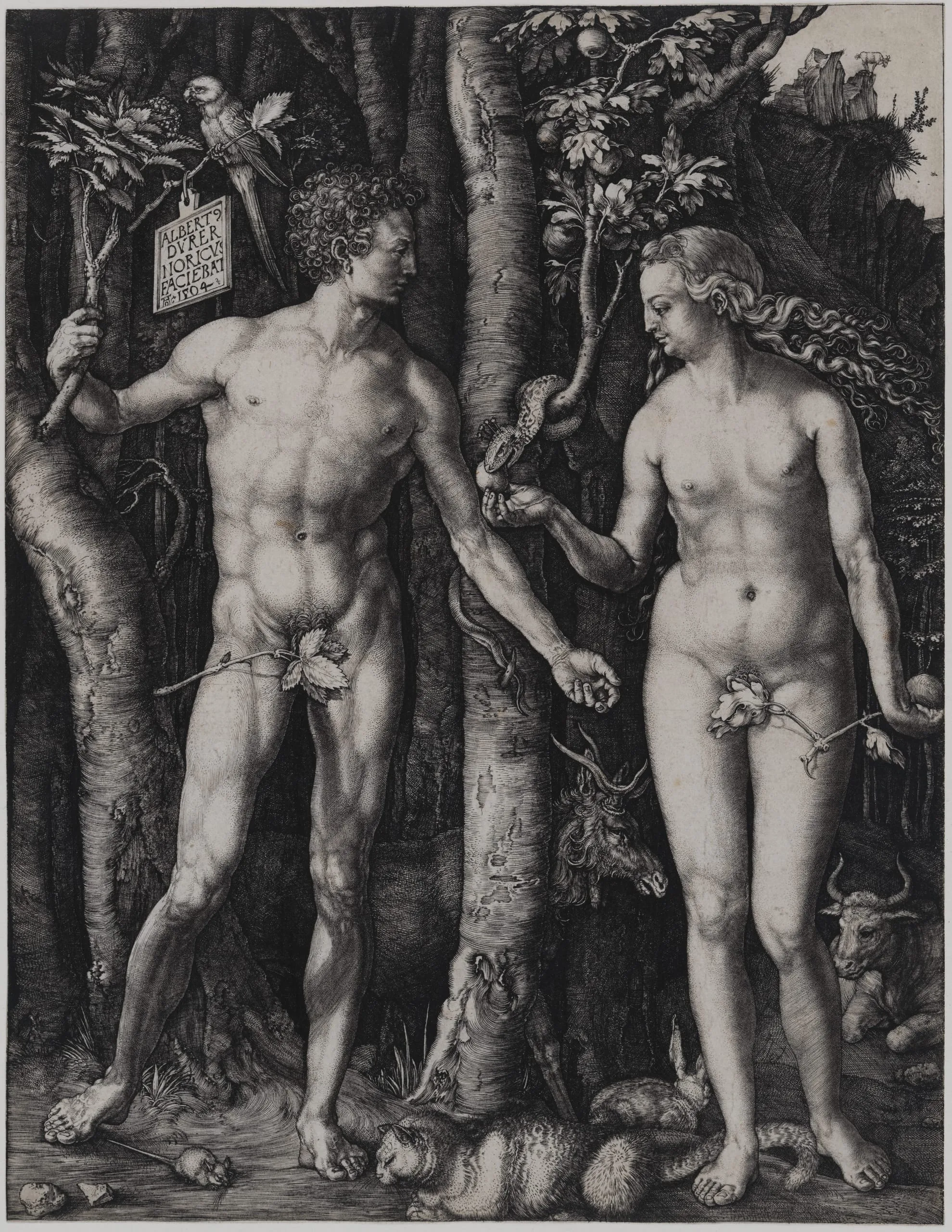
Adam and Eve helped establish Albrecht Dürer as one of the undisputed masters of engraving, even in his own day. Dürer's virtuosity is most evident in his use of line. Modeling the figures in light and shade, it varies from coarse, for tree trunks, to very fine, for shading on the legs. The print also exhibits Dürer's fascination with classical canons of beauty and proportion as well as minute descriptions of the natural world.
Adam and Eve are depicted in the moment before the Fall. Eve conceals one apple in her left hand and is about to accept another from Satan who appears in the guise of a snake. This predatory theme is echoed by the cat, tensely crouched to pounce on the mouse between Adam's feet. The parrot, symbol of wisdom, turns its gaze from the impending debacle.
Dürer represented this final moment of man's untarnished state with perfect human figures of mathematically determined proportions. Adam is posed like the Apollo Belvedere, the classical sculpture representing the male physical ideal, and Eve is modeled on classical prototypes of Venus.
Naturalism and whimsy carry the narrative to an audience well versed in symbol and imagery and accustomed to their visual interpretation. The cat, elk, rabbit, and ox represent man's four temperaments, or humors, elements found in harmony in the perfectly balanced soul: choler or anger, melancholy, the sanguine or sensuous, and phlegmatic or apathetic. In the distance a goat teetering on a precipice provides a symbolic image of Adam and Eve's final moment of precarious equilibrium.