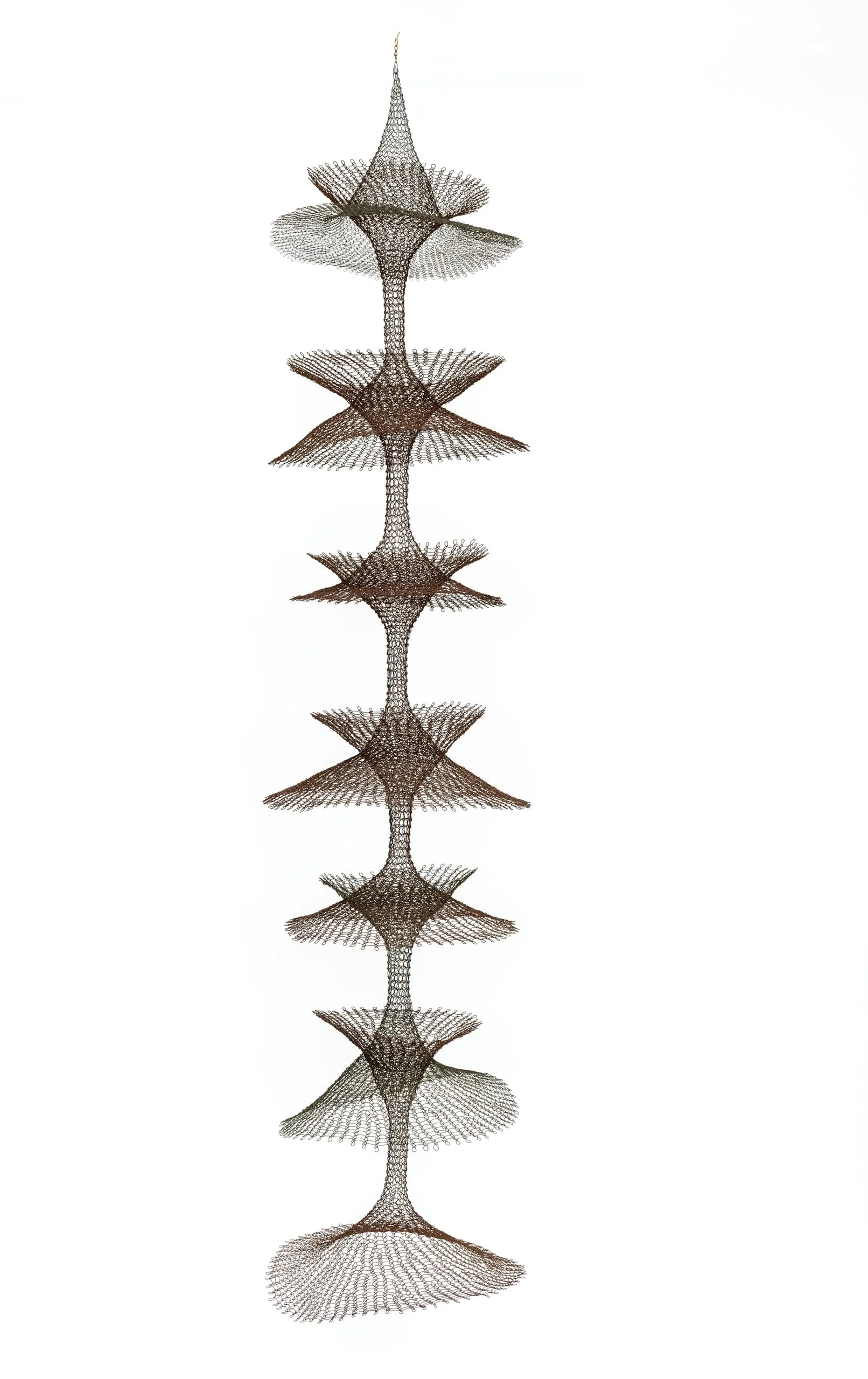
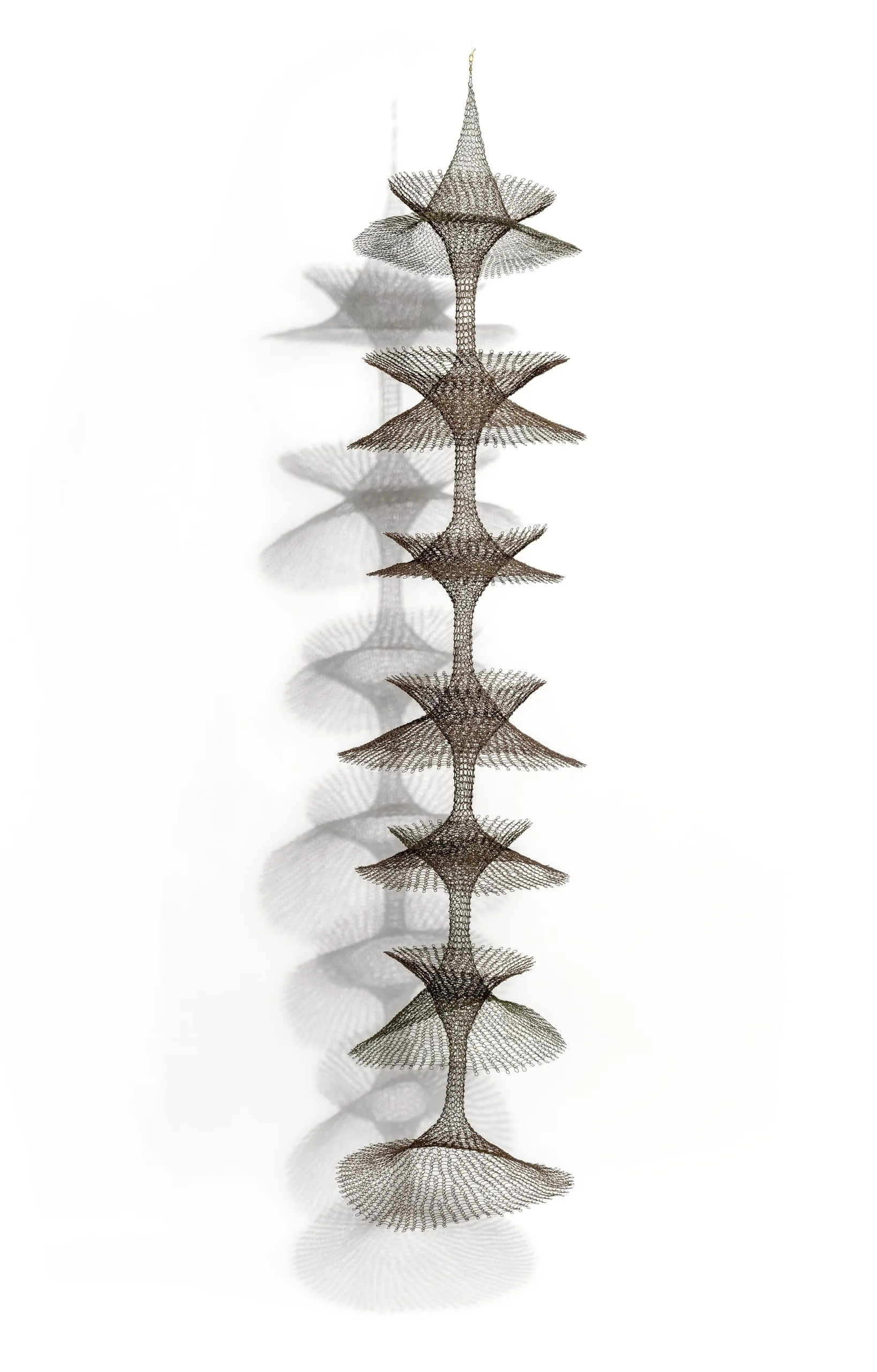
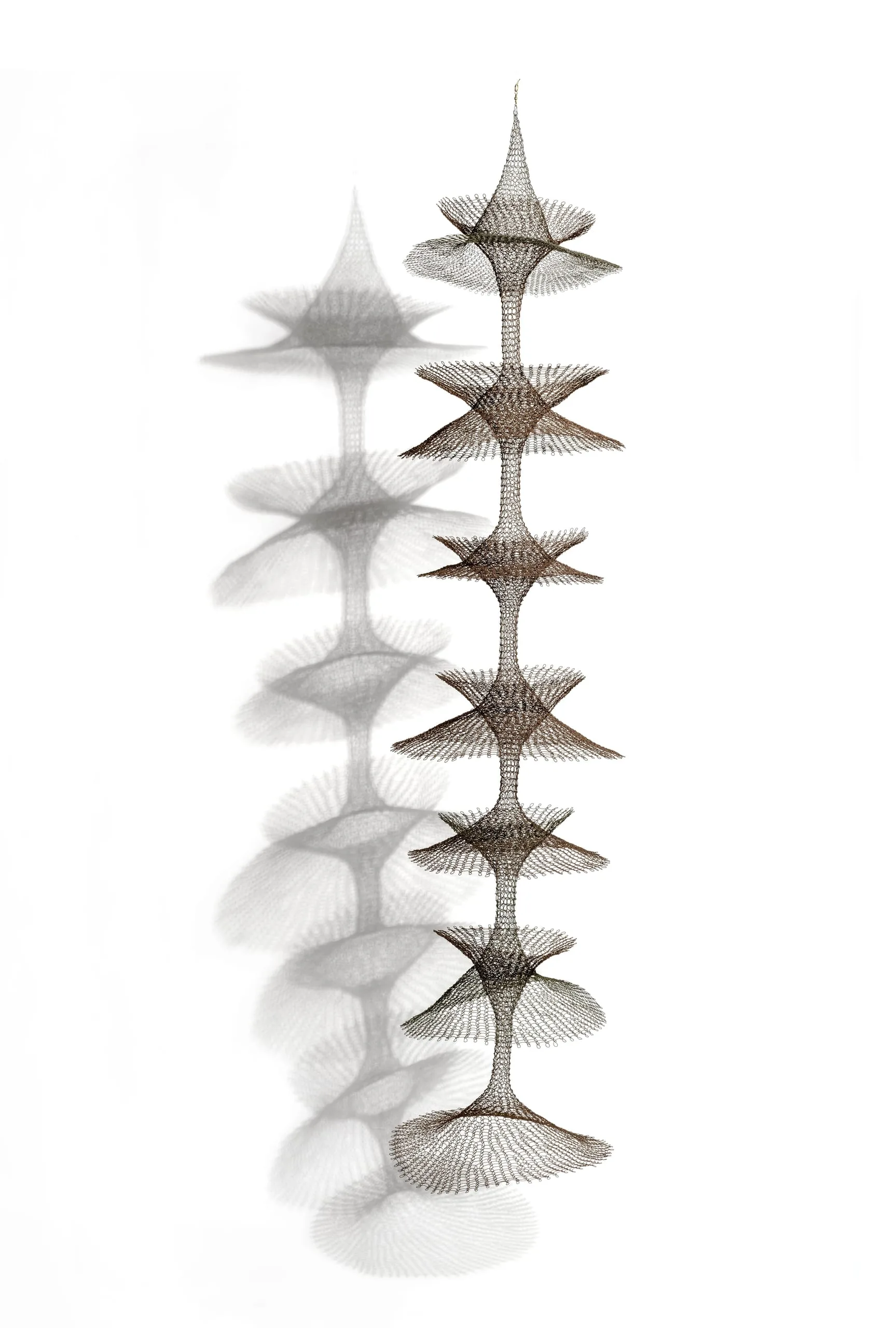
The California sculptor, educator, and arts activist Ruth Asawa is most renowned for wire hangings such as Untitled S.027, which challenge conventional notions of material and form through their ethereal transparency. The daughter of Japanese immigrants, she grew up on a farm in Southern California, where, as art historian Jenny Gheith points out, “repetition, order, and structure within an economy of means pervaded Asawa’s upbringing” and would later characterize her art.
Following the attack on Pearl Harbor in 1941, Asawa and her family were interned at Santa Ana racetrack, where she first took art classes, and then at Rohwer Relocation Center in Arkansas. In 1943, she was allowed to enroll at Milwaukee State Teachers College and planned to become an art teacher. Encouraged by designer Clara Porset, with whom she had studied in Mexico City in 1945, Asawa enrolled in Black Mountain College in 1946, studying drawing, design, and color theory with former Bauhaus master Josef Albers. The following year, she returned to Mexico on a community service trip to Toluca, where she observed local artisans forming baskets from a mesh of interlocking wire loops. Upon her return to Black Mountain, she first applied this method to make utilitarian pieces such as egg baskets. She then began her lifelong journey of transforming this functional technique into poetic works of art.
In 1949, Asawa moved to San Francisco with her architect husband, whom she had met at Black Mountain. There she would spend the rest of her life, continuing to make basket forms that grew ever more complicated by building several shapes upon each other, creating spheres filled with smaller woven volumes nested within them. Or, as with this example, producing sculptures that decades later she would describe as “open hyperbola forms that penetrate each other.”
Untitled S.027 is one of the first of her sculptures with these open penetrating forms. Always kept by Asawa in her home and then by one of her daughters, it was exhibited the year it was made (1954) at a group show of four women artists at the San Francisco Museum of Art (now SFMoMA).
Wendy Kaplan, Department Head and Curator, Decorative Arts and Design
Adapted from the 2017 text