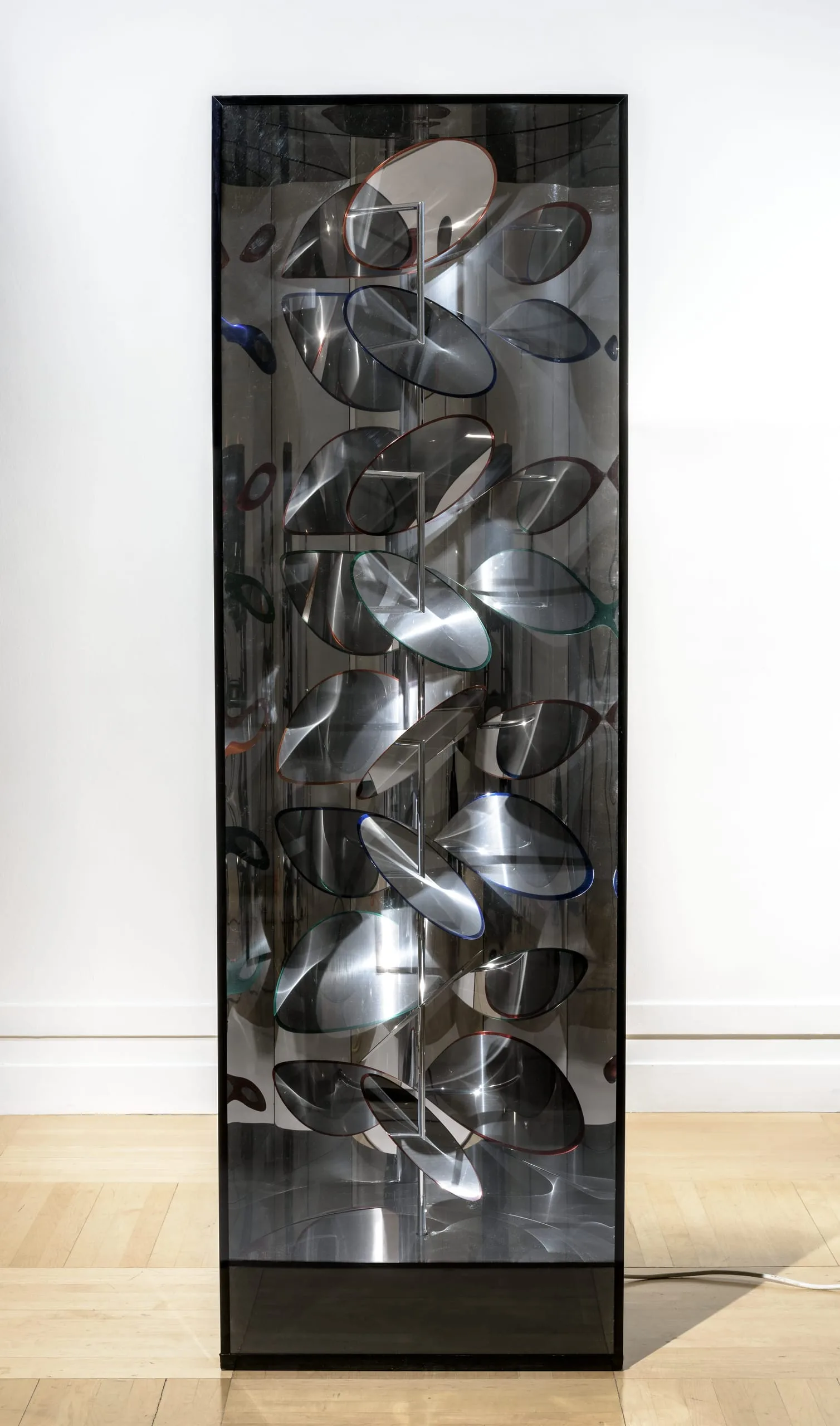
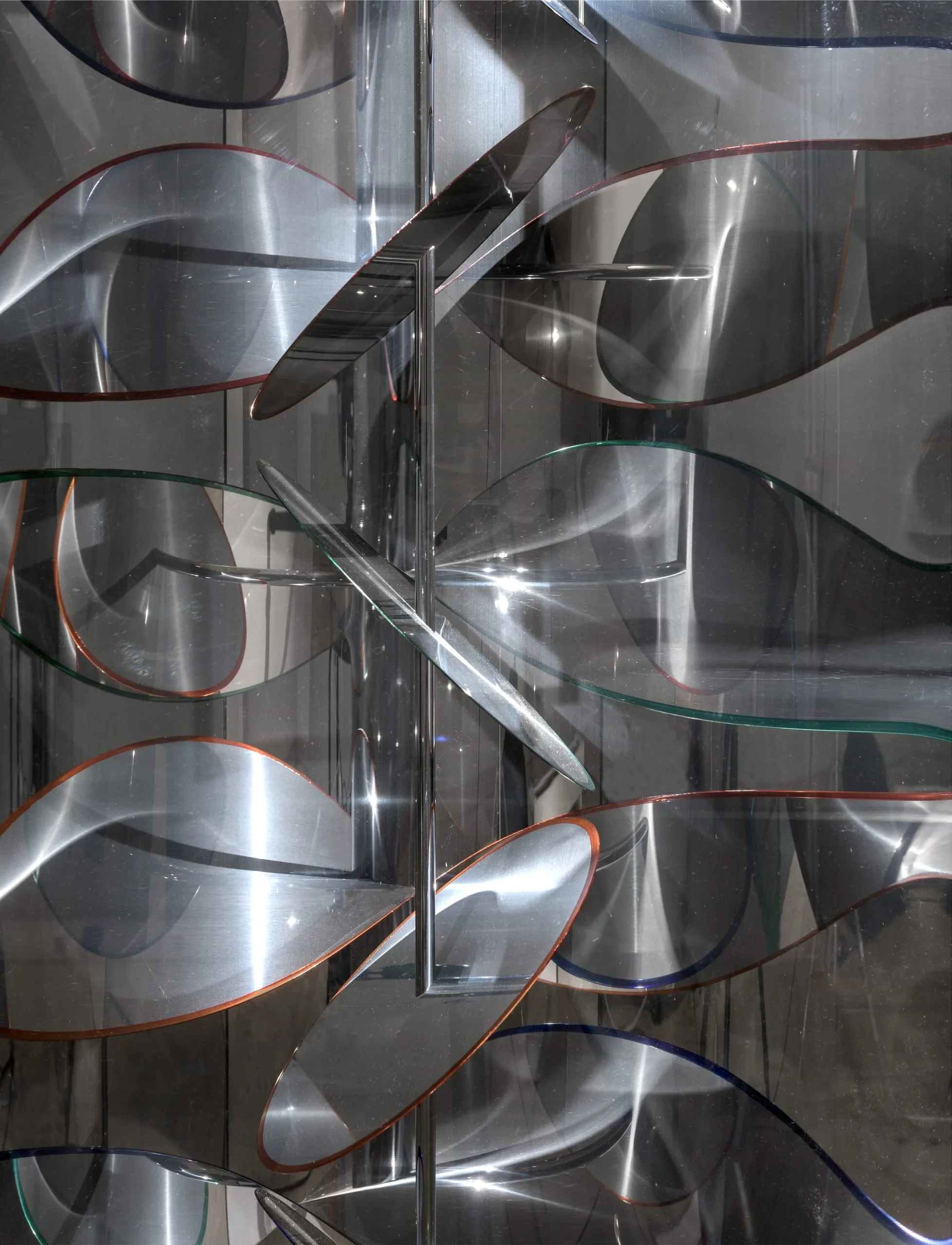
Martha Boto created Optique Hélicoidal (Mouvement) during the heyday of the kinetic art movement in the 1960s. Deceptively simple, the work consists of a central rod with a series of chromo-polished disks arranged as a spiral, or helicoid, that turn and reflect environmental light on the curving mirrors. The cadence of the rotations engenders a quiet, mesmerizing effect that repeats endlessly, as forms appear and disappear. The goal of kinetic artists was to transform viewers from passive observers to active participants, and compel them to question the nature of art by creating works in constant flux. Boto explained: “I seek an art capable of arousing different emotions, psychological reactions of joy or tension, an art that can become medicine for the spirit. . . . My particular means of movement, color and light can give the illusion of contraction, diminishment or multiplication, so that by optical means the spectator undergoes a series of reactions.”
After World War II, Buenos Aires was a bustling metropolis on the brink of industrialization. Several Argentinian artists rejected figurative art and set out to create a new, abstract visual language that would convey the spirit of hope and optimism of the time. In 1956, Boto cofounded the group Artistas No Figurativos Argentinos (Argentinian Non-Figurative Artists) with her soon-to-be husband Gregorio Vardanega (1923–2007; M.2020.233, M.2020.217); three years later, the couple relocated to Paris, becoming part of an international cohort that aspired to revolutionize the art establishment. There, Boto found a fertile ground for her artistic explorations; she became a major figure of the kinetic art movement, and one of the few women to work in this vein. Her kinetic boxes appeared in Contact (1967), a futuristic short film about intergalactic love starring Brigitte Bardot, which underscores the recognition of Boto’s work.
Ilona Katzew
2024