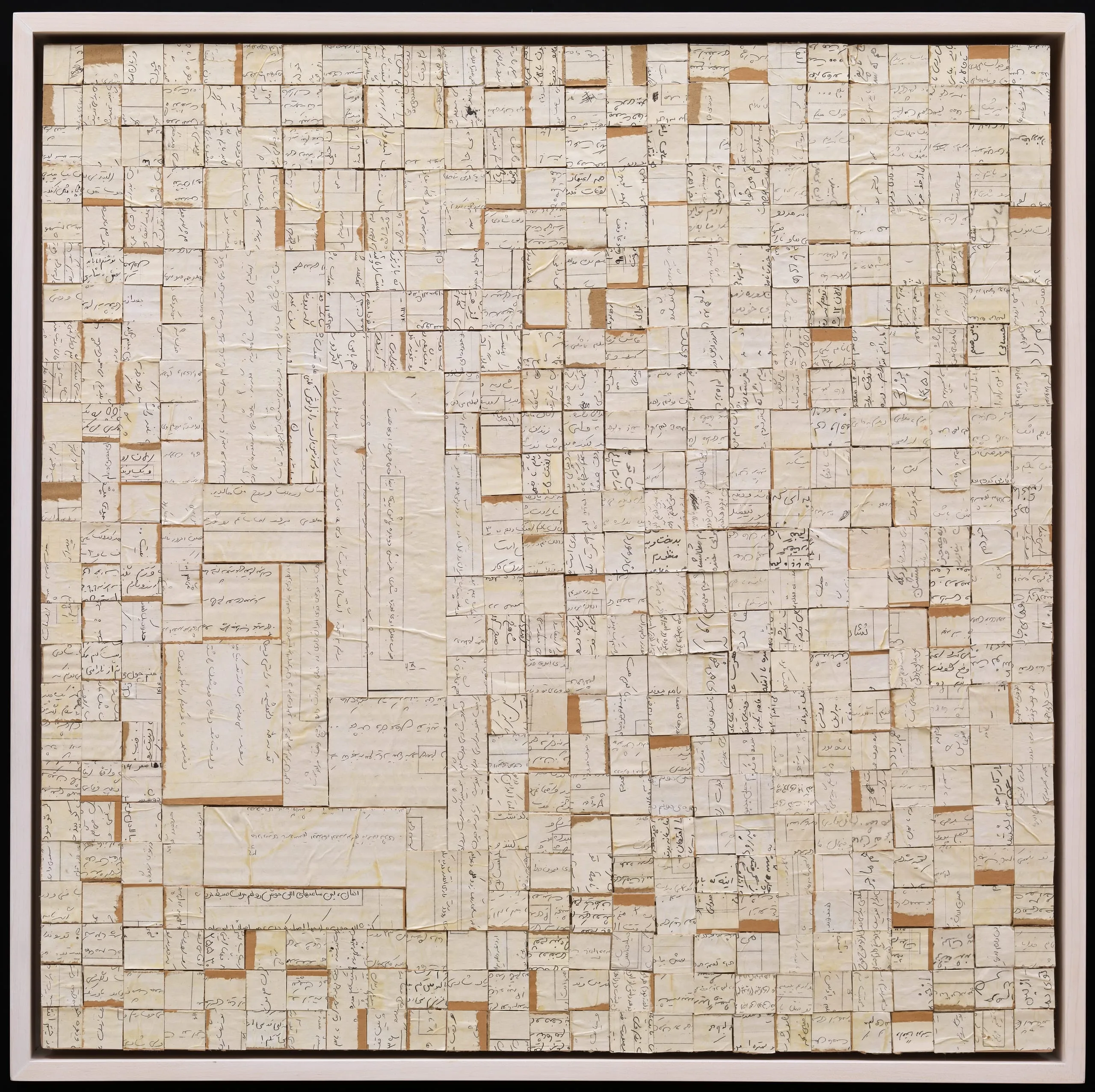
Each work in Shadi Yousefian’s on-going series of collages Letters, as here in Letters #3, is at once an act of destruction and an act of preservation. After the artist emigrated from Iran to the United States as a teenager, she kept in touch with friends and family through letter-writing in Persian. She held on to her personal archive of handwritten correspondence for many years until she began a process of reopening the boxes and revisiting their words. She began cutting out excerpts, selecting parts that felt particularly poignant or seemed to capture the essence of a specific communication, relationship, or person. Later on, Yousefian incorporated these cut-outs into her artwork, mounting them on wood with glue or nails and arranging them in grid-like formations. She dyes the carefully hand-cut excerpts with tea, coffee, wine, and soy sauce, lending them a warm hue and weathered patina. From afar, the work gives the impression of a tiled mosaic or a work of abstract minimalism. A closer inspection, however, reveals details that are specific and personal, residing in the words committed to paper by hand with black or blue ink. For readers of Persian script, the writing offers snippets of a private past while remaining universal in its resonance with themes of separation, longing, alienation, as well as joy and the excitement of new horizons.