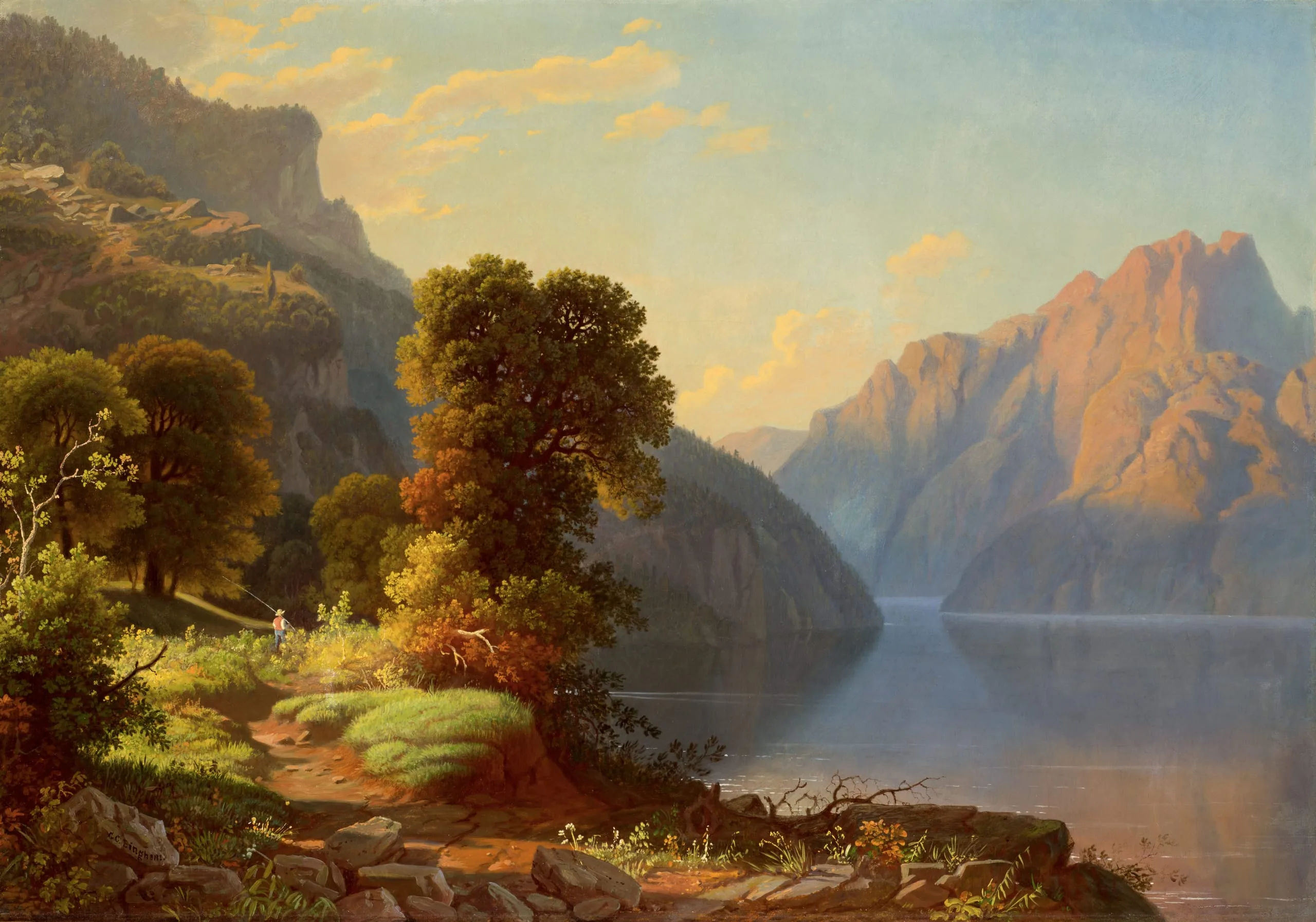
Although Bingham is known primarily for his genre images of the frontier, he also created approximately forty landscapes in which figures are only a minor element or were omitted altogether. Actually the landscapes fit well into his oeuvre, since nearly all of Bingham’s narrative scenes were set out-of-doors, in locales often similar to those of his landscapes. Based on formal criteria, most of Bingham’s landscapes are dated from the late 1840s and early 1850s. A View of a Lake in the Mountains has traditionally been considered a work from the years prior to Bingham’s study in Düsseldorf, dating either c. 1851 or 1853-56. While A View of a Lake has motifs similar to those in Landscape with Fisherman, c. 1850 (Missouri Historical Society, Saint Louis)--the tiny figure of the fisherman and the rocky setting near a body of water--it is a much more complex and formal landscape.
One authority has suggested that Bingham painted A View of a Lake in the mountains while in Germany; he is known to have done landscapes for his own satisfaction when in Düsseldorf. The landscape displays the sophisticated approach to form and space of the Düsseldorf school. Unlike his earlier landscapes in which numerous passages are amorphous and ill defined, the rocks and foliage in the foreground of A View of a Lake are sharply delineated with a crisp drawing technique and clear light. The sunlight on the right forms a pattern of alternating passages of light and shadow, a characteristic typical of Bingham’s German-period figure paintings. The rocks and trees in the foreground of the landscapes of the early 1850s frame the scene, while the rocks in this mountain view are placed one behind the other to define spatial recession. In the one known landscape datable to his Düsseldorf period, Moonlight Scene: Castle on the Rhine, c. 1857-59 (private collection), Bingham adopted a hard finish and massed lights and darks in a similar manner to emphasize a progression of planes rather than a continuous recession as in his earlier landscapes. The distant rock formations appear more idealized and their stylized shapes are described by a softer, almost opalescent palette. They have been compared with Alpine scenery. Thus, the increased sophistication Bingham demonstrated in this landscape compared with those from the early 1850s suggests that the painting dates from his years in Düsseldorf or from the period immediately following his European visit.