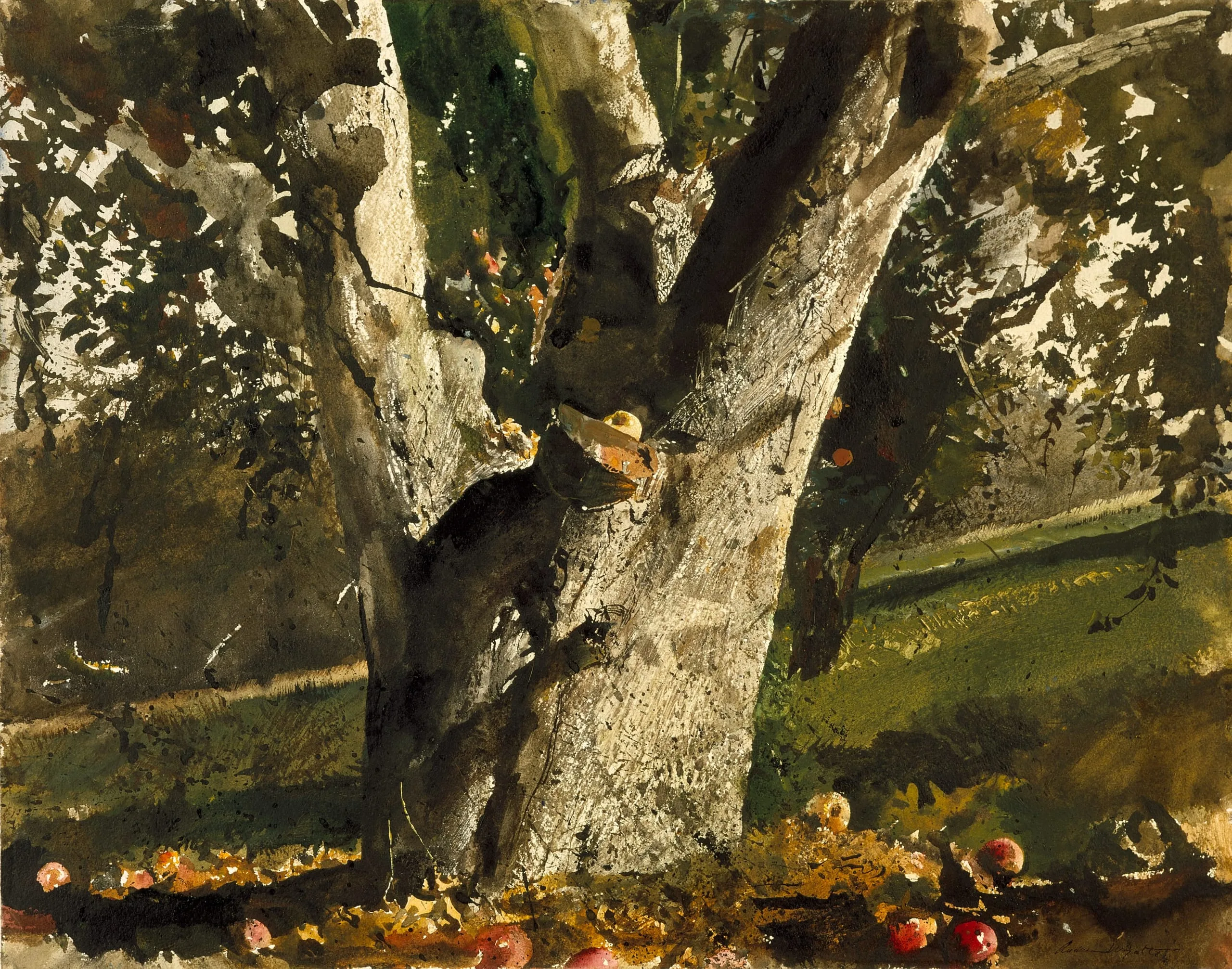
During the late 1950s Wyeth began painting watercolors of the family apple orchard planted by his father and maintained by his sister. In these paintings he often combined the fluid watercolor and drybrush techniques to utilize the medium effectively. Thus these mature paintings differ from his early watercolors in which, in the tradition of Homer, Wyeth applied the paint in bold, vigorous strokes, often manipulating its bleeding. The drybrush enabled him to suggest texture, as in the rough bark of the tree in Cider Apples, and to delineate details, such as the grass blowing in the wind in Early Spring. In neither painting, however, did Wyeth relinquish the fluid brush.
Some of his studies of trees contain genre details that introduce narrative elements to the scene, but most are pure painting. Thus despite Wyeth’s reputation as a realist, these watercolors reveal the strong abstract quality beneath his detailed specificity. Wyeth usually focuses on a single tree and only on part of that tree’s trunk and limb structure. The Y configuration of the tree in Cider Apples appears in several other paintings, the most famous being Frosted Apples, 1967 (M. H. de Young Memorial Museum, San Francisco). The irregularity of a tree’s limbs is emphasized in Early Spring and other studies, such as Fungus, 1959 (private collection), by the artist’s placement of the limbs against a light background. Early Spring is not read so much as the trunk and branches of a tree as an abstract angular form.
Although Wyeth’s realistic approach reveals an almost cold, analytic mood, a sense of mystery still pervades these watercolors. Wyeth permits the viewer to glimpse his private world but does not allow us to comprehend his enigmatic personality.