- Title
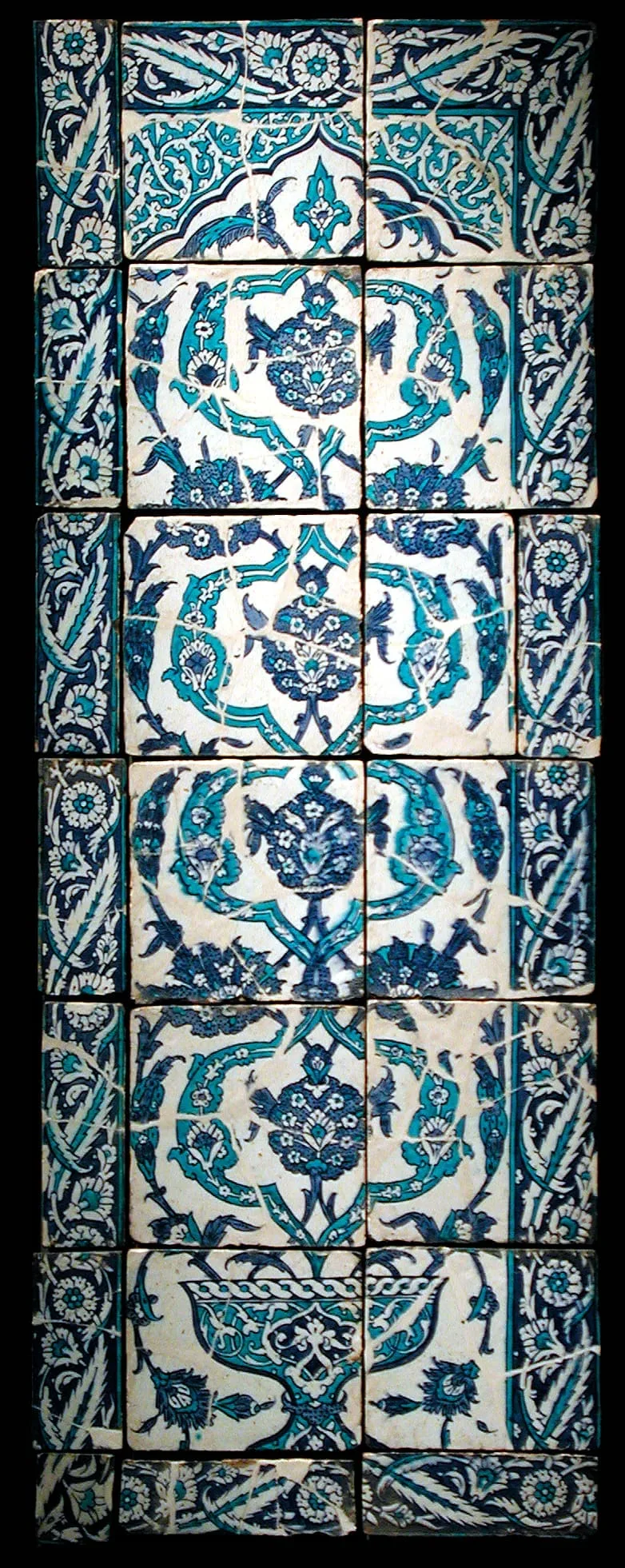
- Panel
- Date Made
- second half of 17th century
- Medium
- Fritware, underglaze painted
- Dimensions
- Overall panel: 61 1/4 x 22 3/4 in. (155.6 x 57.8 cm)
- Accession Number
- M.73.5.763a-r
- Curatorial Notes
Ceramics made in Iznik, in western Turkey, represent one of the most renowned and influential arts of the Ottoman period. The Iznik kilns, about 85 miles southeast of the capital, Istanbul, produced both tableware and architectural revetment such as this. Tiles were first manufactured at Iznik around the early sixteenth century; however, production increased dramatically in the second half of the century.
Toward the mid-sixteenth century, the palette of Iznik wares expanded to include a brilliant red and a bright grass-green. At about the same time that the Iznik palette reached its classic form, the focus of the ceramic industry shifted from tableware to tile work. This shift may have occurred as a result of the massive building projects undertaken by the court beginning in the 1550s during the reign of Süleyman the Magnificent (1520–66) and continuing under his immediate successors. By the 1660s, large panels with impressive designs were still being made, but the colors were limited to shades of blue and green, as here.
- Selected Bibliography
- Pal, Pratapaditya, ed. Islamic Art: The Nasli M. Heeramaneck Collection. Los Angeles: Museum Associates, 1973.