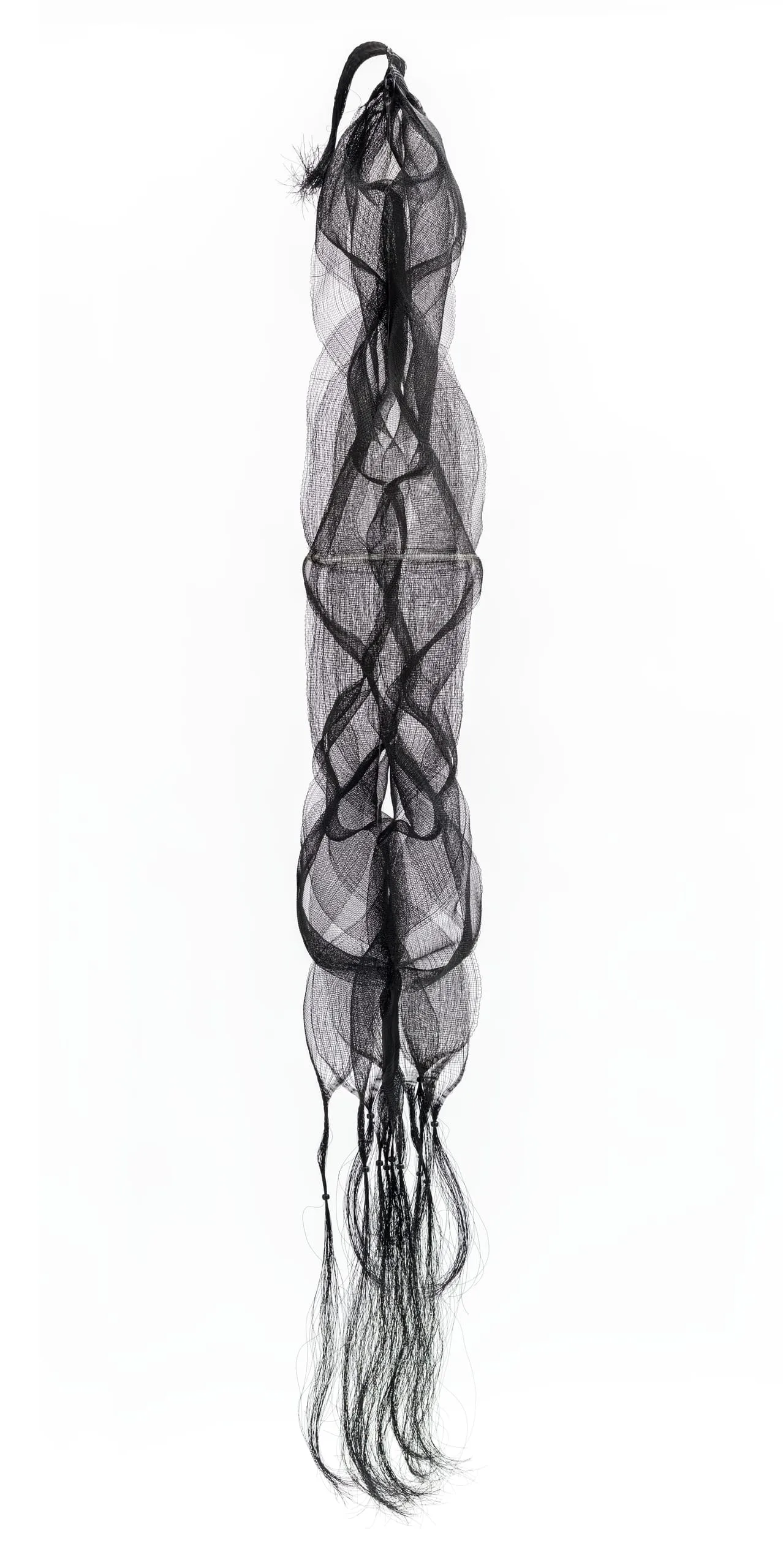
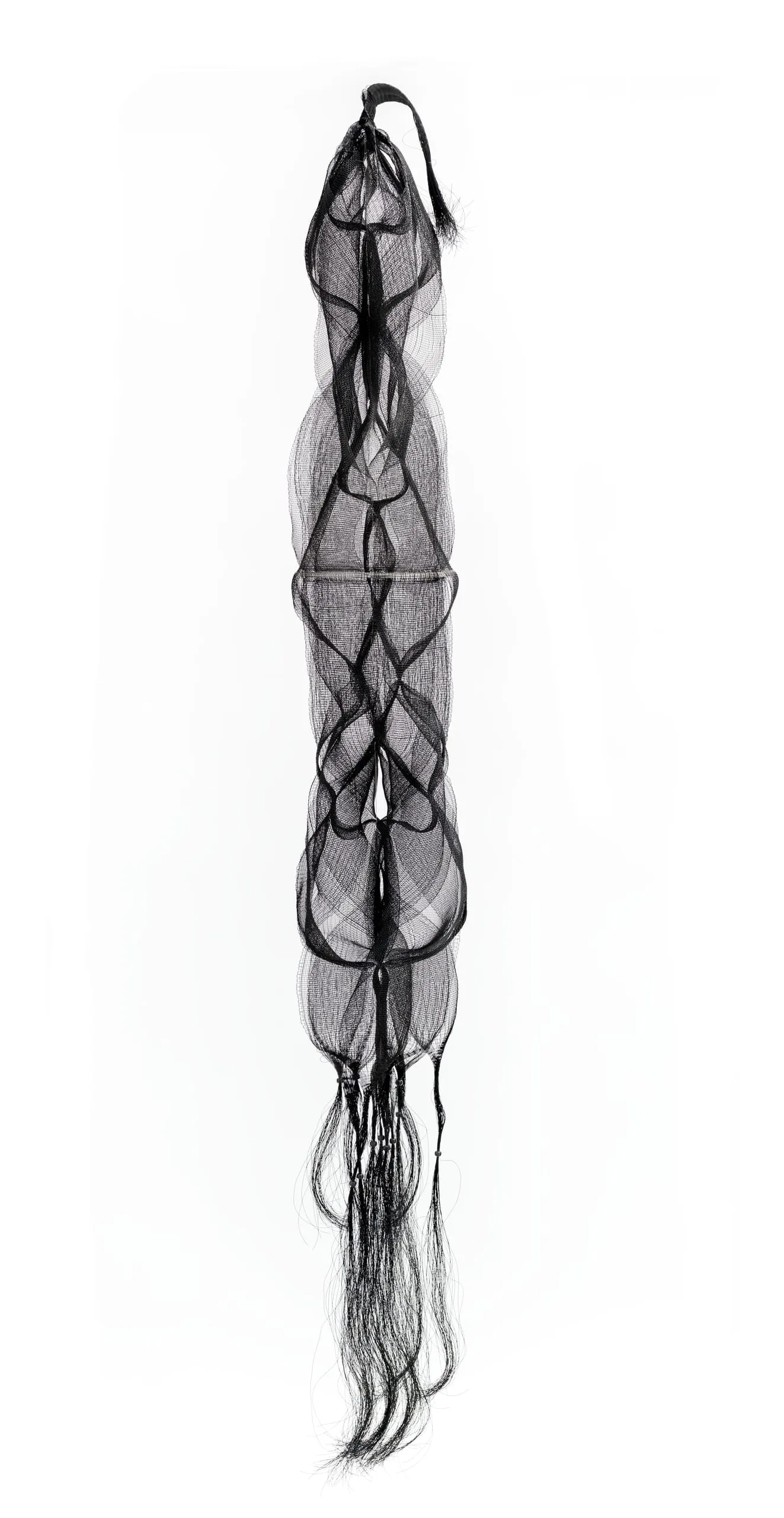
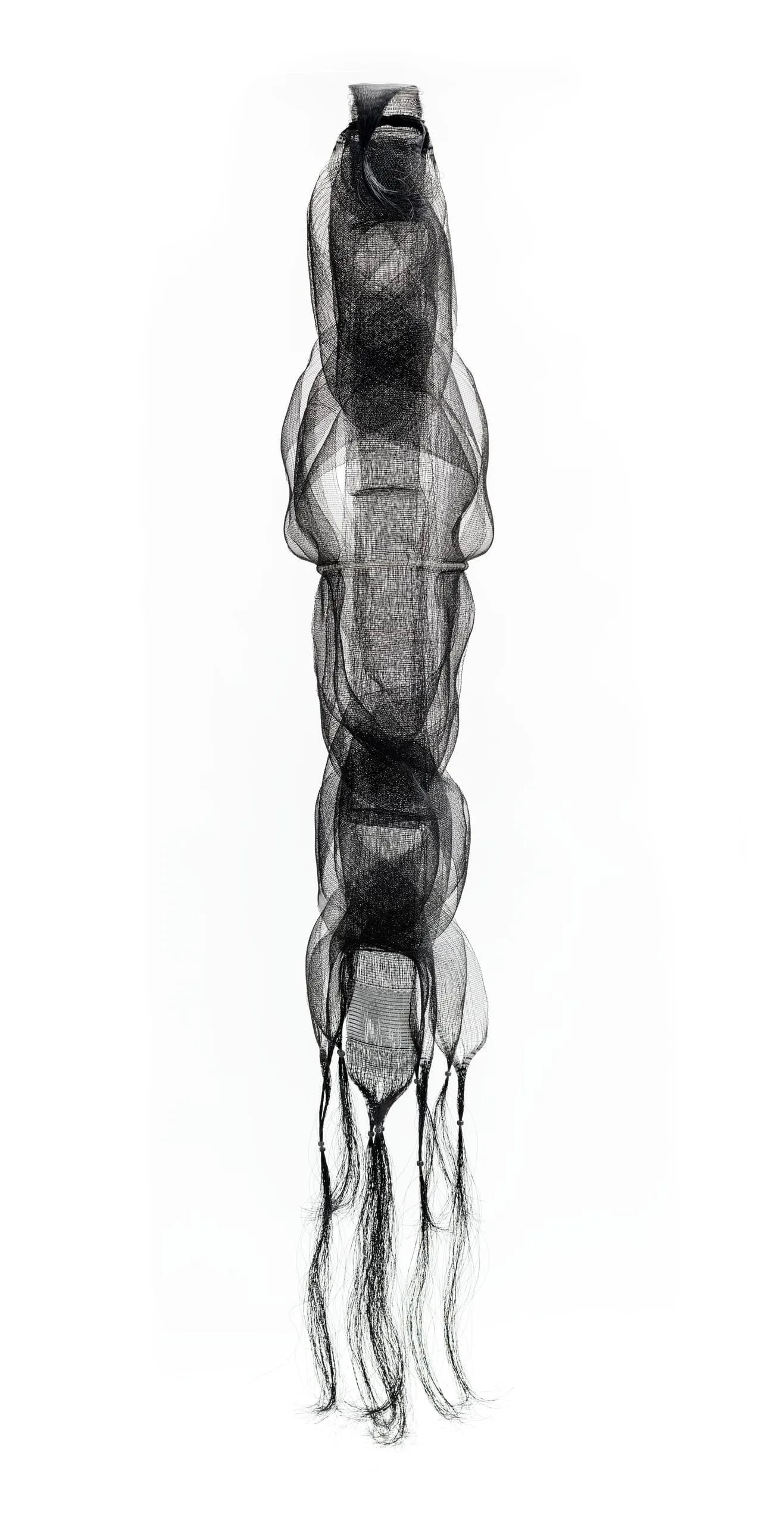
Kay Sekimachi is a master of many mediums but is best known for her work as a weaver and fiber artist. Nagare I (Flow) is a seminal example of her experiments in nylon monofilament hangings, one of a series begun in 1964. As she explained decades later in the catalogue to a monographic exhibition at the DeYoung museum, their forms were inspired by jellyfish, and the material itself was liberating: “Monofilament, commonly known as fishing line, is a pliable material that had recently been developed by DuPont. I felt like an explorer because no one else was using that material, so no one could tell me what to do, and the possibilities seemed endless. After dyeing the monofilament black with Rit dye, I wove four interlocking layers on an eight-harness loom, using tubular-weave and slit-warp techniques.” Of the (about) twenty-five hangings in the monofilament series, Nagare I is perhaps the most remarkable for its elegance and ambition. At one point, the artist had twelve shuttles going; it took an hour to complete each inch of the weaving, with no mistakes possible. Sekimachi told LACMA curators that the hanging was “one of her most resolved.”
A second-generation Japanese American born in San Francisco, Sekimachi was interned with her family during World War II. Despite the hardships of camp life, she was able to study art as well as crafts such as origami during this period. When she returned, she studied design briefly at the California College of Arts and Crafts (CCAC). In 1949, she became fascinated by weaving and left college to pursue this craft through night school and an apprenticeship. Sekimachi returned to CCAC to take summer courses with German émigré Trude Guermonprez, a legendary fiber artist who had taught at Black Mountain College. Guermonprez became her mentor, steering her toward more experimental techniques and complex structures such as double-weaves.
Although her weaving was mainly for exhibition in galleries and museums, Sekimachi did some production work, most notably for the designer, author, and curator Jack Lenor Larson. In the 1960s, her art became increasingly less functional. Experiments with double-weaves led to work in multiple layers, as in Nagare I. While her early, more functional textiles appeared in several major crafts exhibitions, including Designer-Craftsmen USA (1953), these new pieces became associated with the emerging field of fiber art and were included in landmark shows such as MoMA’s Wall Hangings (1969) and Deliberate Entanglements at UCLA (1971). In 1974, Sekimachi decided to move on to other experiments in off-loom techniques, such as card weaving. To this day, she continues to experiment with new forms and fibers, creating boxes, baskets, jewelry, and other objects. Both as an artist and a teacher (she taught for eighteen years at San Francisco City College), she has influenced generations of fiber artists.
Wendy Kaplan, Department Head and Curator and Staci Steinberger, Curator, Decorative Arts and Design
Bibliography
Kay Sekimachi: Student, Teacher, Artist. San Francisco: DeYoung Museum, 2016.