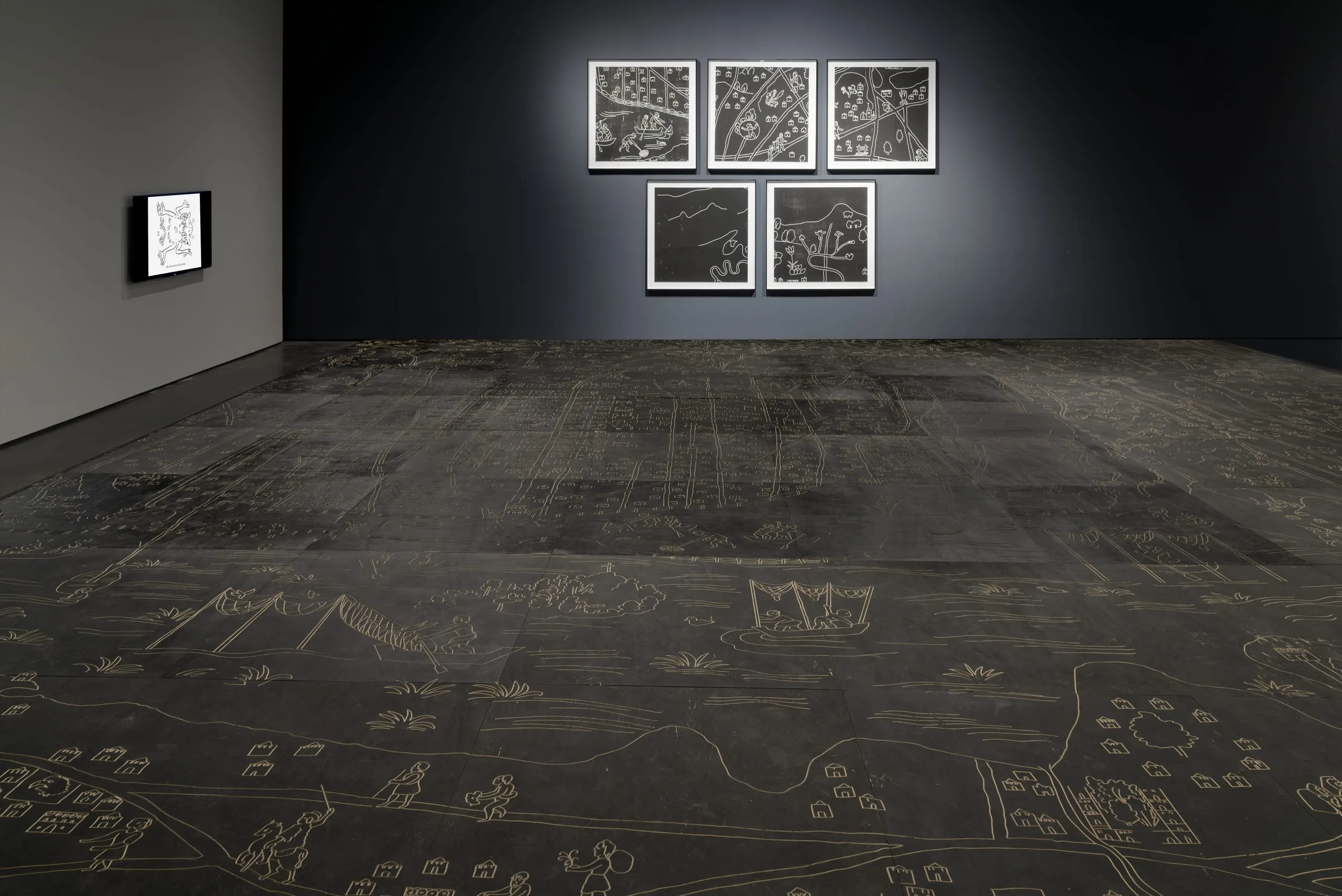
Mariana Castillo Deball’s art engages with ideas and concepts from a dynamic range of disciplines. Her collaborations with archaeologists and conservators, novelists and graphic designers, mathematicians and physicists have yielded elegant works in sculpture, photography, drawing, video, and printed matter. The installation Vista de Ojos considers an object referred to as the Map of Mexico 1550 painted by an Indigenous cartographer and housed in the library of Uppsala University in Sweden. Made only thirty years after the Conquest, it is thought to be the oldest surviving map of Tenochtitlan (present-day Mexico City) as the capital of New Spain. The map appears at first to mime European Renaissance cartography, but close examination reveals its relationship to Mesoamerican pictorial language and glyphic writing systems. A forced coupling of two distinct worldviews, the map operates in a transitional, hybrid space.
The title of Castillo Deball’s piece, which translates to “eyesight,” refers to a tautological cartography term from the sixteenth century. Through the vista of the map we see a moment of transformation as Tenochtitlan morphed from a planned Aztec city-state structured around waterways to a Spanish municipal grid, the kind that would be established throughout the Americas during the Conquest. Clusters of Spanish homes and official buildings are set amid Aztec neighborhoods and important civic sites; some 150 of these are denoted with glyphs. Along with local flora and fauna, the cartographer has illustrated daily life in the city, such as Aztecs canoeing and fishing in the canals.
Castillo Deball’s sculptural intervention upon this archival form adds another dimension to the map’s multiple registers. Incised on black plywood panels, her version highlights the pictographic quality of the original map’s drawing style, allowing for a ready comparison to other forms of Mesoamerican visual culture utilizing glyphic language, including codices, murals, stelae, ceramics, and stone sculpture. Thus the artist facilitates our reading of the map not only as a product of European conquest but within the legacy of visual production native to the region. As a further restorative gesture, Vista de Ojos is positioned as a pavement underfoot: viewers must walk on it around the gallery space, eliciting recognition of the historic layering of time and place in situ.
Rita Gonzalez and Pilar Tompkins Rivas
2017