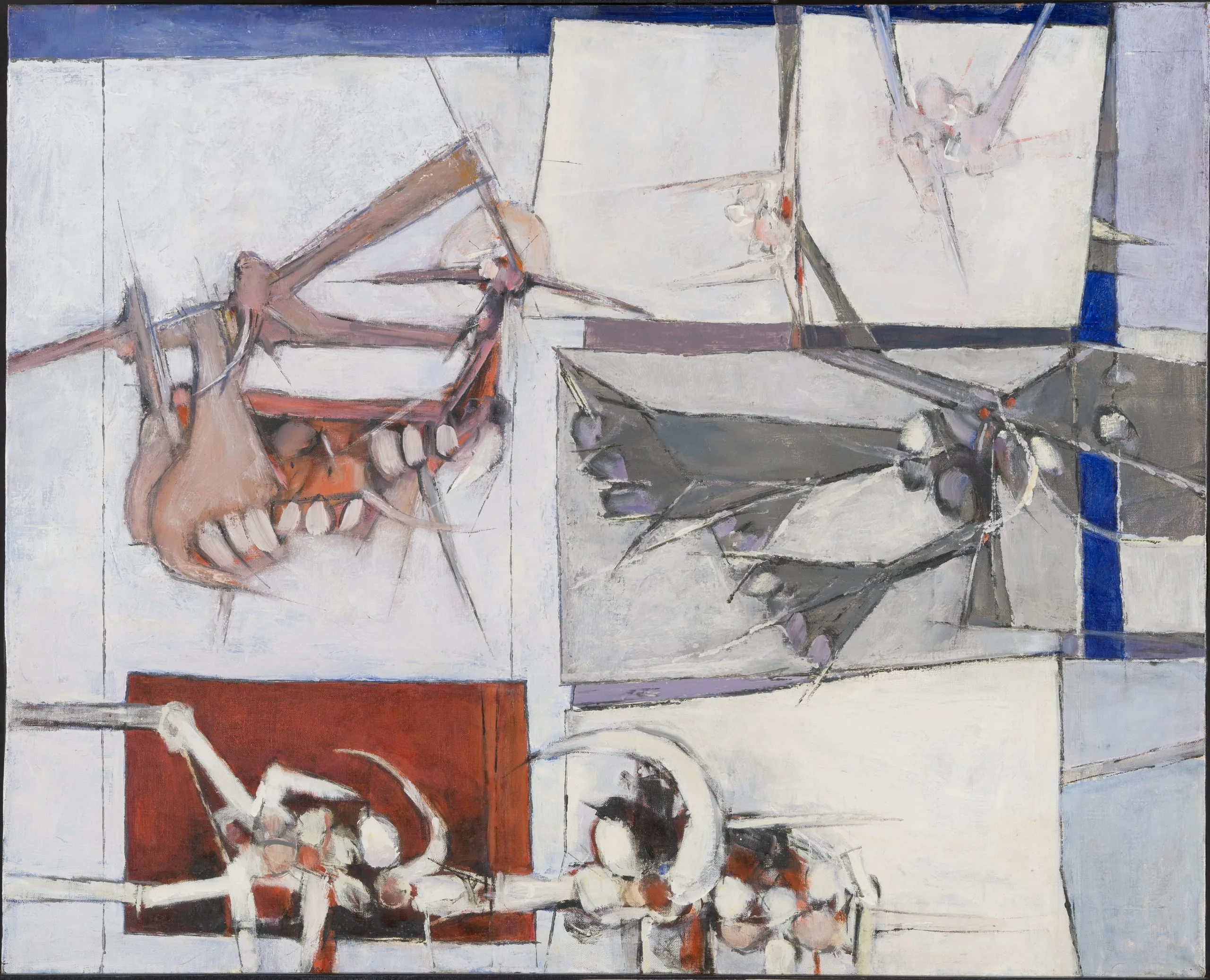
From October 1964 to August 1965 Guillermo Núñez lived in Manhattan, where he formed part of an enclave of Chilean expatriates. His stay in New York coincided with mounting tensions fueled by U.S. involvement in the Vietnam War and its forceful intervention in the Dominican Republic. Gruesome imagery proliferated in news media, to which Núñez responded through his art. In this painting, military aircraft are reinterpreted as part-beast, part-machine, incorporating bones, teeth, and clawlike limbs. Núñez also drew on the visual strategies of the Pop art he encountered in New York, creating what he would later call arte pop-lítico, or pop-litical art (https://unframed.lacma.org/2017/05/23/violence-and-dissent-%E2%80%9Cpop-litical%E2%80%9D-art-guillermo-n%C3%BA%C3%B1ez). Here, the white squares derive from his interest in comic-strip frames. Alternately known as Non Comic Strip, the painting addresses the lack of humor in contemporary events while employing the compositional devices of this familiar format.
After returning to Chile, Núñez’s work remained explicitly political. He was detained during the military dictatorship of Augusto Pinochet (1973–90) and spent twelve years living in exile in Paris. The artist’s prescient early paintings foreshadow later traumas in his own life.
Rachel Kaplan
2024