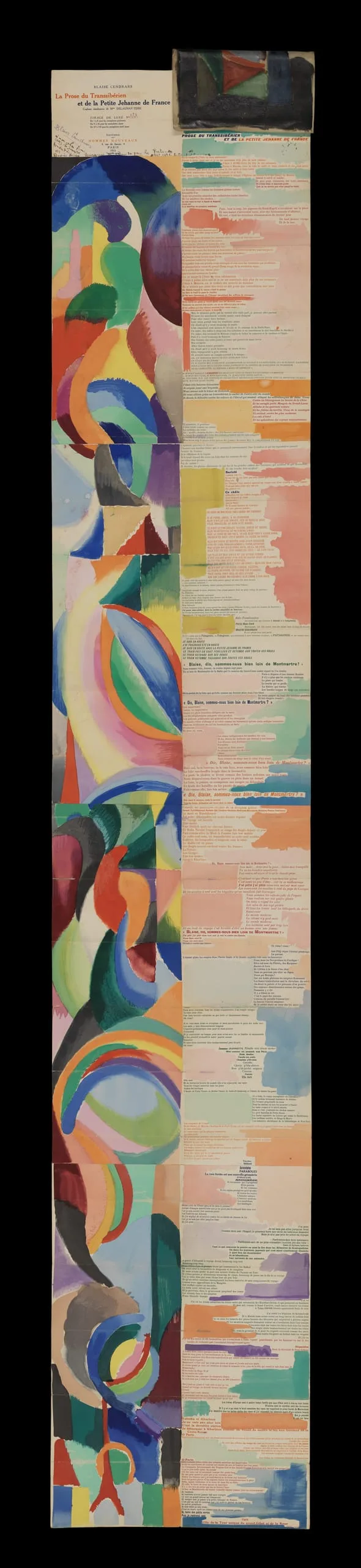
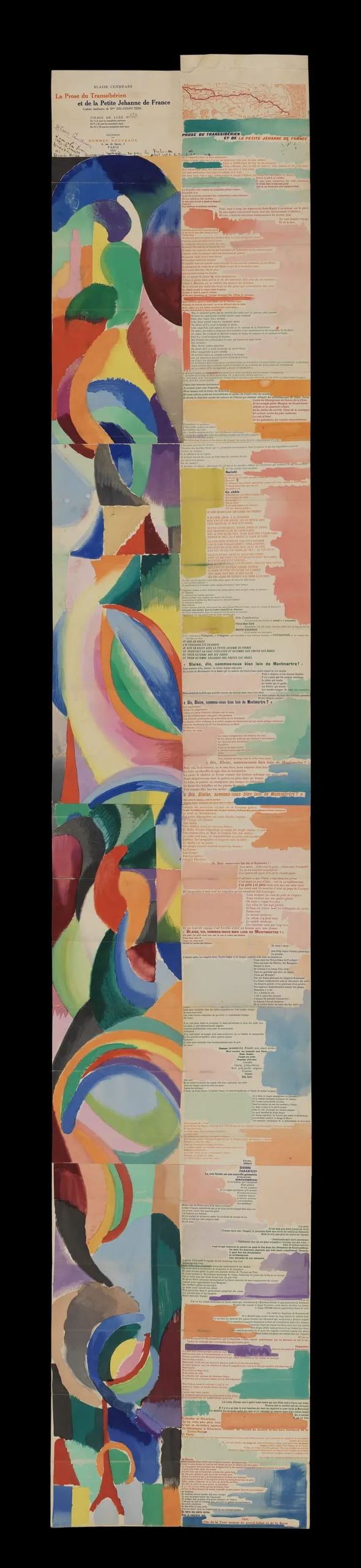
Sonia Delaunay-Terk and her collaborator, French poet Blaise Cendrars, called this epic work “the first simultaneous book,” a reference to Simultanism, which connected art to the vibrant simultaneity of modern urban life, transportation, and communication. Together the two transformed the traditional handheld book (read page by page) into a long, accordion-folded sheet in which text and illustrations share parallel prominence. Cendrars’ free verse poem, printed in ten different typefaces to simulate movement, is on the right, and Delaunay-Terk’s brilliant colorful forms cascade on the left.
The text recalls an imaginary journey on the newly popular Trans-SIberian Railway taken by a young French sex worker named Jehanne (or Joan). She travels from Moscow to Siberia, China, and the North Pole before arriving in Paris, where the newly-constructed Eiffel Tower, the epitome of modernity, is depicted on the bottom left. Folded up, the work nestles in a hand-colored parchment wallet. Delaunay-Terk, a key figure in the Parisian avant-garde, is known for her vivid and colorful work spanning painting, fashion, and design beginning in 1906. This example of Prose of the Trans-Siberian and of Little Joan of France remained folded for most of its existence, and its colors are thus exceedingly fresh.
Provenance:
This particular example is inscribed by Cendrars to the Chilean artist Manuel Ortiz de Zárate, who introduced Diego Rivera to Pablo Picasso in Paris in 1914.