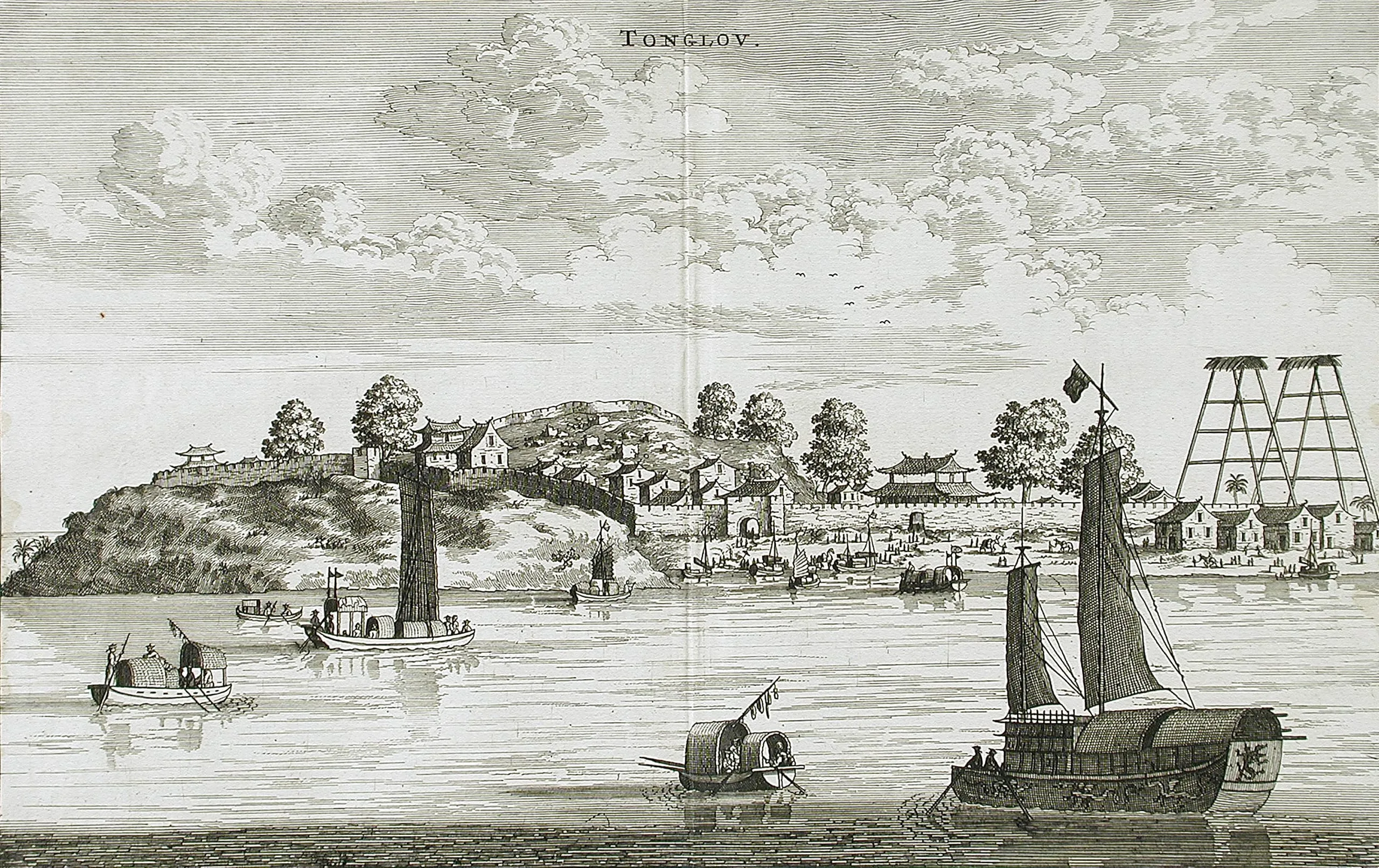
Explorer Johannes Nieuhof recorded his travels through China between 1655 and 1657, including sketches of the landscape. As the first Dutch envoy to China, he was tasked with documenting the country, and his renderings and notes were later used to produce engraved illustrations for An Embassy from the East-India Company of the United Provinces…, published in 1665 by Jacob van Meurs. However, the travelogue was embellished beyond Nieuhof’s descriptions and drawings, exoticizing the Chinese scenery with vegetation and pagodas and ultimately contributing to the rise of chinoiserie in eighteenth-century Europe.
LACMA’s engraving would have originally been bound as a foldout illustration. It shows a settlement on a riverside bluff, called Tonglov, with many houses, pagodas, and thatched pillars within the city’s walls, while a variety of boats carrying passengers approach its banks. This is likely meant to depict the port of Tongling along the Yangtze River, though it has also been identified as the village of Dongliu. Confirming the print’s exact subject is complicated by the addition of inventions made by the engraver to enhance the exoticness of the landscape, like palm trees and foliage. Almost certainly the artist responsible for this engraving did not travel to China. Above, clouds swirl in an expansive sky, which situates the scene at a high vantage point. This compositional approach, common among Northern artists during the seventeenth century, reinforces a distinctly Dutch perspective on the Chinese landscape.
Claire Spadafora Baes
2025