- Title
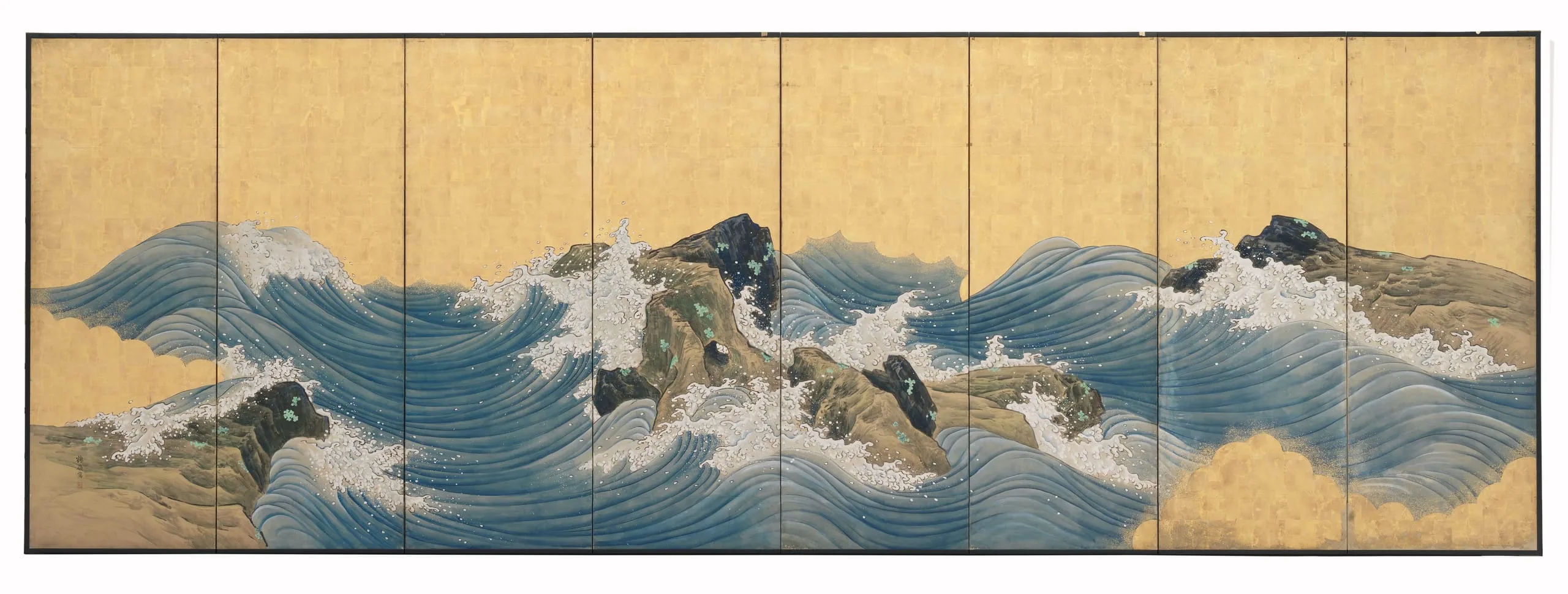
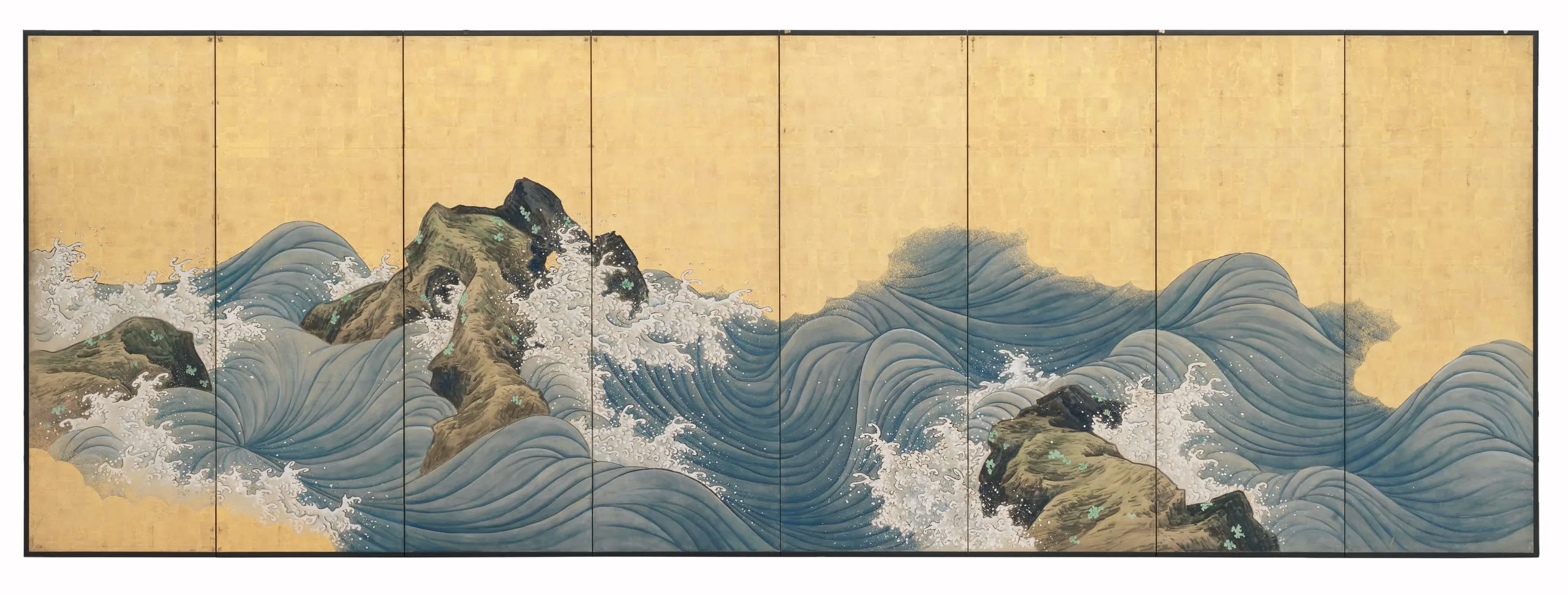
- Rocks Amid Crashing Waves
- Date Made
- circa 1810
- Medium
- Pair of eight-panel screens; gold leaf, mineral pigments (including malachite and azurite), and ink on paper
- Dimensions
- (.1-.2; each) Image: 64 13/16 × 191 3/16 in. (164.6 × 485.6 cm)
(.1-.2; each) Mount: 66 3/8 × 192 3/4 × 11/16 in. (168.6 × 489.6 × 1.7 cm)
- Accession Number
- M.2017.90.1-.2
- Curatorial Notes
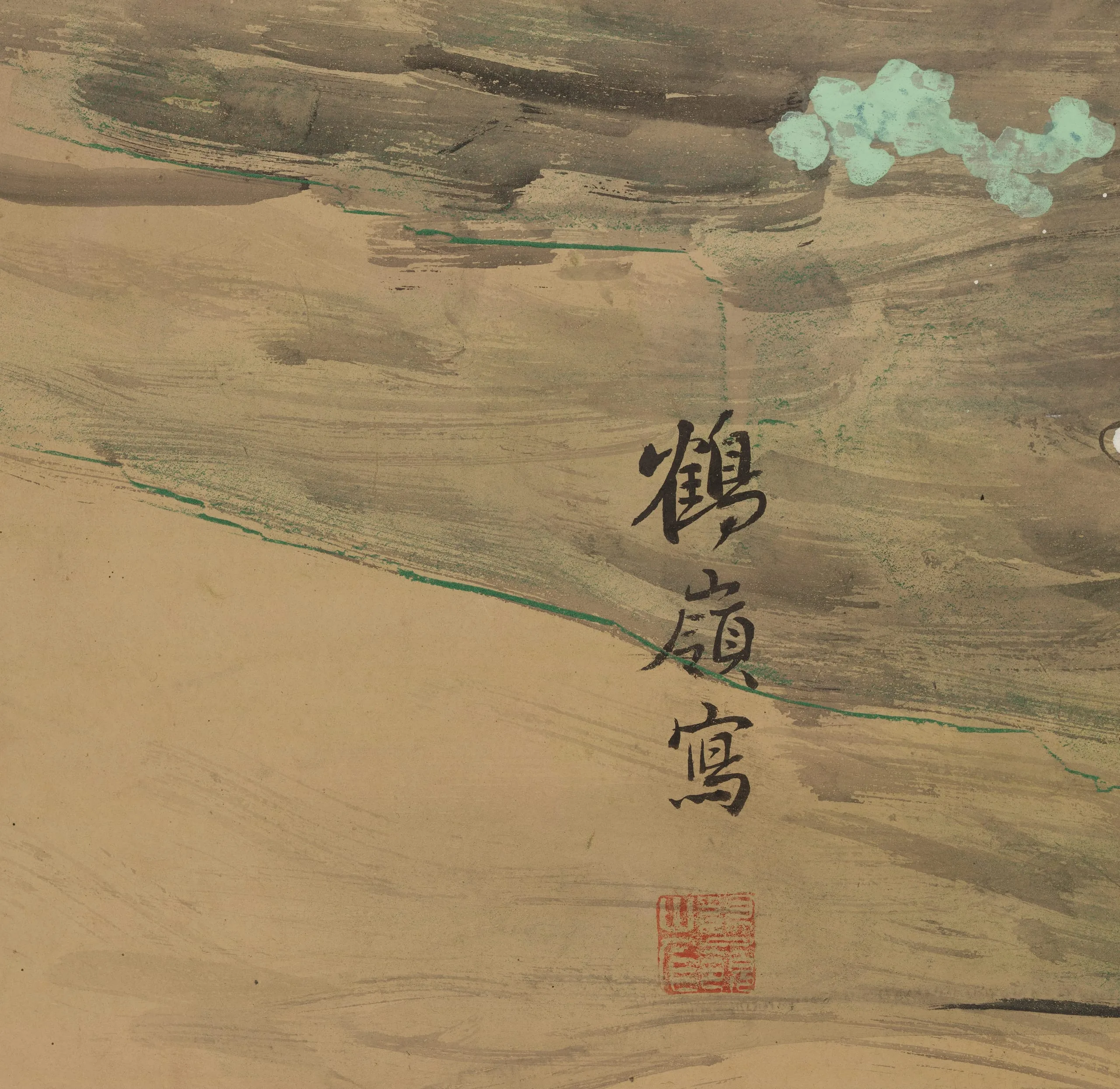
Yamaato Kakurei was counted among the “Ten Great Disciples” of famed artist Maruyama Ōkyo (1733–1795), founder of the Maruyama-Shijō School of painting in Kyoto. This pair of eight-panel screens was inspired by Ōkyo’s three rooms of painted sliding doors at the Kongōji temple (1788), today registered as Important Cultural Properties, depicting waves and rocks with landing cranes. Kakurei borrowed his mentor’s idea of a fully encompassing scene of rough waves and rocks and applied it to a different format. These oversized screens could be placed on either side of a viewer to give the sense of immersion in the seascape; one side shows calmer waves, the other side is wilder. While Ōkyo’s original design included cranes, Kakurei eliminated them here, further focusing attention on the motion of the waves. In addition, rich colors against gold enhance the cooling effect. One unusual aspect of this set is the continuation of painting on the hinges between each panel, which adds to their luxurious appeal.
2018/2024
- Selected Bibliography
- Singer, Robert T., and Kawai Masatomo, editors. The Life of Animals in Japanese Art. Washington, D.C.: National Gallery of Art, 2019.