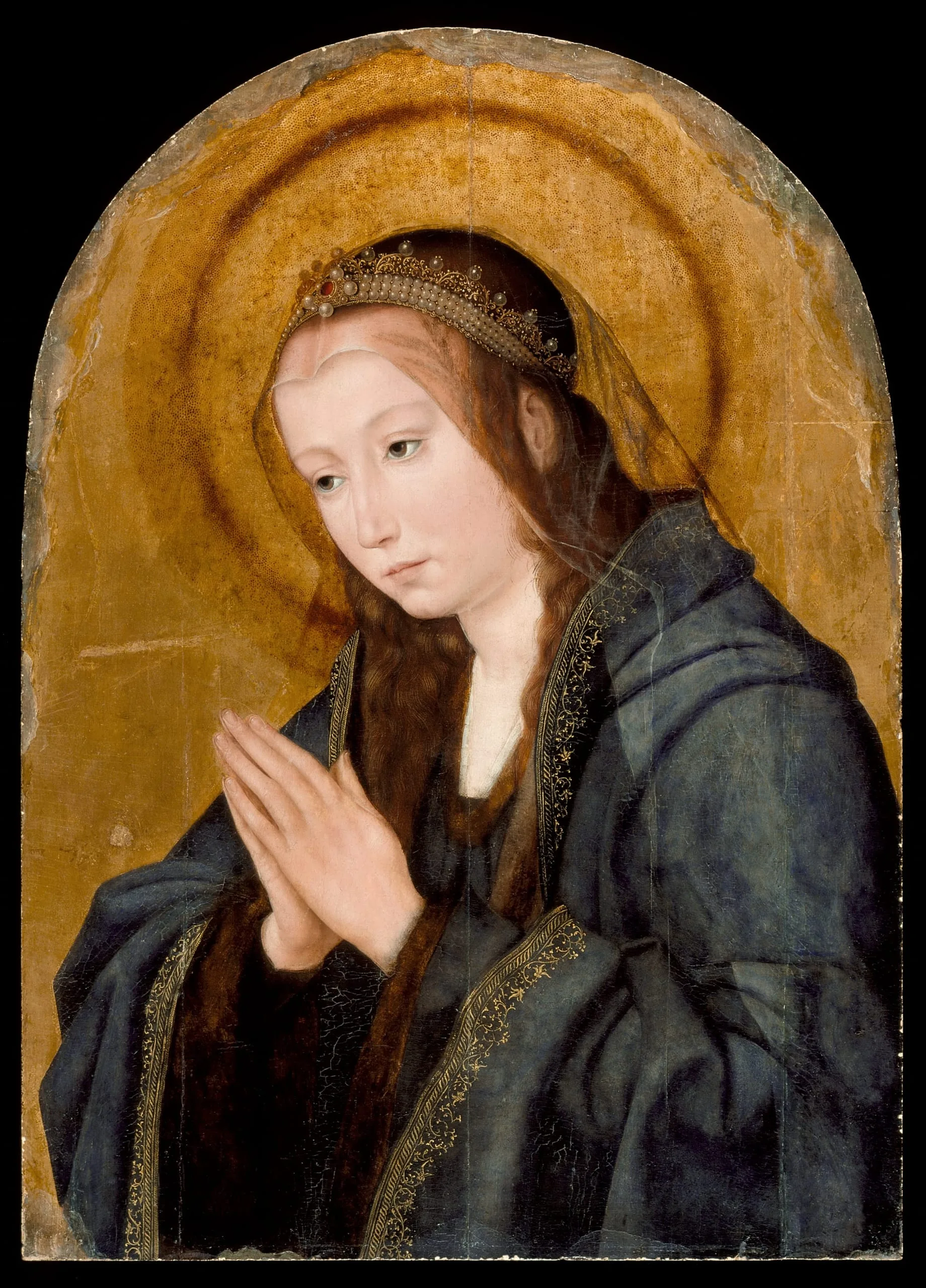
In this painting, a half-length figure of the Virgin Mary, deep in contemplation, clasps her hands in prayer. The thick folds of a blue fur-lined cloak with gold embroidery envelop her form, and a translucent veil cascades down her shoulders. Her adornments symbolize both humility and power. On her head, a pearl-encrusted gold diadem denotes her role as Queen of Heaven, and the pearls allude to her Immaculate Conception. The halo and the gold background reinforce this holy status. The painting’s shape and composition suggest it was made for a religious diptych used for personal devotions. Typically, diptych images of the Virgin in Adoration were paired with a figure of Christ, either as Salvator Mundi (Savior of the World) or the Man of Sorrows.
Quentin Massys ran his workshop in Antwerp, Belgium, which would supersede Bruges as a major center of commerce in the region during the sixteenth century. As a port city, Antwerp saw trade in raw materials, foodstuffs, and luxury goods—like the pearls and red gemstone used in Mary’s diadem, which merchants sourced from around the globe, from the Persian Gulf to the Americas. In addition to expensive private commissions painted by the master himself, Massys’s studio likely created ready-made paintings to meet the demand of Antwerp’s robust art market. The many versions of the Virgin in Adoration offer insights into this workshop practice. Designs were kept and circulated, and panels were adapted for other compositions, as is the case with a version at the National Gallery, London, which was cut down to match the size of a Salvator Mundi painting also from Massys’s studio. While our contemporary society prizes the unique, during the medieval and Renaissance eras, copies signaled a successful composition, and multiplication increased the devotional potency of an object. Reproducible prints and pilgrim badges, for example, spread the fame of miraculous images around Europe, often generating personal mystical experiences for their owners. Even powerful rulers were known to have commissioned replicas of artworks.
2024