- Title
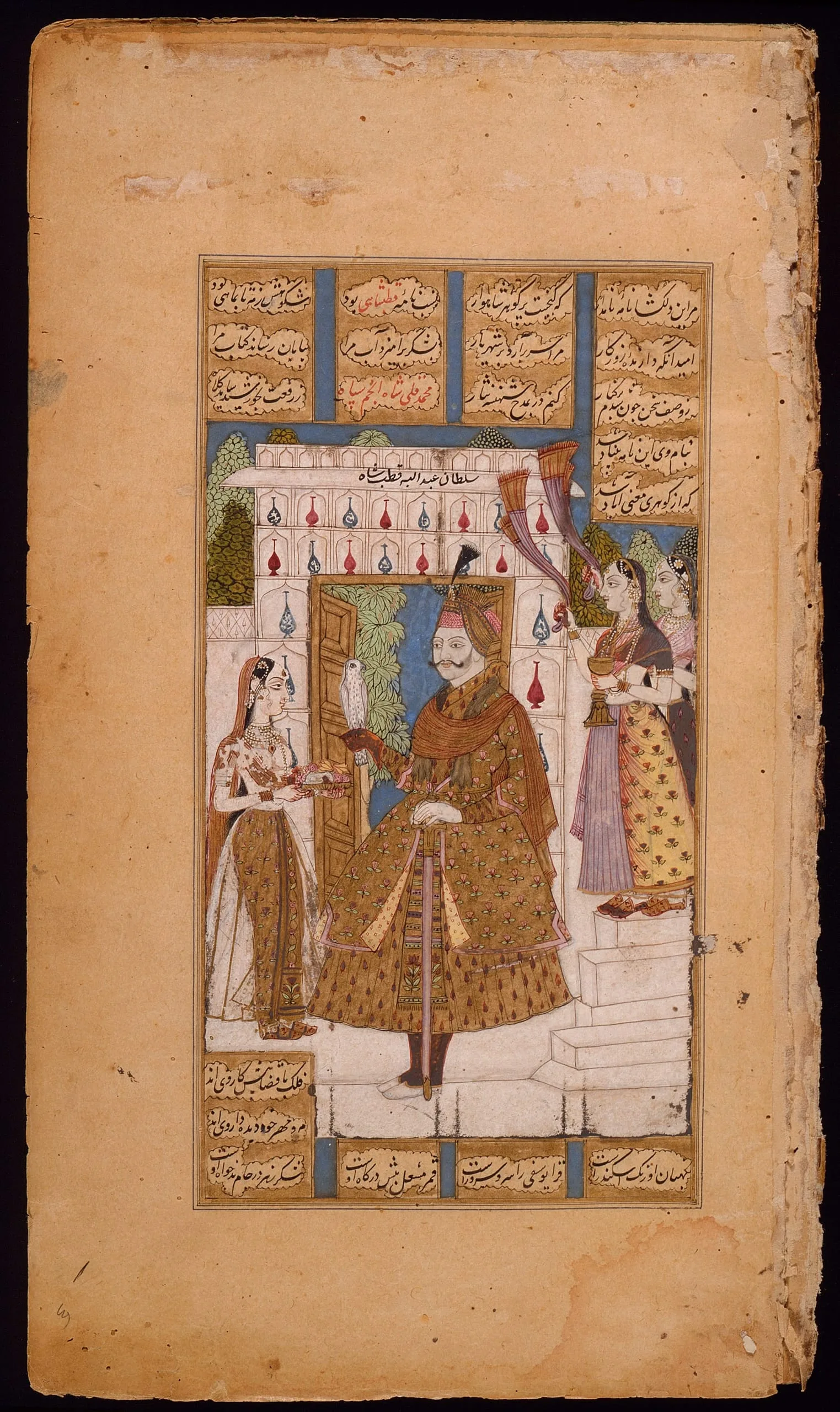
- Sultan Abdullah Qutb Shah (r. 1626-1672), Folio from an Illuminated Manuscript of the History of the Qutb Shahi Sultans of Golconda and Hyderabad
- Date Made
- manuscript dated 1610-1611; illustrations: circa 1700
- Medium
- Opaque watercolor, gold, and ink on paper
- Dimensions
- Sheet: 12 1/2 × 7 1/8 in. (31.75 × 18.1 cm)
Panel (Text): 8 7/8 × 4 1/2 in. (22.54 × 11.43 cm)
- Accession Number
- M.89.159.4e
- Curatorial Notes
The Qutb Shahi dynasty (or the Golconda Sultanate, 1518–1687) ruled from Golconda Fort and, after 1591, nearby Hyderabad, Telangana. It was founded in 1518 when Sultan Quli Qutb Shah (or Sultan Quli Qutb al-Mulk, r. 1496-1543) declared his independence from the Bahmani Sultanate (1347-1527), which splintered into the independent sultanates of Ahmadnagar, Bijapur, and Berar in 1490; Golconda in 1518; and Bidar in 1528. This illuminated manuscript consists of 450 pages with five illustrations. Its colophon states it was copied by the scribe Habibullah Gilani in 1610-1611 (AH 1019) during the reign of Sultan Muhammad Quli Qutb Shah (r. 1580-1612). The illustrations were likely added in circa 1700.
Sultan Abdullah Qutb Shah (r. 1626-1672) was born in 1614. He was the seventh sultan of Golconda and Hyderabad in the Qutb Shahi dynasty. He was a patron of poetry, music, and mathematics. Under pressure from the encroaching Mughal armies, in 1635 Abdullah Qutb Shah partially submitted to Mughal hegemony and Golconda became a Mughal protectorate. In 1687, after an eight-month siege of Golconda Fort by the Mughal armies of Emperor Aurangzeb (r. 1658-1707), Golconda’s independence was finally lost. Here, Abdullah Qutb Shah is portrayed wearing a feather plume turban ornament (jigha) and luxurious garments, including a fur wrap around his neck. He holds a falcon with a gauntlet in his right hand. His left hand grasps the grip of a “Firangi” (European) straight sword with a pommel spike.
- Selected Bibliography
- Pal, Pratapaditya. Indian Painting, vol.1. Los Angeles: Los Angeles County Museum of Art, 1993.
- Markel, Stephen. Mughal and Early Modern Metalware from South Asia at LACMA: An Online Scholarly Catalogue. Los Angeles: Los Angeles County Museum of Art, 2020. https://archive.org/details/mughal-metalware (accessed September 7, 2021).