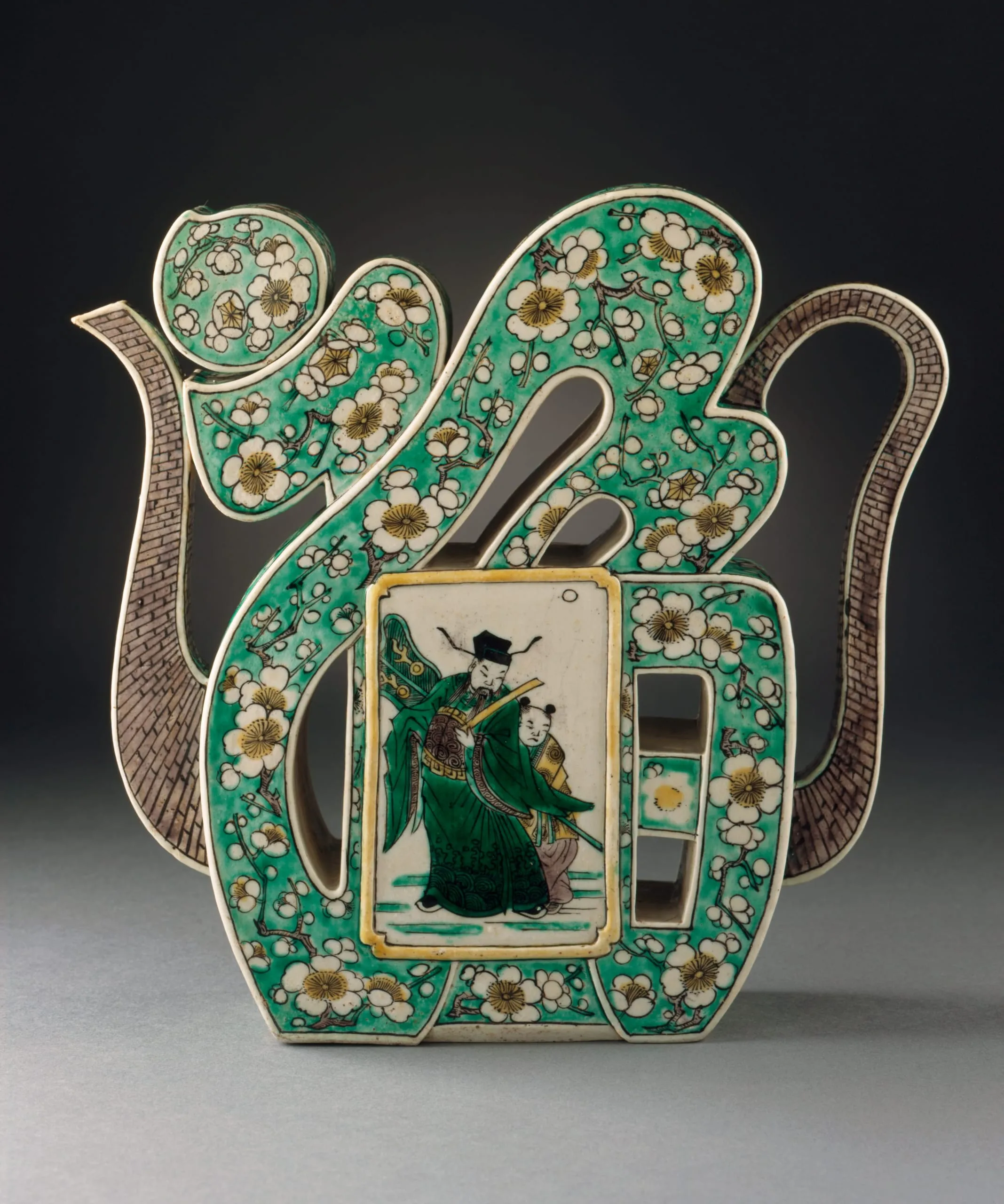
This ewer was made in the shape of the cursive form of the Chinese written character fu, meaning “good fortune.” First handbuilt and fired in a kiln, the ewer was then decorated with green, yellow, aubergine, and clear enamels painted directly on the biscuit (unglazed porcelain) and fired again to fix the enamels to the body. The decoration, in the so-called famille verte (“green family”) palette, consists of boughs of plum blossoms against a green ground, with the handle and spout painted in a pattern resembling a brick wall. A rectangular cartouche on one side depicts Fuxing, the god of good fortune, while the corresponding cartouche on the other side depicts Shouxing, the god of longevity. Together with Luxing, the god of emolument or salary, who does not appear on the ewer, these deities from the pantheon of Chinese popular religion were known as the Sanxing (Three Stars).
The earliest known image of the Three Stars appears in an anonymous painting dating to the Yuan dynasty (1260–1368) in the collection of the Nezu Museum, Tokyo. The earliest literary evidence comes from a play titled The Festival of the Immortal Officials Fu, Lu, and Shou, written by Zhu Youdun and published in 1443. Here, the Three Stars descend to the mortal world for the lunar New Year’s festival. In another play by the same author, The Eight Immortals Convey Wishes for Longevity at the Turquoise Pond, the duties of the Three Stars are enumerated as multiplying happiness (fu), conferring emolument or high salary (lu), and increasing longevity (shou). Based on the evidence, it appears that belief in this group first emerged in the fourteenth century and proliferated in the early fifteenth. As scholar Mary Fong has shown, the gods Fuxing and Luxing have no mythologies of their own, and no known history before the early Ming dynasty. The Three Stars are not Daoist gods per se, but instead gods of Chinese popular religion—there are, for example, no texts in the Ming-dynasty Daoist Canon (Daozang) devoted to this triad.
Stephen Little
2022