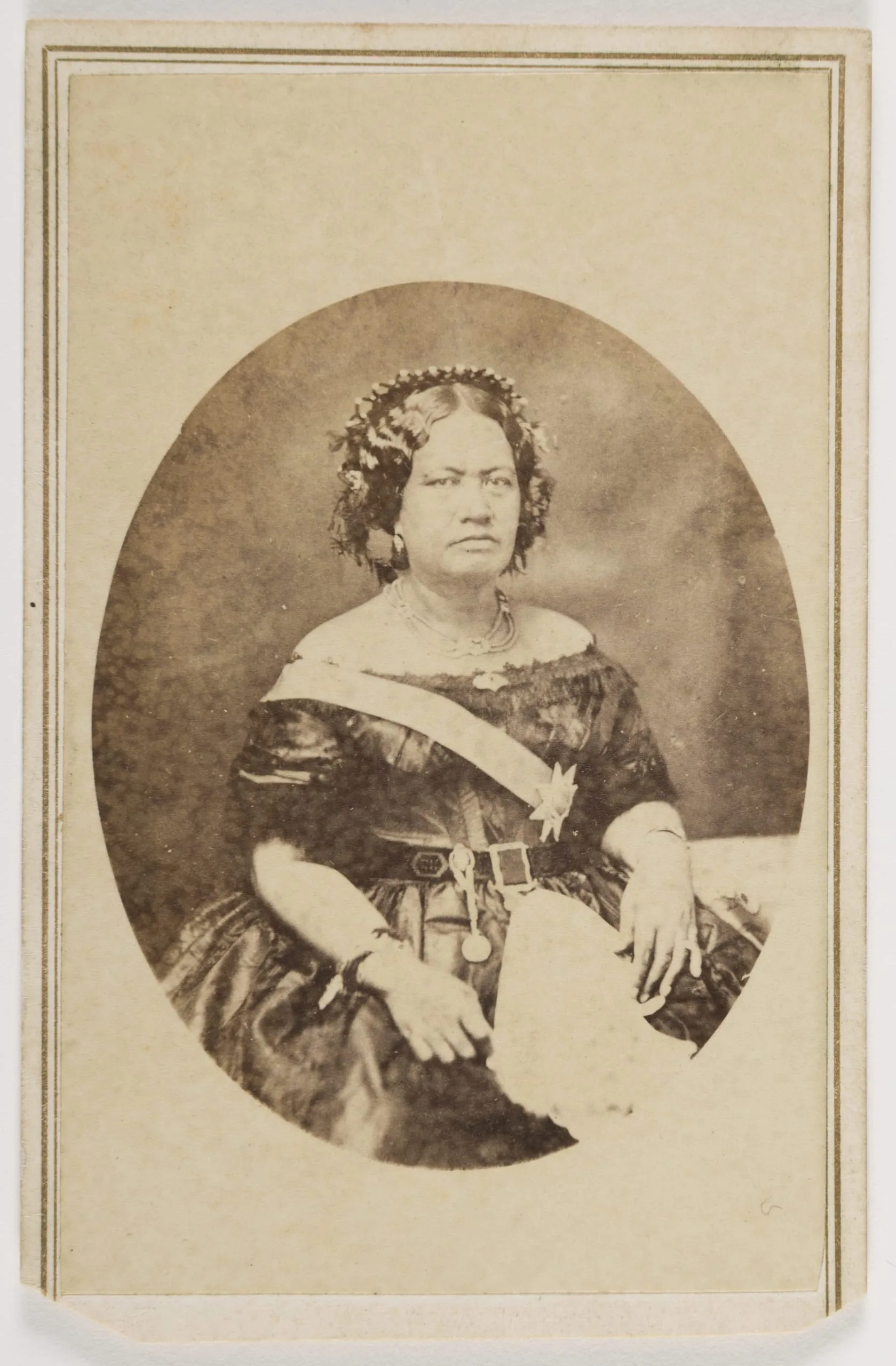
Kalama Hakaleleponi Kapakuhaili (about 1817 – September 20, 1870), whose first name translates to “Light or Torch,” became the queen consort of the Kingdom of Hawai’i when she married King Kamehameha III (1814-1854) on February 14, 1837. Their love marriage upset many, as Kalama was not considered an appropriate match for the monarch. After losing two children in infancy, the royal couple adopted their nephew Alexander Liholiho (1834-1863), who would inherit the throne in 1854. They also adopted a daughter, Ka’imina’auao (1845-1848), and another son, Albert Kuka’ilmoko Kuniakea (1851-1903). Queen Kalama outlived both her husband, Kamehameha III, and her son, Kamehameha IV. She became an adept business woman, eventually owning 22,000 acres on the windward side of Oahu, where she established a sugar plantation. A beach there in Kailua now bears her name. In a portrait of an older Kalama, who by then was the queen dowager, she holds an even stronger, more confident pose than she did in the Getty portrait.
On January 16, 1893 the Hawaiian Kingdom was invaded by United States marines which led to the illegal overthrow of the Hawaiian government the following day.
Photo also on the Smithsonian's National Portrait Gallery website, object number: S/NPG.80.51, dated 1862 and credited artist is H.L Chase. Also found on State Library of New South Wales online collection, dated 1865-1870, reference number 889211.