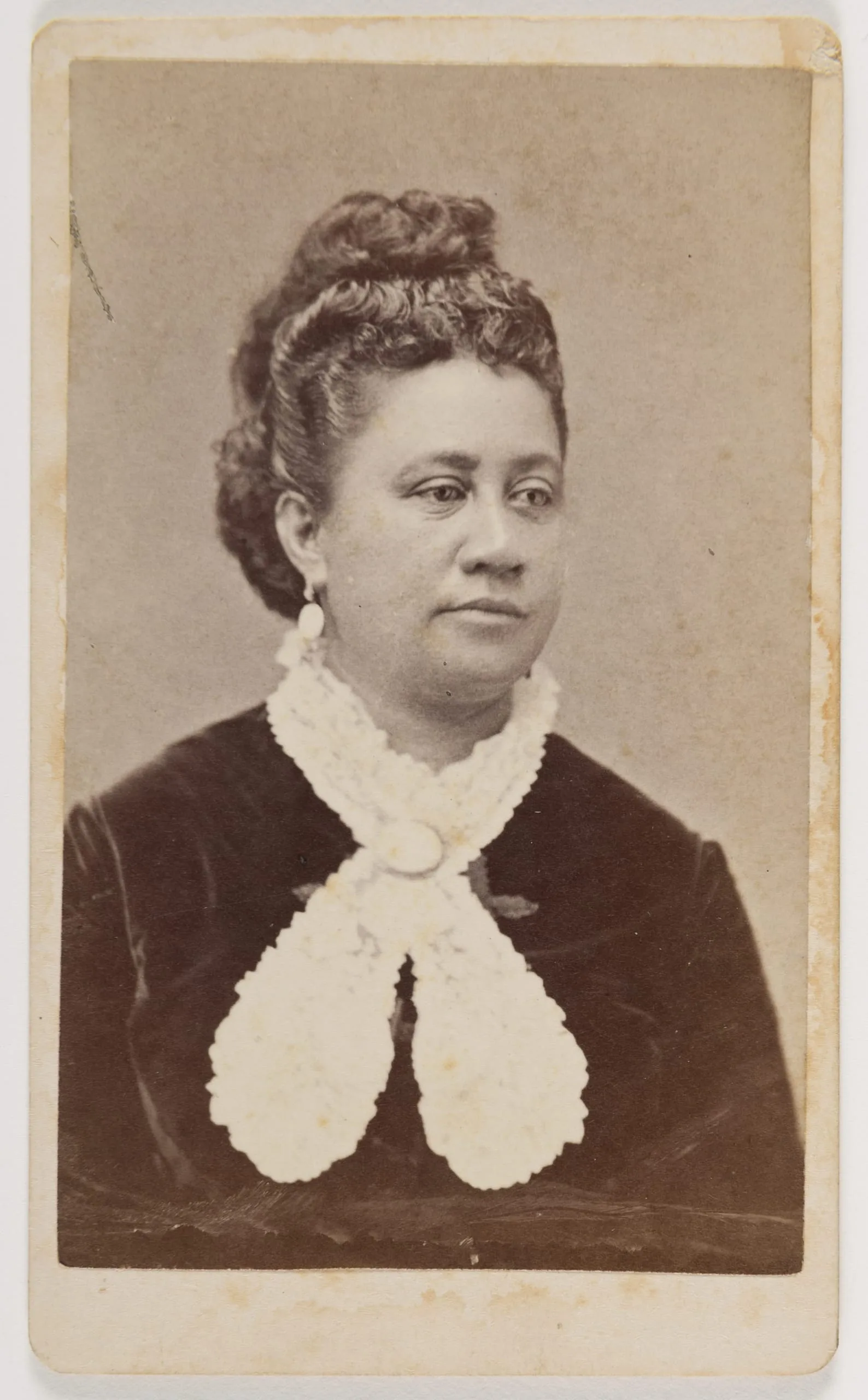
Similar photo found on Manu Antiques auction site. Identical photo but has J. Williams & Co. credited as photographer.
Julia Na-pela-kapu-o-Kakaʻe Kapi‘olani was born on December 31, 1834, in Hilo, Hawaiʻi. Her father was high chief Kūhiō, and her mother Kinoiki was the daughter of King Kaumualiʻi of Kauaʻi who negotiated peace with Kamehameha the Great to unify the islands in 1810. Her first marriage was to Bennet Namakeha, making her an aunt of Queen Emma. She served as the wet nurse to Prince Albert, the son of Kamehameha IV and Queen Emma, who died when he was only four years old. Kapiʻolani married David Kalākaua in 1863, the first postmaster general of the Hawaiian Kingdom.
According to the 1864 Constitution of the Hawaiian Kingdom, if a king died without naming a successor to the throne, the legislature must elect a new king from a pool of candidates of noble birth. Thus, David Kalākaua was elected to replace the deceased King Lunalilo in 1874, making Kapiʻolani the Queen Consort to King Kalākaua. Kapiʻolani was a visible monarch, often traveling throughout the kingdom. In 1887, en route to England to attend Queen Victoria’s Golden Jubilee celebrations, Kapiʻolani made headlines when President and Mrs. Grover Cleveland hosted a formal state dinner at the White House in her honor. She also visited schools, hospitals, and other public institutions in San Francisco, Washington D.C, Boston, and New York. As the first queen to visit the United States, her activities received extensive coverage in various U.S. newspapers.
Queen Kapiʻolani reigned for nearly seventeen years and was much beloved by the Hawaiian people. The king named Kapiʻolani Park in Waikīkī in honor of his queen. She visited Kalauapapa in 1884 to learn how she could assist those who were diagnosed with leprosy and exiled there, and she raised the funds to build the Kapiʻolani Home for Girls whose parents had leprosy. Though childless, the Queen cherished the Hawaiian family and the role of mother. In 1890, she established the Kapiʻolani Maternity Home, which is today the Kapiʻolani Medical Center for Women and Children. To honor her our institution has adopted the Queen’s motto, “Kūlia i ka Nuʻu” – “Strive for the Highest”.
In 1891, King Kalākaua passed away at the age of fifty-four. Since the royal couple bore no children, the king’s sister Lili‘uokalani succeeded the throne. Dowager Queen Kapiʻolani was sixty-four years old when she died on June 24, 1899, at Pualeilani, her modest home in Waikiki.
On January 16, 1893 the Hawaiian Kingdom was invaded by United States marines which led to the illegal overthrow of the Hawaiian government the following day.