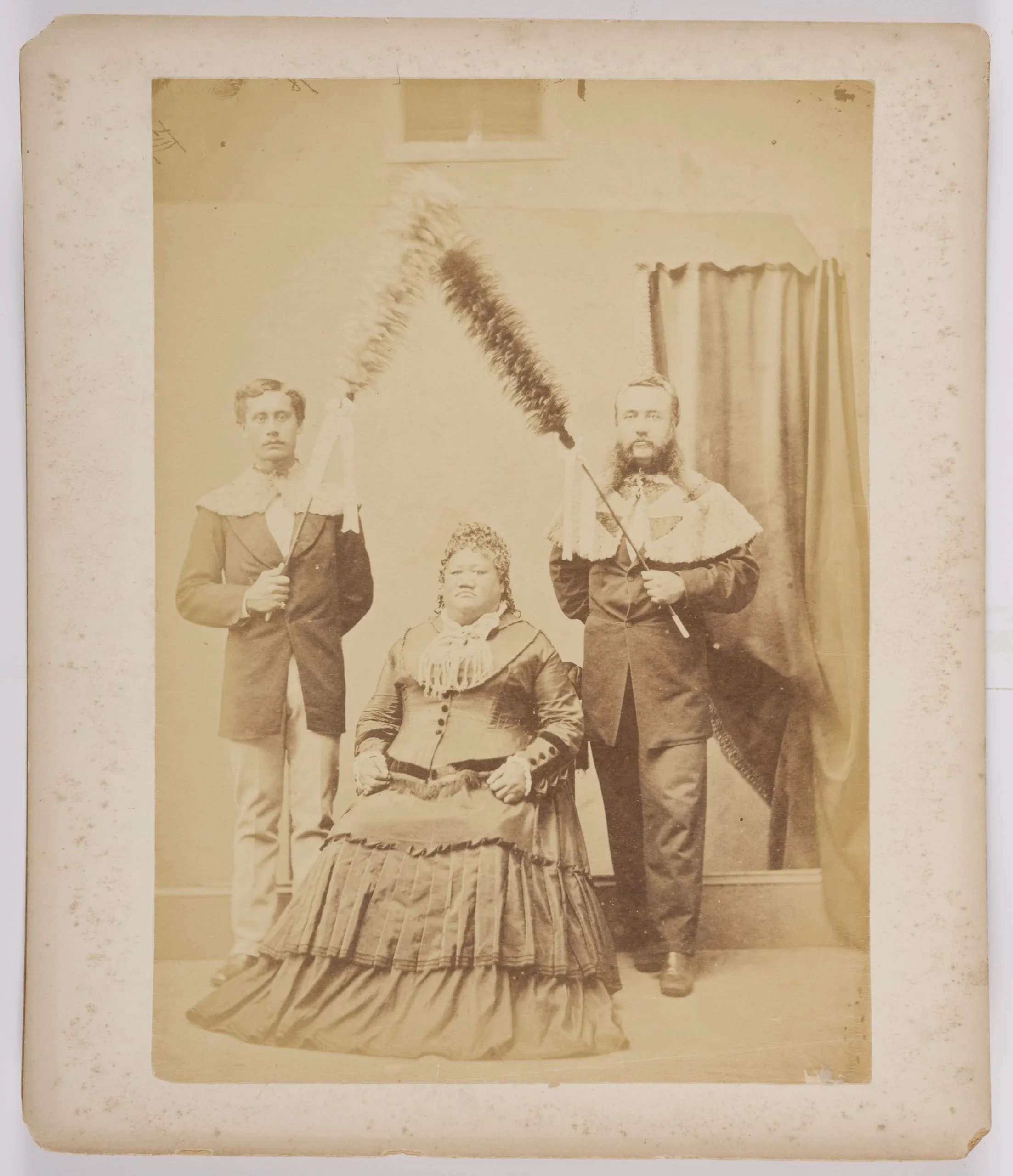
Princess Ruth hired Samuel Parker (of Parker Ranch) and John Adams Cummins (Politician and businessman) to help her adapt to the new American rules for land ownership in Hawai'i (post 1893).
Princess Ruth Keʻelikōlani was a direct descendent of Kamehameha I, the leader who united the Hawaiian islands and founded the kingdom of Hawai‘i. She was an advocate for Hawaiian culture who was best known for defending the town of Hilo during the 1880–1881 eruption of the Mauna Loa Volcano that is part of the Hawai‘i Volcanoes National Park.
Keʻelikōlani was born in Pohukaina, Oahu in 1826. Her mother, Chiefess Pauhi, married her third husband, Mataio Kekūanāoʻa, only three months before she died while giving birth to Princess Ruth. Both Kekūanāoʻa and the Chiefess’s second husband, High Chief Kahalaiʻa Luanuʻu, claimed Keʻelikōlani as a daughter. She was publicly recognized as keiki po‘olua, a “two heads” child, or someone who would inherit the mana (spiritual energy) of both fathers. This early controversy surrounding her paternity presented enduring challenges as she navigated the U.S. legal system to secure a vast land inheritance. When she was sixteen, the princess married Leleiohoku with whom she had two children. After Leleiohoku’s death, Keʻelikōlani married Isaac Young Davis, grandson of the haole (a white person) advisor to Kamehameha I. Together they had a son, whom she gave to her cousin Bernice Pauahi Bishop to raise in the Hawaiian tradition of hānai.
Ke‘elikōlani maintained distinctive Hawaiian beliefs and practices during a period of ongoing tensions between self-proclaimed traditionalists and Christian Hawaiian chiefs. Educated by missionaries in English, she insisted on conducting business in the ‘ōlelo Hawai'i (the Hawaiian language). Inheriting palaces from her father, she preferred to live in a traditional grass house (hale pili) in Kailua. Her rejection of Christianity and the Anglo-American culture made her revered by her countrymen and women, and they turned to her for intervention when the volcano Mauna Loa began erupting in 1880.
She died in May 1883 after a brief illness. At the time of her death she was proclaimed to be the highest ranking descendent of Kamehameha I. She laid claim to 353,000 acres of Kamehameha land, all of which she bequeathed to Bernice Pauahi Bishop, who established the Bernice Pauahi Bishop Estate to set aside land for the preservation of Hawaiian culture and the advancement of Native Hawaiian people. In her will, Pauahi Bishop dedicated the estate to the development of the Kamehameha Schools for Hawaiian Children.
On January 16, 1893 the Hawaiian Kingdom was invaded by United States marines which led to the illegal overthrow of the Hawaiian government the following day.